Understanding could vs would can make your writing clearer, more natural, and more polite. These two words appear in everyday conversations, professional emails, essays, questions, and even job interviews. Although they sometimes appear in similar sentences, you cannot always exchange one for the other.
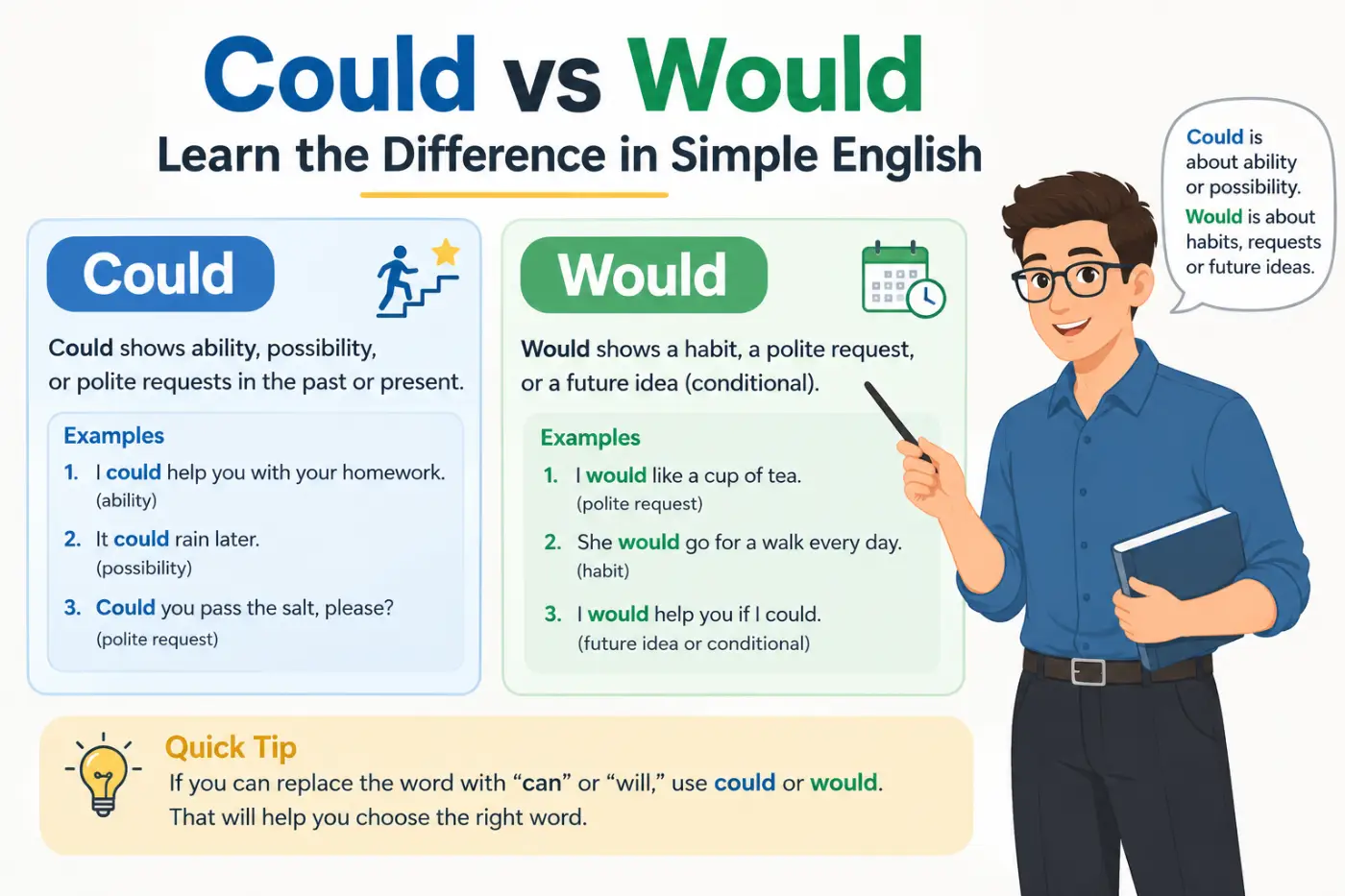
Could expresses ability, possibility, or a polite request. Would expresses willingness, preference, imagined situations, or the expected result of a condition. Both are modal verbs, but they serve different purposes.
This guide explains their meanings, origins, grammar rules, alternatives, and common mistakes. You’ll also find comparison tables, practical examples, and simple tips to help you choose the correct word confidently.
What Is the Difference Between Could and Would?
The main difference between could and would comes down to possibility and willingness.
Could usually describes something that is possible, something a person was able to do in the past, or a polite request.
Would usually describes something a person is willing to do, prefers to do, or imagines happening under certain conditions.
Consider these examples:
- I could help you tomorrow. (Helping is possible.)
- I would help you tomorrow if I had time. (Helping depends on a condition.)
- Could you open the window? (A polite request.)
Could vs Would Quick Comparison Table
| Feature | Could | Would |
|---|---|---|
| Basic meaning | Ability or possibility | Willingness or imagined result |
| Original verb | Can | Will |
| Past ability | Yes | Not normally |
| Polite requests | Yes | Yes |
| Imaginary situations | Yes | Yes |
| Preferences | Not normally | Yes |
| Past habits | Not normally | Yes |
| Possibility | Yes | Usually needs a condition or context |
| Conditional sentences | Possible action | Expected or intended result |

Where Do Could and Would Come From?
Understanding the history of these words makes their modern uses easier to remember.
Both words have roots in Old English and developed from earlier forms of common verbs.
Origin and Meaning of Could
Could developed from the Old English verb cunnan, which meant to know something or possess the ability to do it.
Its earlier past form was cuþe, which eventually developed into could.
The letter “l” was added to its spelling centuries later, partly because of the influence of words such as would and should. Interestingly, the “l” in could remains silent.
Today, could works as a modal verb connected to can.
Examples:
- I can swim. (Present ability.)
- I could swim when I was younger. (Past ability.)
- I could visit you tomorrow. (Future possibility.)
Origin and Meaning of Would
Would comes from the Old English verb willan, which expressed wanting, wishing, or intending to do something.
Its past form developed into the modern word would.
That history explains why would still has a strong connection with willingness, wishes, intentions, and imagined situations.
Examples:
- I will help you. (A future intention.)
- I would help you if I could. (Conditional willingness.)
- I would like some coffee. (A polite preference.)
Both words originally developed as past forms, but modern English uses them for much more than talking about the past.
When Should You Use Could in English?
Could has several important uses. Learning them separately will help you recognize the correct meaning in different situations.
1. To Describe Past Ability
Use could when someone had the general ability to do something in the past.
Examples:
- My grandfather could run five miles without stopping.
- She could read before starting school.
- I could speak French when I lived in Paris.
These sentences describe abilities that existed earlier in someone’s life.
For one successful action on a particular occasion, “was able to” is often more natural.
Example:
I was able to finish the difficult assignment yesterday.
2. To Express Possibility
Could describes something that might happen, even when the speaker isn’t certain.
Examples:
- It could rain this evening.
- Your package could arrive tomorrow.
- This decision could affect our future.
- We could find a better solution.
Notice that could doesn’t promise an outcome. It simply introduces a possibility.
3. To Make Polite Requests
Could helps make requests sound respectful and less demanding.
Examples:
- Could you send me the report?
- Could I borrow your notebook?
- Could you explain this rule again?
These questions are common in classrooms, workplaces, restaurants, and everyday conversations.
When Should You Use Would in English?
Would is especially useful when discussing imagined situations, personal preferences, polite offers, and actions that depend on certain conditions.
1. To Describe Imaginary Situations
Use would when explaining what someone imagines doing or what would happen under a particular condition.
Examples:
- I would travel more if I had extra money.
- She would buy that house if it were cheaper.
- We would move abroad if we found suitable jobs.
These sentences describe imagined situations rather than established facts.
2. To Express Willingness
Would can describe someone’s willingness to perform an action, particularly in a conditional statement or a question.
Examples:
- I would gladly help you.
- Would you join our team?
- She would support the project if necessary.
3. To Express Preferences
Would commonly appears with like, love, prefer, and rather.
Examples:
- I would like a glass of water.
- He would prefer to work from home.
- I would rather stay inside tonight.
- We would love to attend your wedding.
These expressions are especially useful when speaking politely.
Could vs Would Synonyms and Related Expressions
Could and would are grammatical helping verbs. Unlike ordinary descriptive words, they don’t have one fixed list of interchangeable synonyms.
Their alternatives depend on the meaning of the entire sentence.
For example, “might” can replace could when expressing possibility, but it cannot replace could when describing someone’s past ability.
The following tables include more than 30 useful alternatives and related expressions, grouped by everyday usage and tone.
Simple Alternatives
| Word or Phrase | Meaning | Tone | Example |
|---|---|---|---|
| Can | Present ability | Simple | I can finish this today. |
| May | Possibility or permission | Neutral | It may rain later. |
| Might | Uncertain possibility | Neutral | She might visit tomorrow. |
| Will | Future intention | Direct | I will call you tonight. |
| Able to | Having the ability | Neutral | He was able to solve it. |
| Possible | Something that can happen | Neutral | A delay is possible. |
| Want to | Having a desire | Casual | I want to join the group. |
| Plan to | Having an intention | Neutral | We plan to leave early. |
Everyday Alternatives
| Word or Phrase | Meaning | Tone | Example |
|---|---|---|---|
| Be willing to | Agreeing to act | Neutral | I’m willing to help. |
| Be happy to | Gladly agreeing | Friendly | I’d be happy to assist. |
| Be likely to | Having a good chance | Neutral | Prices are likely to rise. |
| Have a chance to | Having an opportunity | Conversational | We have a chance to win. |
| Prefer to | Favoring one choice | Neutral | I’d prefer to stay home. |
| Be ready to | Prepared to act | Neutral | We’re ready to begin. |
| Be open to | Willing to consider | Friendly | I’m open to suggestions. |
| Be interested in | Showing interest | Neutral | I’m interested in joining. |
| Be up for | Willing to participate | Casual | I’m up for a movie. |
Formal Alternatives
| Word or Phrase | Meaning | Tone | Example |
|---|---|---|---|
| Be capable of | Having the necessary ability | Formal | She is capable of leading. |
| Be permitted to | Having permission | Formal | Employees are permitted to leave. |
| Be authorized to | Having official approval | Formal | The manager is authorized to sign. |
| Be prepared to | Being ready or willing | Professional | We are prepared to assist. |
| Be inclined to | Having a preference | Formal | I’m inclined to agree. |
| Be feasible | Being practical or possible | Formal | The proposal may be feasible. |
| Be expected to | Being anticipated or required | Professional | Sales are expected to increase. |
| Be disposed to | Having a tendency or willingness | Formal | He is disposed to cooperate. |
| Be in a position to | Having the ability or circumstances | Professional | We are in a position to respond. |
Casual and Slang Alternatives
These expressions are useful in informal conversations, but they aren’t exact grammatical replacements.
| Word or Phrase | Meaning | Tone | Example |
|---|---|---|---|
| Wanna | Want to | Very casual | Wanna grab lunch? |
| Gonna | Going to | Informal speech | I’m gonna call her. |
| Down to | Willing to participate | Slang | I’m down to help. |
| Up for it | Interested or willing | Casual | Are you up for it? |
| Game for | Willing to try | Casual | I’m game for a challenge. |
| Might as well | Seeing no better alternative | Conversational | We might as well leave. |
| Feel like | Having a desire | Casual | I feel like watching a movie. |
| Be cool with | Accepting an idea | Slang | I’m cool with that plan. |
Which Alternatives Sound Mild or Strong?
English modal verbs help speakers control how certain, willing, or direct they sound.
Choosing the right expression can make a sentence more accurate.
Possibility From Mild to Strong
| Expression | General Strength | Example |
|---|---|---|
| Might | Uncertain possibility | It might happen. |
| Could | Something is possible | It could happen. |
| May | A possible outcome | It may happen. |
| Is likely to | A probable outcome | It is likely to happen. |
| Will | A confident prediction | It will happen. |
| Is certain to | Very strong certainty | It is certain to happen. |
Willingness From Mild to Strong
| Expression | General Meaning | Example |
|---|---|---|
| Might consider | Tentative interest | I might consider helping. |
| Would consider | Openness under certain conditions | I would consider helping. |
| Would be willing to | Conditional willingness | I would be willing to help. |
| Would gladly | Enthusiastic willingness | I would gladly help. |
| Will | Firm intention | I will help. |
| Am committed to | Strong commitment | I’m committed to helping. |
Are Could and Would Verbs or Different Parts of Speech?
Both words belong to the same grammatical category: modal auxiliary verbs.
A modal auxiliary is a helping verb that adds meaning to another verb. It can express possibility, ability, permission, willingness, or necessity.
Could and would aren’t nouns, adjectives, or adverbs in their ordinary grammatical uses.
Basic Sentence Structure
The standard structure is:
Subject + modal verb + base form of the main verb.
| Subject | Modal | Main Verb | Complete Sentence |
|---|---|---|---|
| I | could | help | I could help. |
| She | would | agree | She would agree. |
| They | could | leave | They could leave. |
| We | would | prefer | We would prefer tea. |
Can You Use Could or Would With Have?
Yes. Both can appear with “have + past participle” to discuss past situations.
Could have describes a past possibility or an opportunity that existed.
Example: I could have called you yesterday.
Would have describes an imagined past result, usually connected to a condition.
Example: I would have called you if I had your number.
This difference becomes especially useful when explaining missed opportunities and past regrets.
Is There a Difference Between American and British English?
The basic grammar of could and would is the same in American and British English.
Both varieties use these modal verbs for possibility, willingness, requests, and imagined situations.
However, certain expressions may sound more common or natural in one region.
| Expression | American English | British English |
|---|---|---|
| Could you help me? | Common | Common |
| Would you mind helping? | Common | Common |
| I’d like some coffee. | Common | Common |
| I could do with a break. | Understood but less common | Familiar everyday expression |
| Shall we leave? | Less common in everyday speech | More familiar |

How Should You Use Could and Would in Different Situations?
The best choice depends on your purpose, audience, and the message you want to communicate.
A word that sounds natural in a text message may not be the strongest choice for a professional resume.
Could and Would in a Resume
Resumes should highlight actual skills, completed achievements, and measurable results.
Could can describe ability, but it may make an achievement sound like a possibility rather than something you accomplished.
Weak: I could manage a team of ten employees.
Better: Managed a team of ten employees and improved daily productivity.
Would is also usually unnecessary when describing completed work.
Weak: I would prepare monthly financial reports.
Better: Prepared monthly financial reports for senior management.
Use strong action verbs when describing real achievements. Save modal verbs for statements that genuinely require them.
Could and Would in an Essay
Academic writing requires careful language, particularly when discussing possible outcomes and hypothetical situations.
Use could when a result is possible but not guaranteed.
Example:
Increased access to education could improve employment opportunities.
Use would when describing an expected outcome under a stated condition.
Example:
If public transportation were more affordable, more residents would consider using it.
Avoid using would when presenting an established fact that doesn’t require an imagined condition.
Could and Would in Text Messages
Both words work naturally in casual texting.
Examples:
- Could you call me later?
- We could meet after dinner.
- Would you like to come over?
- I’d love to see you this weekend.
In texting, contractions such as I’d, you’d, and we’d are common.
However, remember that “I’d” can mean either “I would” or “I had.” The words that follow usually clarify its meaning.
Could and Would in Professional Emails
These words help make workplace communication respectful.
Use could for polite requests:
“Could you please review the attached document before Friday?”
Use would for preferences, offers, and conditional statements:
“I would appreciate your feedback on the proposal.”
Another natural expression is:
“Would you be available for a short meeting tomorrow?”
Both choices are professional. The difference lies in what you’re asking or expressing.
Could and Would in Everyday Speaking
In conversation, could often introduces suggestions, while would frequently introduces preferences.
Example conversation:
A: What should we do this weekend?
B: We could visit the museum.
A: That sounds nice. Would you prefer Saturday or Sunday?
B: I’d prefer Saturday.
This exchange shows how both modal verbs can work together without carrying the same meaning.
Could vs Would Examples in Real Situations
The following examples show how these words change meaning across everyday situations.
| Situation | Example With Could | Example With Would |
|---|---|---|
| Travel | We could visit Italy next year. | I would visit Italy if I saved enough money. |
| Education | She could pass the exam. | She would pass if she studied regularly. |
| Workplace | I could finish the report today. | I would finish it today if I had the data. |
| Shopping | You could buy the blue jacket. | I would buy the black jacket instead. |
| Weather | It could snow tonight. | It would snow more often if the climate were colder. |
| Relationships | He could apologize first. | He would apologize if he understood his mistake. |
| Health | Walking could improve your fitness. | I would walk daily if my schedule allowed it. |
| Money | We could save more each month. | We would save more if our expenses were lower. |
| Food | You could try the pasta. | I would prefer the soup. |
| Technology | This update could improve performance. | The software would run faster with more memory. |
| Sports | Our team could win tomorrow. | Our team would have a better chance if everyone practiced. |
| Home | We could paint the bedroom. | I would choose a lighter color. |
Could vs Would in Conditional Sentences
Conditional sentences describe situations in which one event depends on another.
Both modal verbs can appear in conditional sentences, but they communicate different meanings.
Consider this example:
If I had more free time, I could learn Spanish.
This means learning Spanish would become possible.
Now compare:
If I had more free time, I would learn Spanish.
This means the speaker intends or expects to learn Spanish under that imagined condition.
Side by Side Comparison
| Could | Would |
|---|---|
| Describes a possible action | Describes an imagined or intended action |
| Focuses on opportunity | Focuses on the expected choice or result |
| I could travel if I had money. | I would travel if I had money. |
| She could join us if she were free. | She would join us if she were free. |
Could Have vs Would Have Explained
These expressions are closely related, but they serve different purposes when discussing the past.
Could Have
Could have + past participle often describes an opportunity that existed or a past event that was possible.
Examples:
- I could have helped you yesterday.
- She could have won the competition.
- We could have taken an earlier train.
The expression may suggest that an available opportunity wasn’t used, depending on context.
Would Have
Would have + past participle describes an imagined past outcome.
Examples:
- I would have helped you if you had asked.
- She would have attended the party if she hadn’t been sick.
- We would have arrived earlier if the road had been clear.
The important difference is that could have focuses on possibility or ability, while would have focuses on an imagined result.
Would You or Could You Which Is More Polite?
Both expressions are polite, and either can work in most everyday requests.
However, they emphasize slightly different ideas.
| Could You | Would You |
|---|---|
| Traditionally relates to ability or possibility | Traditionally relates to willingness |
| Common for polite requests | Common for polite requests |
| Could you help me? | Would you help me? |
| Could you close the door? | Would you close the door? |
Common Mistakes When Using Could and Would
Even experienced English learners sometimes confuse these modal verbs.
Here are several mistakes worth avoiding.
Mistake 1 Using Would for Past Ability
Incorrect: When I was young, I would run very fast.
This sentence can describe a repeated past activity, but it doesn’t clearly express general past ability.
Better: When I was young, I could run very fast.
Use could when describing what someone was capable of doing.
Mistake 2 Using Could for a Definite Promise
Unclear: I could send you the document tomorrow.
This suggests that sending it is possible, not guaranteed.
Better: I will send you the document tomorrow.
Use will when making a firm promise or stating a definite intention.
Mistake 3 Using Would Incorrectly After If
Incorrect: If I would have more money, I would buy a car.
Correct: If I had more money, I would buy a car.
In standard hypothetical conditional sentences, the if-clause normally uses the past simple rather than would.
What Are the Opposites of Could and Would?
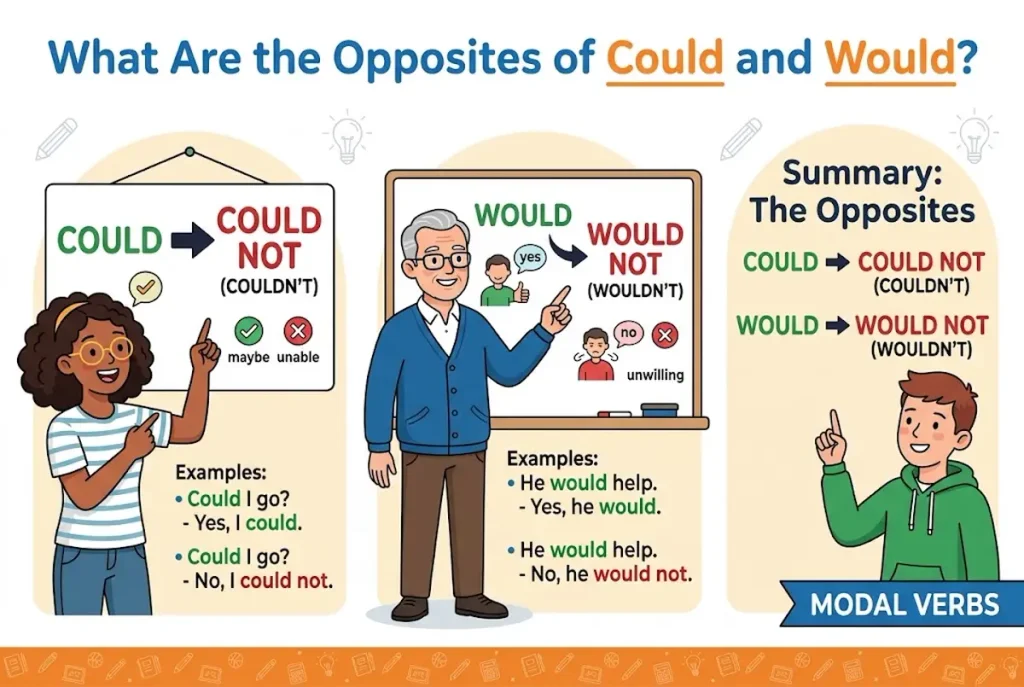
These modal verbs don’t have perfect opposites in every context.
However, their negative forms are straightforward.
| Word | Negative Form | Example |
|---|---|---|
| Could | Could not / Couldn’t | I couldn’t open the door. |
| Would | Would not / Wouldn’t | She wouldn’t accept the offer. |
Couldn’t can express inability or impossibility.
Wouldn’t can express unwillingness, refusal, or a negative conditional result.
Compare:
- He couldn’t help me. (He was unable to help.)
- He wouldn’t help me. (He was unwilling to help.)
This small difference can completely change the message.
Conclusion
Understanding could vs would becomes easier when you focus on the meaning behind each sentence rather than treating the words as interchangeable.
Could is useful for discussing past abilities, possible outcomes, polite requests, and available options. Would helps express willingness, preferences, repeated past actions, and imagined results. Both also appear in conditional sentences, where a small change in wording can change the speaker’s intended message.
For everyday communication, remember that could often introduces what is possible, while would often explains what someone prefers or expects under certain conditions.
Practice by writing a few sentences about your plans, preferences, and past experiences. The more you use these words in meaningful situations, the easier it becomes to recognize which one sounds natural and communicates your message accurately.
Frequently Asked Questions
What is the main difference between could and would?
Could usually expresses ability or possibility, while would expresses willingness, preference, or an imagined result. Both can also make polite requests.
Can could and would be used interchangeably?
Sometimes, but their meanings aren’t always identical. For example, “I could help” expresses possibility, while “I would help” suggests willingness, often under certain conditions.
Is could or would more polite?
Both are polite in everyday English. Could you and would you are widely accepted ways to make respectful requests.
What’s another way to say could in a sentence?
Depending on context, you can use might, may, can, or be able to. The correct alternative depends on the meaning you want to express.
How do I remember could vs would easily?
Connect could with ability or possibility and would with willingness or imagined situations. This simple distinction works in many everyday sentences.
Can I use would when talking about the past?
Yes. Would can describe repeated past habits, reported future events, and imagined past results when combined with have and a past participle.
What is the difference between could have and would have?
Could have describes a past possibility or opportunity. Would have describes an imagined past result, often connected to a condition that wasn’t fulfilled.
Is it correct to say I would like or I could like?
“I would like” is the standard expression for politely stating a desire. “I could like” is possible in a special context, such as “I could like this job if the hours were better,” but it isn’t a normal substitute.

Daniel Grammarfield — The Language Learner
Age: 28Occupation: ESL Learner & Digital Professional
Bio:Daniel is a non-native English speaker who wants to communicate more confidently at work and online. He uses Synotrench to improve grammar, understand confusing words, learn correct sentence structures, and build everyday English skills. He prefers simple explanations with practical examples.
Goals:
Master English grammar rules
Avoid common language mistakes
Improve professional communication
Learn English through real-life examples
Quote:“Learning English is not about memorizing rules — it’s about expressing ideas clearly.”