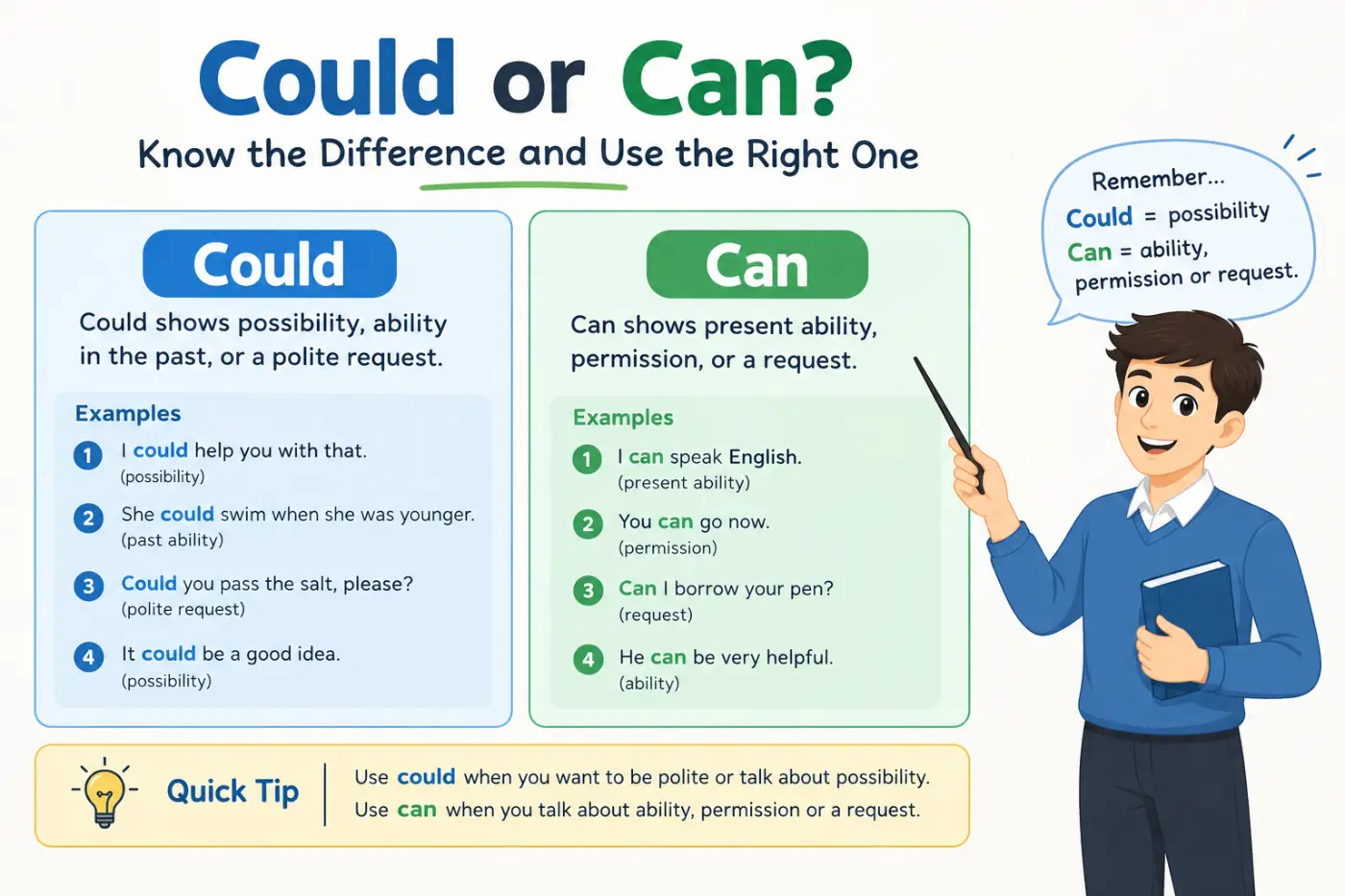
Understanding Could or Can is easier than it seems. These two words often express ability, permission, requests, and possibility. However, they don’t always mean the same thing. Your choice depends on the situation, the time you’re talking about, and the tone you want to create.
Can usually expresses present ability, permission, or possibility. Could often expresses past ability, polite requests, uncertain possibility, or imaginary situations. Both are correct, but their meanings and uses can differ.
This guide explains their origins, meanings, related expressions, grammar rules, and everyday uses. You’ll also find comparison tables, practical examples, common mistakes, and simple tips to help you choose the right word confidently.
What Is the Meaning of Could or Can?
Can and could are modal verbs. A modal verb is a helping verb that adds meaning to another verb. It can show ability, permission, possibility, necessity, or willingness.
These words usually appear before the base form of another verb.
For example:
- I can speak English.
- She could swim when she was younger.
- Can you open the window?
- Could you explain this question?
Although both words belong to the same verb family, they serve different purposes.
What Does Can Mean?
Can usually describes something a person is able or allowed to do. It can also describe something that is generally possible.
Examples:
- I can drive a car.
- You can borrow my notebook.
- Birds can fly.
- Can we leave early?
- Learning English can take time.
In these sentences, can expresses ability, permission, or general possibility.
It often makes a sentence sound straightforward and confident.
What Does Could Mean?
Could is historically the past tense form of can. However, modern English uses it for much more than past events.
It can express past ability, polite requests, possible situations, suggestions, and imaginary conditions.
Examples:
- I could run faster when I was younger.
- Could you close the door?
- We could visit the museum tomorrow.
- It could rain tonight.
- If I had more money, I could buy a new laptop.
Notice that could doesn’t always describe the past. In several examples, it refers to the present or future.
This is one of the most useful grammar rules to remember.
Where Did Can and Could Come From?
Both words have a long history in the English language.
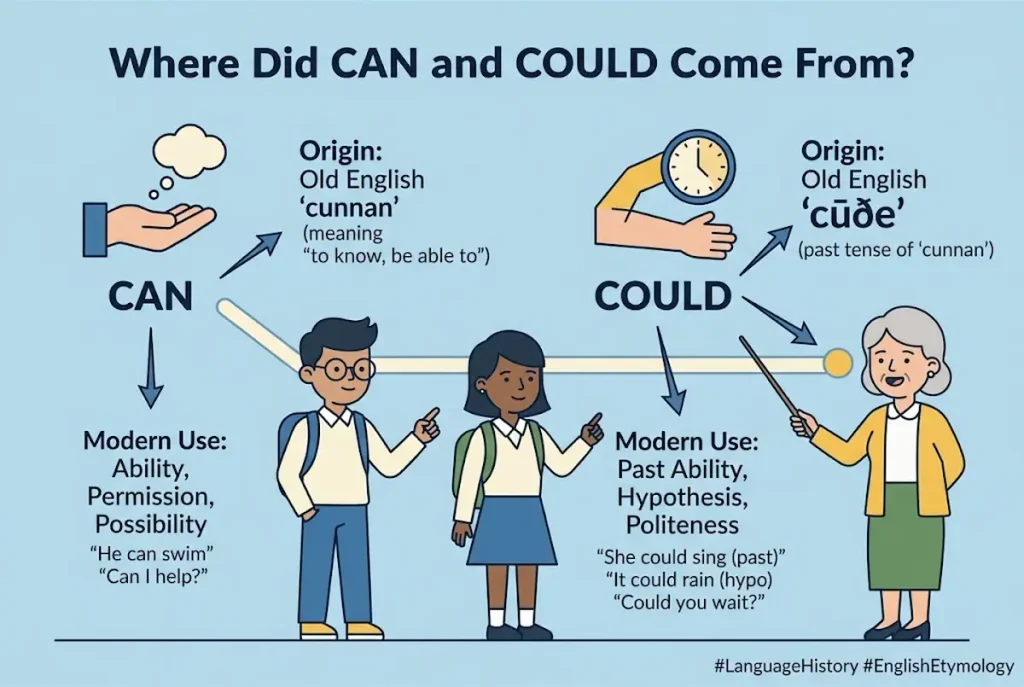
Can comes from the Old English word cunnan, which meant to know, understand, or know how to do something.
Over time, its meaning developed into the modern idea of having the ability to perform an action.
Could developed from the Old English past tense form of the same verb, commonly written as cūþe.
As English changed, could became the standard spelling.
An interesting detail is that the letter l in could wasn’t part of its original spelling. It was added later, probably because of the spelling patterns of would and should.
That’s why the l in could is silent.
Today, both words have meanings that extend beyond their historical relationship.
| Word | Original idea | Modern meaning |
|---|---|---|
| Can | Knowing how to do something | Ability, permission, possibility |
| Could | Past form of knowing how | Past ability, polite requests, possibility |
What Is the Main Difference Between Can and Could?
The main difference involves time, certainty, and politeness. Can often sounds more direct and expresses a present ability or a general fact.
| Situation | Can | Could |
|---|---|---|
| Present ability | I can swim. | Not normally used for direct present ability |
| Past general ability | Not used alone | I could swim at five. |
| Permission | Can I leave? | Could I leave? |
| Request | Can you help? | Could you help? |
| Possibility | It can happen. | It could happen. |
| Suggestion | Less common for tentative suggestions | We could try again. |
| Imaginary situation | Not normally used | I could travel if I had money. |
| Tone | Direct and casual | Often softer and more polite |
Can vs Could for Ability
Use can when someone has an ability now.
Example: My sister can play the piano.
Use could when describing a general ability someone had in the past.
Example: My sister could play the piano when she was six.
However, could isn’t always suitable for a single successful past action.
For example:
Incorrect: Yesterday, I could finish the difficult assignment.
Better: Yesterday, I managed to finish the difficult assignment.
Could works naturally for general past abilities, while managed to or was able to often describes a particular successful event.
Can vs Could for Permission
Both words can be used to ask permission.
Can I use your phone?
Could I use your phone?
The first sentence sounds natural and direct. The second sounds slightly more polite or careful.
Neither sentence is grammatically wrong.
What Are 30 Alternatives to Can and Could?
English offers several expressions that communicate similar ideas.
However, these alternatives aren’t always interchangeable. Some describe ability, others express permission, and a few communicate possibility or requests.
Understanding their meanings helps you avoid using the same expression repeatedly.
Simple Alternatives
| Word or Phrase | Meaning | Tone | Example |
|---|---|---|---|
| Be able to | Have the ability | Neutral | I am able to help. |
| Know how to | Have learned a skill | Simple | She knows how to cook. |
| Be allowed to | Have permission | Neutral | We are allowed to enter. |
| May | Have permission or possibility | Polite | May I sit here? |
| Might | Express possibility | Neutral | It might snow. |
| Manage to | Successfully do something | Neutral | He managed to escape. |
| Be possible | Something can happen | Neutral | It is possible to improve. |
| Have permission | Be officially allowed | Neutral | You have permission to leave. |
Everyday Alternatives
| Word or Phrase | Meaning | Tone | Example |
|---|---|---|---|
| Get to | Have the chance or permission | Casual | We get to leave early. |
| Have a chance to | Have an opportunity | Friendly | I have a chance to travel. |
| Be free to | Have permission or freedom | Neutral | You’re free to join us. |
| Be capable of | Have the necessary ability | Neutral | She’s capable of leading. |
| Be willing to | Agree or be ready to act | Neutral | I’m willing to help. |
| Be in a position to | Have the means or authority | Professional | We’re in a position to assist. |
| Have the option to | Have an available choice | Neutral | You have the option to wait. |
| Be likely to | Have a good chance of happening | Neutral | Prices are likely to rise. |
Formal Alternatives
| Word or Phrase | Meaning | Tone | Example |
|---|---|---|---|
| Have the capacity to | Possess the necessary ability | Formal | The system has the capacity to expand. |
| Have the capability to | Possess the necessary skill or power | Formal | The device has the capability to detect errors. |
| Be authorized to | Have official permission | Formal | Staff are authorized to enter. |
| Be permitted to | Be officially allowed | Formal | Visitors are permitted to take photos. |
| Have the potential to | Be capable of future development | Formal | This project has the potential to grow. |
| Be feasible | Be practical or possible | Formal | The proposed solution is feasible. |
| Be equipped to | Have the tools or skills needed | Professional | Our team is equipped to respond. |
| Be eligible to | Meet the required conditions | Formal | Students are eligible to apply. |
Casual and Slang Alternatives
These expressions work mainly in informal conversations. They aren’t exact replacements in every sentence.
| Word or Phrase | Meaning | Tone | Example |
|---|---|---|---|
| Be up for | Be willing to participate | Casual | Are you up for a movie? |
| Be down to | Be willing to do something | Slang | I’m down to help. |
| Pull off | Successfully do something difficult | Casual | She pulled off an amazing performance. |
| Make it happen | Successfully arrange something | Casual | We can make it happen. |
| Be good to go | Be ready or permitted to proceed | Casual | You’re good to go. |
| Have a shot at | Have a chance of success | Casual | He has a shot at winning. |
| Be game for | Be willing to try | Casual | I’m game for another round. |
| Be all set to | Be fully prepared | Casual | We’re all set to leave. |
The best alternative depends on the meaning you want to communicate.
For example, be authorized to expresses official permission, while be capable of expresses ability. Replacing one with the other would change the meaning.
How Do Can and Could Change the Strength of a Sentence?
These words can make statements sound more certain, direct, polite, or cautious.
There isn’t one fixed scale for every situation. The meaning changes depending on the sentence.
From Uncertain to More Certain Possibility
| Expression | Meaning | Example |
|---|---|---|
| Might | Something is possible | It might rain. |
| Could | Something is a possible outcome | It could rain. |
| May | Something is possible | It may rain. |
| Is likely to | Something has a good chance of happening | It is likely to rain. |
| Will | Expresses a prediction or expectation | It will rain. |
| Is certain to | Expresses very strong confidence | It is certain to rain. |
May, might, and could overlap in meaning. Their exact level of certainty depends on context, so they don’t form a strict probability ranking.
From Direct to More Polite Requests
Consider these examples:
- Open the door.
- Can you open the door?
- Could you open the door?
- Would you mind opening the door?
- Would it be possible for you to open the door?
The first is a direct command. The following sentences gradually become more indirect.
Still, tone and context matter. A friendly can often sounds more polite than an impatient could.
Are Can and Could Different Parts of Speech?
No. Both words are modal auxiliary verbs.
They don’t become nouns, adjectives, or adverbs in their ordinary grammatical use.
However, related expressions can communicate similar meanings through different grammatical structures.
| Grammatical form | Expression | Example |
|---|---|---|
| Modal verb | Can | I can solve this problem. |
| Modal verb | Could | She could help us. |
| Noun | Ability | His ability impressed everyone. |
| Noun | Capability | The machine has limited capability. |
| Adjective | Capable | She’s capable of completing the task. |
| Adjective | Possible | A solution is possible. |
| Adverb | Possibly | He could possibly arrive early. |
| Verb phrase | Be able to | We will be able to attend. |
An important rule is that can and could must normally be followed by the base form of a verb.
Correct: She can write.
Incorrect: She can writes.
Correct: He could understand.
Incorrect: He could understood.
Also, don’t place to immediately after either modal verb.
Incorrect: I can to swim.
Correct: I can swim.
Is There a Difference Between American and British English?
American and British English follow essentially the same grammar rules for these two modal verbs.
Both use can for present ability and could for general past ability, polite requests, and hypothetical situations.
However, certain expressions and conversational preferences may vary.
| Situation | American English | British English |
|---|---|---|
| Casual request | Can you help me? | Can you help me? |
| Polite request | Could you help me? | Could you help me? |
| Asking permission | Can I leave? | Can I leave? |
| More formal permission | May I leave? | May I leave? |
| Past ability | I could swim. | I could swim. |
In both varieties, could is a natural choice for a polite request.
British speakers also commonly use expressions such as could do with when describing something they want or need.
Example: I could do with a cup of tea.
This expression is understood in American English, but it is especially associated with British usage.
The grammar itself remains largely consistent across both varieties.
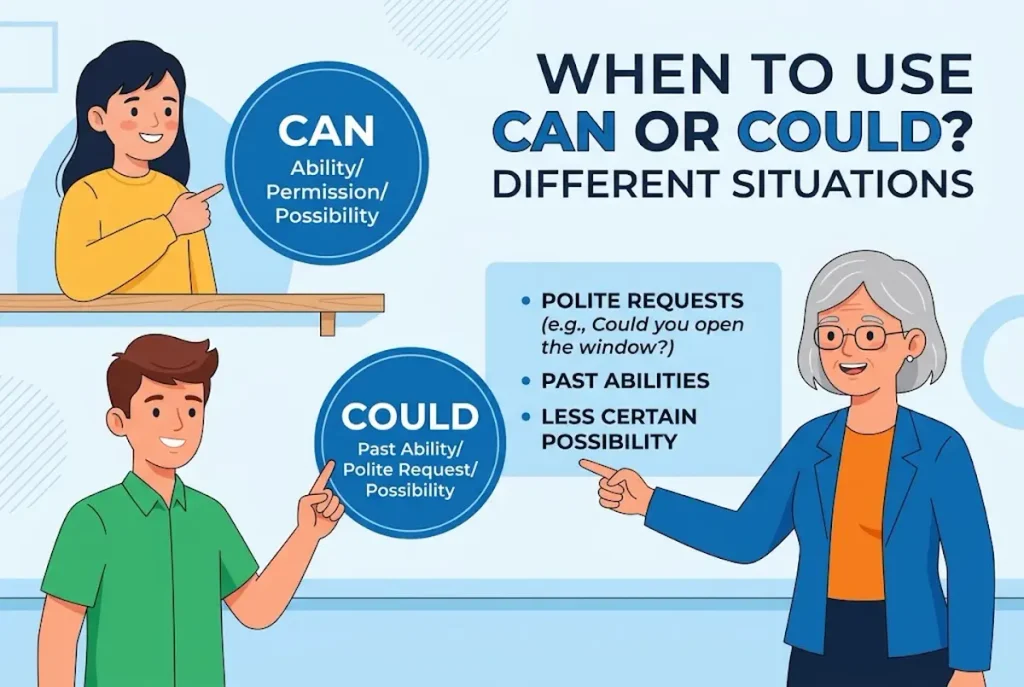
When Should You Use Can or Could in Different Situations?
The right choice depends on your audience and the message you’re trying to communicate.
A resume requires a different tone from a friendly text. Similarly, academic writing may require more careful language than everyday speech.
Which Word Should You Use in a Resume?
Use can to describe a present ability, but strong action verbs usually make resume statements more effective.
For example:
Basic: I can manage multiple projects.
Better: Managed multiple projects while meeting deadlines.
A resume should demonstrate what you’ve accomplished rather than simply claim what you’re able to do.
Could is less useful when describing your current professional skills because it can sound hypothetical.
Example: I could manage a team.
This sentence doesn’t clearly communicate actual experience.
Which Sounds Better in Text Messages?
Can usually works well in casual text messages because it sounds natural and straightforward.
Examples:
- Can you call me later?
- Can we meet tomorrow?
- Can I send you the pictures?
Could is useful when you want to sound a little more considerate.
Examples:
- Could you pick me up after work?
- Could we change our meeting time?
Neither sounds unnatural. Your relationship with the person and the situation matter more than following a strict rule.
Which Word Sounds More Natural When Speaking?
Both sound natural in everyday conversations.
Use can when discussing what you’re able to do.
Example: I can help you with your homework.
Use could when offering a possible suggestion.
Example: We could watch a movie after dinner.
Could can also make spoken requests sound more polite.
Example: Could you pass me the salt?
Remember that politeness comes from the whole sentence, not just one word.
Can and Could Examples in Everyday English
Understanding grammar becomes easier when you see how it works in real situations.
The following examples show how the meaning changes across different contexts.
| Situation | Example sentence | Meaning |
|---|---|---|
| Present skill | I can speak three languages. | Current ability |
| Childhood skill | I could ride a bicycle at six. | Past ability |
| Permission | Can I use your computer? | Asking permission |
| Polite permission | Could I leave a little early? | Softer permission request |
| Request | Can you explain this lesson? | Direct request |
| Polite request | Could you repeat that sentence? | Polite request |
| General possibility | Mistakes can happen. | Something is generally possible |
| Future possibility | The weather could change. | Possible future event |
| Suggestion | We could order pizza tonight. | Offering an idea |
| Imaginary situation | I could travel more if I had time. | Hypothetical ability |
| Professional ability | Our team can finish the project. | Present capability |
| Warning | This road can become dangerous. | General possibility |
| Uncertain explanation | She could be at home. | Possible explanation |
| Past inability | I couldn’t understand the instructions. | Past lack of ability |
| Current inability | I can’t attend the meeting. | Present inability |
Examples in Questions
- Can you hear me clearly?
- Could you help me carry these bags?
- Can students use calculators during the exam?
- Could we discuss this tomorrow?
- Can your brother drive?
- Could your grandfather speak French?
Examples in Negative Sentences
- I can’t find my keys.
- She couldn’t attend yesterday’s meeting.
- We can’t park here.
- He couldn’t swim when he was younger.
- I can’t promise an immediate answer.
- That explanation couldn’t be correct.
Can’t is the contraction of cannot. Couldn’t is the contraction of could not.
Notice that couldn’t can also express disbelief or a judgment about possibility, as in the final example.
Can vs Be Able To: What’s the Difference?
Can and be able to often express the same basic idea: having the ability to do something.
However, their grammatical flexibility differs.
| Can | Be able to |
|---|---|
| I can swim. | I am able to swim. |
| She can drive. | She is able to drive. |
| Not used after will | I will be able to drive. |
| Not used directly after have | I have been able to drive. |
Can is usually shorter and more natural in everyday conversation.
Be able to becomes especially useful when a sentence requires another tense or grammatical structure.
For example:
Incorrect: I will can attend tomorrow.
Correct: I will be able to attend tomorrow.
Could vs Might: What’s the Difference?
Could and might both express possibility.
In many sentences, their meanings overlap.
| Could | Might |
|---|---|
| It could rain tomorrow. | It might rain tomorrow. |
| She could be busy. | She might be busy. |
| We could visit the park. | We might visit the park. |
For example:
We could visit the park.
This can mean visiting the park is one available option.
We might visit the park.
This usually means visiting the park is something we may decide to do.
Might doesn’t normally express ability.
Incorrect: I might swim when I was five. (If you mean past ability.)
Correct: I could swim when I was five.
Could vs Would: What’s the Difference?
Could often expresses ability or possibility. Would frequently expresses willingness, preference, or a hypothetical result.
Compare these sentences:
| Could | Would |
|---|---|
| I could help you. | I would help you. |
| She could travel abroad. | She would travel abroad. |
| Could you open the window? | Would you open the window? |
I could help you suggests that helping is possible.
I would help you often communicates willingness, sometimes depending on a condition.
For example:
I would help you if I had more time.
Could and would also appear together in conditional sentences.
Example: If I had a car, I could drive you home, and I would gladly do it.
What Are the Most Common Mistakes With Can and Could?
Several mistakes appear repeatedly in English writing and speaking.
Most involve verb forms, time references, or confusion about possibility.
Mistake 1: Adding To After Can or Could
Incorrect: She can to dance.
Correct: She can dance.
Incorrect: He could to answer.
Correct: He could answer.
Modal verbs normally take the base form of the following verb without to.
Mistake 2: Using the Past Form After Could
Incorrect: I could went home.
Correct: I could go home.
Could already carries the modal meaning. The following verb stays in its base form.
Mistake 3: Using Can for General Past Ability
Incorrect: When I was seven, I can swim.
Correct: When I was seven, I could swim.
Use could when describing a general ability someone had in the past.
When Should You Avoid Using Words?
Sometimes another expression communicates your meaning more accurately.
Avoid relying on can when you need to describe a future ability with will. Use will be able to instead.
Example: I will be able to attend next week.
Avoid could when you’re trying to describe a definite present skill.
Less direct: I could operate this machine.
Clearer: I can operate this machine.
Avoid using either word when a stronger action verb makes your professional writing clearer.
Weak: I can organize events.
Stronger: I organized five successful community events.
Also, don’t use could to express a guaranteed outcome. It normally leaves room for uncertainty when describing possibility.
What Are the Opposites of Can and Could?
The most direct negative forms are cannot and could not.
However, the opposite expression depends on the original meaning.
| Original expression | Opposite expression | Example |
|---|---|---|
| Can | Cannot | I cannot attend. |
| Could | Could not | She could not understand. |
| Be able to | Be unable to | He is unable to travel. |
| Be allowed to | Be forbidden to | Visitors are forbidden to enter. |
| Be possible | Be impossible | The task is impossible. |
| Be permitted to | Be prohibited from | Students are prohibited from entering. |
| Be capable of | Be incapable of | The device is incapable of recording audio. |
Cannot is normally written as one word.
Can’t and couldn’t are common contractions, especially in conversations and informal writing.
How Can You Choose the Correct Word Quickly?
These practical rules cover most everyday situations.
- Use can for present ability: I can drive.
- Use could for general past ability: I could drive at sixteen.
- Use can for direct requests: Can you help me?
- Use could for softer requests: Could you help me?
- Use can for general possibility: Accidents can happen.
- Use could for a possible outcome: An accident could happen.
- Use could for hypothetical situations: I could travel if I had money.
- Use be able to when another tense requires it: I will be able to attend.
Conclusion
Understanding Could or Can helps you communicate ability, permission, and possibility more accurately. The key is to consider the time, meaning, and tone of your sentence.
Use can when discussing present abilities, general possibilities, or direct requests. Choose could when describing general past abilities, offering suggestions, discussing imaginary situations, or making requests sound softer.
Remember that could isn’t limited to past events. It can also describe something that may happen now or in the future. You don’t need complicated grammar rules to make the right choice. Read your sentence, identify what you’re trying to express, and select the word that communicates it naturally.
With regular reading, writing, and speaking practice, these differences will become easier to recognize. Soon, choosing between the two will feel like a natural part of everyday English.
Frequently Asked Questions
What is the difference between could and can?
Can generally expresses present ability, permission, or possibility. Could expresses general past ability, polite requests, hypothetical situations, or uncertain possibilities.
When should I use Could or Can in a sentence?
Use can for present abilities and direct requests. Choose could for general past abilities, polite requests, and hypothetical situations.
Is could more polite than can?
Could usually sounds more polite because it makes a request less direct. However, both words are grammatically correct and acceptable in everyday conversations.
Can I use could for future situations?
Yes. Could can describe something that may happen in the future. For example, “We could visit our grandparents tomorrow.”
What’s another way to say can?
Common alternatives include be able to, be capable of, and know how to. The best replacement depends on the meaning of your sentence.
Is could always the past tense of can?
No. Although could developed as the past tense of can, it also expresses polite requests, possibilities, suggestions, and imaginary situations.

Daniel Grammarfield — The Language Learner
Age: 28Occupation: ESL Learner & Digital Professional
Bio:Daniel is a non-native English speaker who wants to communicate more confidently at work and online. He uses Synotrench to improve grammar, understand confusing words, learn correct sentence structures, and build everyday English skills. He prefers simple explanations with practical examples.
Goals:
Master English grammar rules
Avoid common language mistakes
Improve professional communication
Learn English through real-life examples
Quote:“Learning English is not about memorizing rules — it’s about expressing ideas clearly.”