Imagine you’re writing a science essay and need to describe the shape of a mirror. You know it curves, but should you call it concave vs convex? Both words describe curved surfaces, yet they mean opposite things. Choosing the wrong one can completely change your sentence.
Understanding Concave vs Convex is easier than it sounds. You don’t need advanced math or science knowledge. A simple picture of a bowl and a ball can help you remember the difference.
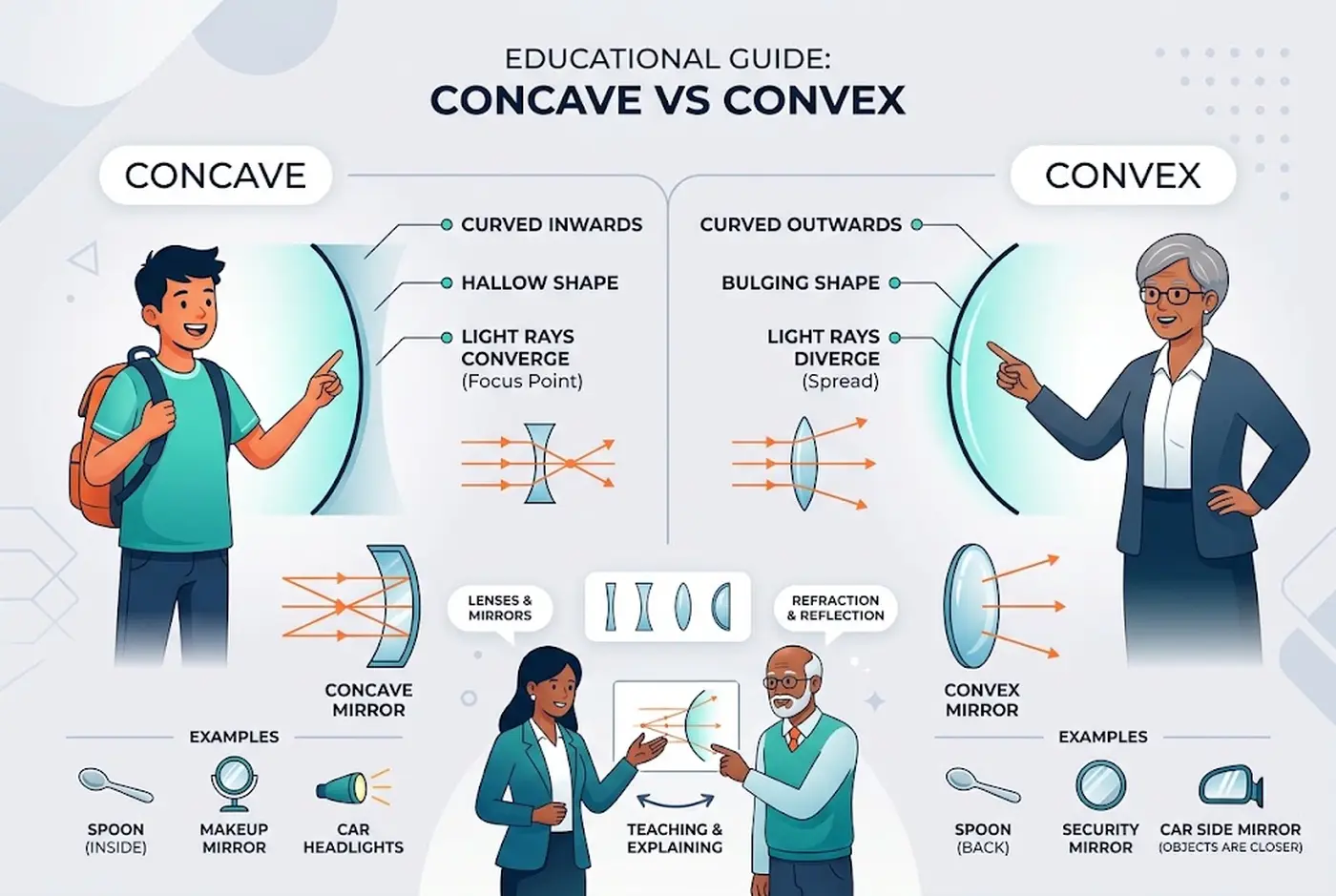
Concave means a surface curves inward, like the inside of a bowl. Convex means a surface curves outward, like the outside of a ball.
These two terms appear in geometry, science, architecture, photography, and everyday conversations. This guide explains their meanings, word origins, related vocabulary, real examples, common mistakes, and simple ways to remember which one to use.
What Is the Difference Between Concave and Convex?
The main difference is the direction of the curve. A concave surface bends inward, while a convex surface bulges outward.
Think about an ordinary spoon. Its inner side is concave because it forms a small hollow. Turn the spoon around, and its rounded back is convex.
Here is a simple comparison:
| Feature | Concave | Convex |
|---|---|---|
| Basic meaning | Curves inward | Curves outward |
| Shape | Hollow or sunken | Rounded or bulging |
| Common example | Inside of a bowl | Outside of a ball |
| Direction | Toward the inside | Away from the inside |
| Memory trick | Like a cave | Like a dome |
| Mirror example | Shaving mirror | Vehicle side mirror |
| Lens example | Thinner in the middle | Thicker in the middle |

What Does Concave Mean in Simple English?
Concave describes a surface that curves inward, creating a hollow, dip, or depression.
Imagine pressing your thumb into soft clay. The small hollow left behind has a concave shape.
Common examples include:
- The inside of a bowl.
- The inner surface of a spoon.
- A curved shaving mirror.
A useful memory trick is to connect concave with cave. A cave has an opening that leads inward, just as a concave surface bends inward.
What Does Convex Mean in Simple English?
Convex describes a surface that curves outward, creating a rounded or raised shape.
Picture a basketball. Its outer surface bulges away from the center, making it convex.
Other familiar examples include:
- The outside of a globe.
- The back of a spoon.
- A rounded camera lens surface.
Remember that convex surfaces bulge outward rather than forming a hollow.
Where Do Concave and Convex Come From?
Both words have Latin roots. Their original meanings closely match how we use them today.
Origin of Concave
Concave comes from the Latin word concavus, meaning hollow or arched inward.
The word combines two elements:
- Con: A Latin prefix used in the formation of the word.
- Cavus: Meaning hollow.
The root cavus also appears in English words such as cavity and cavern.
This connection makes the meaning easier to remember. A cavity is an empty or hollow space, while a concave surface curves inward.
Origin of Convex
Convex comes from the Latin word convexus, associated with a rounded or arched shape.
It is historically connected with the Latin verb convehere, meaning to bring or carry together.
Over time, convex became the standard English term for a surface that curves outward.
Today, both words are widely used in mathematics, physics, engineering, design, and medicine.
Concave vs Convex Synonyms and Related Words
There are several ways to describe inward and outward curves without repeating the same technical terms.
However, not every related word is an exact synonym. Some describe a general appearance, while others refer to a particular shape, structure, or scientific feature.
For example, hollow can describe a concave surface, but it can also describe an object with empty space inside. Similarly, round is related to convex, but not every round shape is convex in the strict mathematical sense.
The following tables provide more than 30 useful synonyms and related expressions, organized by tone and usage.
Simple Words for Concave and Convex
These words work well when explaining shapes to beginners.
| Word | Meaning | Tone | Example |
|---|---|---|---|
| Hollow | Having an empty or sunken area | Simple | The stone has a hollow center. |
| Sunken | Lower than the surrounding surface | Simple | The button has a sunken middle. |
| Dipped | Curved or lowered inward | Simple | The plate has a dipped center. |
| Inward | Directed toward the inside | Simple | The surface bends inward. |
| Curved | Having a bend rather than being straight | Simple | The glass has a curved surface. |
| Rounded | Having a smooth, circular appearance | Simple | The container has a rounded bottom. |
| Raised | Higher than the surrounding area | Simple | The design has a raised center. |
| Bulging | Swelling or projecting outward | Simple | The ball has a bulging surface. |
| Outward | Directed away from the inside | Simple | The wall curves outward. |
Everyday Words for Describing Curves
These expressions sound natural in conversations, product descriptions, and general writing.
| Word | Meaning | Tone | Example |
|---|---|---|---|
| Bowl-shaped | Curved inward like a bowl | Everyday | The garden has a bowl-shaped pond. |
| Dish-shaped | Shallow and curved inward | Everyday | The antenna has a dish-shaped reflector. |
| Scooped | Having a hollowed-out appearance | Everyday | The chair has a scooped seat. |
| Cupped | Forming a small hollow | Everyday | She held her hands in a cupped position. |
| Recessed | Set below the surrounding surface | Everyday | The handle sits inside a recessed panel. |
| Dome-shaped | Rounded outward like a dome | Everyday | The building has a dome-shaped roof. |
| Ball-shaped | Rounded like a sphere | Everyday | The lamp has a ball-shaped cover. |
| Puffy | Swollen or rounded outward | Everyday | The cushion looks puffy. |
| Protruding | Sticking outward from a surface | Everyday | The wall has a protruding section. |
Formal and Technical Words
These terms are useful in science, geometry, architecture, and professional descriptions.
| Word | Meaning | Tone | Example |
|---|---|---|---|
| Depressed | Lower than the surrounding surface | Formal | The metal contains a depressed area. |
| Indented | Pressed or cut inward | Formal | The panel has an indented section. |
| Incurved | Curving toward the inside | Technical | The flower has incurved petals. |
| Excavated | Hollowed out by removing material | Formal | The excavated surface forms a shallow basin. |
| Reentrant | Turning inward, especially in geometry | Technical | The polygon contains a reentrant angle. |
| Concavity | An inward curve or hollow | Technical | The designer measured the concavity. |
| Protuberant | Projecting outward | Formal | The sculpture has a protuberant surface. |
| Convexity | The quality of being convex | Technical | The lens has noticeable convexity. |
| Domed | Having a rounded outward top | Formal | The structure has a domed ceiling. |
| Hemispherical | Shaped like half a sphere | Technical | The instrument has a hemispherical cover. |
| Biconcave | Curved inward on both sides | Technical | The lens has a biconcave design. |
| Biconvex | Curved outward on both sides | Technical | The magnifying lens is biconvex. |
Which Words Describe Mild and Strong Curves?
Not every inward or outward curve has the same depth.
Some surfaces have barely noticeable bends. Others contain deep hollows or prominent outward projections.
Choosing a descriptive word based on intensity can make your writing more accurate.
Words for Inward Curves From Mild to Strong
| Intensity | Word | Description |
|---|---|---|
| Very mild | Slightly curved | A small inward bend |
| Mild | Shallow | A surface with limited depth |
| Moderate | Dished | A noticeable bowl-like shape |
| Moderate | Recessed | Set below the surrounding surface |
| Strong | Deeply concave | A pronounced inward curve |
| Very strong | Deeply hollowed | A substantial hollow or depression |
Words for Outward Curves From Mild to Strong
| Intensity | Word | Description |
|---|---|---|
| Very mild | Slightly rounded | A gentle outward curve |
| Mild | Gently domed | A smooth, raised surface |
| Moderate | Rounded | A noticeable outward shape |
| Moderate | Bulging | A surface projecting outward |
| Strong | Pronounced | A clearly visible projection |
| Very strong | Strongly protruding | Extending considerably outward |
Are Concave and Convex Adjectives or Nouns?
Both words are primarily adjectives.
An adjective describes a noun. In this case, the words tell readers about the shape of an object or surface.
Examples:
- A concave mirror.
- A convex lens.
- A concave polygon.
Their related noun forms are concavity and convexity.
| Form | Concave family | Convex family |
|---|---|---|
| Adjective | Concave | Convex |
| Noun describing the quality | Concavity | Convexity |
| Related noun | Concave surface | Convex surface |
| Technical expression | Biconcave | Biconvex |

Is There a Difference Between American and British English?
No. Concave and convex have the same spelling and meaning in American and British English.
Unlike color and colour or center and centre, these two words do not have separate regional spelling forms.
American and British textbooks also use the same basic geometric definitions.
Some everyday descriptions may vary by region, but the technical terms remain consistent.
Where Should You Use Concave or Convex in Writing?
The best word depends on your audience and the purpose of your sentence.
In scientific writing, technical accuracy matters. In casual communication, a simpler expression may sound more natural.
How Should You Use Them in a Resume?
Use these words when describing technical experience related to engineering, optics, architecture, manufacturing, or product design.
Avoid adding technical terms just to make your resume sound more impressive.
Example:
Designed and tested concave and convex lens components for an optical imaging project.
This sentence identifies a specific professional skill and gives the reader useful information.
For a nontechnical resume, simpler words such as curved, rounded, or recessed may be more appropriate.
Which Word Is Better in an Essay?
Use the correct scientific term when explaining geometry, light, mirrors, or physical structures.
For example:
A concave mirror curves inward and can concentrate parallel incoming light rays at a focal point.
This sentence is more precise than simply saying that the mirror has a curved surface.
In descriptive essays, you can introduce the technical term and then explain it in familiar language.
How Do You Explain the Difference in a Text Message?
Casual messages don’t always need technical vocabulary.
You can use simple comparisons when explaining the shapes to a friend.
Example:
The inside of your spoon is concave, and the back is convex. That’s the easiest way to remember it!
This explanation sounds natural and gives the reader a familiar object to picture.
What Are Some Real-Life Examples of Concave and Convex?
The terms appear in more places than you might expect.
From household objects to scientific instruments, curved surfaces often serve a practical purpose.
Here are 16 original example sentences showing how these words work in different situations.
Concave Examples in Everyday Life
- The inside of the soup bowl has a concave surface.
- The dentist used a small concave mirror to examine the patient’s teeth.
- The designer created a concave seat to support the user’s body.
Convex Examples in Everyday Life
- The security mirror has a convex surface that provides a wider field of view.
- The basketball’s outer surface is convex.
- The architect designed a convex dome above the entrance.
These examples also show why curved is not always a complete description. Identifying the direction of the curve gives readers a clearer mental picture.
How Do Concave and Convex Mirrors Work?
Mirrors are among the most useful examples of inward and outward curves.
Although both types reflect light, their shapes affect the direction in which reflected rays travel.
Concave mirror
An inward-curving reflective surface that can bring parallel incoming rays together.
Convex mirror
An outward-curving reflective surface that spreads reflected rays apart.
What Does a Concave Mirror Do?
A concave mirror has a reflective surface that curves inward.
When parallel light rays travel toward the mirror along its principal axis, the reflected rays meet at a focal point.
This property makes concave mirrors useful in:
- Shaving and makeup mirrors.
- Reflecting telescopes.
- Flashlights.
A concave mirror can produce an enlarged upright image when an object is placed between the mirror and its focal point.
At other distances, it may produce an inverted image.
What Does a Convex Mirror Do?
A convex mirror has a reflective surface that bulges outward.
It causes reflected light rays to spread apart, allowing viewers to see a wider area.
This makes it useful for:
- Vehicle side mirrors.
- Security mirrors.
- Parking garages.
A convex mirror produces an upright, reduced virtual image of a real object placed in front of it.
That is why objects in convex vehicle mirrors can appear smaller than they actually are.
What Is the Difference Between Concave and Convex Lenses?
Lenses are transparent optical components that bend light through refraction.
Their shapes affect how incoming light travels.
Concave lens
A typical biconcave lens is thinner in the center and thicker near its edges.
Convex lens
A typical biconvex lens is thicker in the center and thinner near its edges.
| Feature | Typical concave lens | Typical convex lens |
|---|---|---|
| Shape | Curves inward | Bulges outward |
| Center | Thinner | Thicker |
| Edges | Thicker | Thinner |
| Effect on parallel light | Diverges light | Converges light |
| Common use | Correcting myopia | Magnifying glasses |
| Optical power in air | Negative | Positive |
Why Are Concave Lenses Used for Nearsightedness?
Nearsightedness, also called myopia, makes distant objects appear blurry because incoming light focuses in front of the retina when the eye is relaxed.
A diverging lens spreads incoming rays before they enter the eye, helping move the focus back toward the retina.
Why Are Convex Lenses Used in Magnifying Glasses?
A typical magnifying glass uses a converging lens.
When an object is positioned within the lens’s focal length, the viewer sees an enlarged, upright virtual image.
This makes small letters and fine details easier to examine.
How Are Concave and Convex Shapes Different in Geometry?
Geometry gives these terms a more precise meaning than everyday descriptions of curved surfaces.
A convex shape has a special property: every straight line segment connecting any two points inside or on the shape stays entirely within the shape.
A concave polygon does not satisfy this condition.
What Is a Concave Polygon?
A concave polygon has at least one interior angle greater than 180 degrees.
It contains an inward indentation, which means a straight line segment connecting two points within the polygon can pass outside it.
Examples include certain arrowhead and irregular star-shaped polygons.
What Is a Convex Polygon?
A convex polygon has no inward indentation.
Every interior angle is less than 180 degrees, and every line segment joining two points in the polygon remains inside or on its boundary.
Common examples include:
- Squares.
- Rectangles.
- Regular pentagons.
Every triangle is convex. A concave triangle cannot exist in ordinary Euclidean geometry.
| Geometry feature | Concave polygon | Convex polygon |
|---|---|---|
| Inward indentation | Present | Absent |
| Interior angles | At least one exceeds 180° | All are below 180° |
| Connecting two internal points | Segment may leave the shape | Segment always stays inside |
| Common example | Arrowhead-shaped polygon | Square |
Concave vs Convex Close Meaning Comparisons
Some related words appear interchangeable in casual writing, but their meanings are not identical.
Understanding these differences helps you choose more precise descriptions.
Concave vs Hollow
| Concave | Hollow |
|---|---|
| Describes an inward-curving shape | Describes an empty space or depression |
| Usually refers to a surface | May describe an entire object |
| Does not require an empty interior | Often suggests empty space inside |
| Example: A concave mirror | Example: A hollow wooden box |
Convex vs Rounded
| Convex | Rounded |
|---|---|
| Describes an outward curve or geometric property | Describes a generally smooth, round appearance |
| Has a precise technical meaning | Often used in everyday descriptions |
| May describe an entire shape or a surface | May describe corners, edges, or objects |
| Example: A convex mirror | Example: A table with rounded corners |
Concave vs Recessed
Concave describes curvature, while recessed describes position.
A recessed surface sits below the surrounding area, but it does not necessarily curve.
For example, a square opening cut into a wall may be recessed without having a concave curved surface.
Convex vs Bulging
Convex is a neutral geometric description.
Bulging often suggests a noticeable outward swelling or projection.
A carefully manufactured lens may have a convex surface, while a damaged container might have a bulging side.
The second word can sometimes suggest pressure, damage, or an unusual change in shape.
What Are the Most Common Mistakes With Concave and Convex?
These words are easy to confuse because both describe curves and begin with the same three letters.
The following mistakes appear frequently in beginner explanations and science assignments.
Mistake 1: Thinking Every Curved Surface Is Concave
A curved surface is not automatically concave.
It may bend inward, outward, or contain both types of curvature.
Correct example:
The inside of the bowl is concave, while its rounded outer surface is convex.
Mistake 2: Calling a Convex Mirror a Magnifying Mirror
A typical convex mirror makes images appear smaller, not larger.
Concave mirrors can produce magnified images under suitable conditions.
This distinction matters when describing vehicle mirrors, makeup mirrors, and optical instruments.
Mistake 3: Confusing Lens Thickness
Students sometimes reverse the thickness of common lens types.
Remember:
- Biconcave lenses are thinner in the middle.
- Biconvex lenses are thicker in the middle.
This rule applies to these standard lens shapes, not every possible optical design.

What Are the Opposites of Concave and Convex?
These words are direct opposites in many common descriptions of curved surfaces.
However, several other terms can express contrasting shapes depending on context.
| Word | Opposite or contrast | Example |
|---|---|---|
| Concave | Convex | An inward curve versus an outward curve |
| Convex | Concave | A rounded surface versus a hollowed surface |
| Sunken | Raised | A sunken button versus a raised button |
| Inward | Outward | An inward bend versus an outward bend |
| Recessed | Protruding | A recessed panel versus a protruding panel |
| Depressed | Elevated | A depressed area versus an elevated area |
Flat is another useful contrasting term when discussing surface curvature.
A flat surface has neither an inward nor an outward bend in the ordinary geometric sense.
However, flat is not the direct opposite of either technical term because it describes the absence of curvature rather than the reverse direction.
How Can You Remember Which Word to Use?
A few simple memory tricks can help you avoid mixing up these terms.
Remember the Cave Trick
Connect concave with cave.
A cave opens inward and creates a hollow space.
When you see a surface that curves inward, think of the inside of a cave.
Remember the Bowl and Ball Trick
Picture two familiar objects:
- Bowl: Its inner surface is concave.
- Ball: Its outer surface is convex.
This comparison works especially well for beginners because the shapes are easy to visualize.
Use the Spoon Test
Look at both sides of a spoon.
The side that holds food is concave. The rounded back is convex.
You can remember both meanings using a single everyday object.
Conclusion
Understanding Concave vs Convex becomes much easier when you focus on the direction of the curve. Concave describes a surface that bends inward, while convex describes one that curves outward. The inside of a bowl and the outside of a ball are two simple examples worth remembering.
These words are especially useful in geometry, optics, engineering, architecture, and product design. Although related expressions such as hollow, rounded, recessed, and bulging can help describe similar shapes, they aren’t always exact replacements.
When writing, identify the specific surface you’re describing and choose the term that communicates its shape accurately. You don’t need complicated explanations to get it right. A spoon, a bowl, or a ball can provide all the visual reminders you need.
Frequently Asked Questions
What is the main difference between concave and convex?
Concave means curved inward, while convex means curved outward. The inside of a bowl is concave, and the outside of a ball is convex.
What’s the easiest way to remember Concave vs Convex?
Remember that concave sounds like cave, which suggests a hollow or inward curve. Convex describes a surface that bulges outward.
Is a spoon concave or convex?
A spoon has both types of surfaces. The inner side that holds food is concave, while its rounded back is convex.
What’s another way to say concave?
Common alternatives include hollowed, sunken, dished, and inward-curving. The best choice depends on the shape and context you’re describing.
Which mirror makes objects look smaller?
A convex mirror makes objects appear smaller while providing a wider field of view. That’s why convex mirrors are commonly used in vehicles and security systems.
Is a circle concave or convex?
A filled circle, also called a disk, is convex because every straight line segment connecting two points inside it remains within it. A circle’s boundary also encloses a convex region.
What is Concave vs Convex in geometry?
A convex shape contains every line segment connecting any two of its points. A concave polygon has an inward indentation and at least one interior angle greater than 180 degrees.
Can one object be both concave and convex?
Yes. An object can have different surfaces with different curvatures. A spoon is a familiar example because one side curves inward and the other curves outward.

Daniel Grammarfield — The Language Learner
Age: 28Occupation: ESL Learner & Digital Professional
Bio:Daniel is a non-native English speaker who wants to communicate more confidently at work and online. He uses Synotrench to improve grammar, understand confusing words, learn correct sentence structures, and build everyday English skills. He prefers simple explanations with practical examples.
Goals:
Master English grammar rules
Avoid common language mistakes
Improve professional communication
Learn English through real-life examples
Quote:“Learning English is not about memorizing rules — it’s about expressing ideas clearly.”
1 thought on “Concave vs Convex Simple Guide With Examples (2026)”