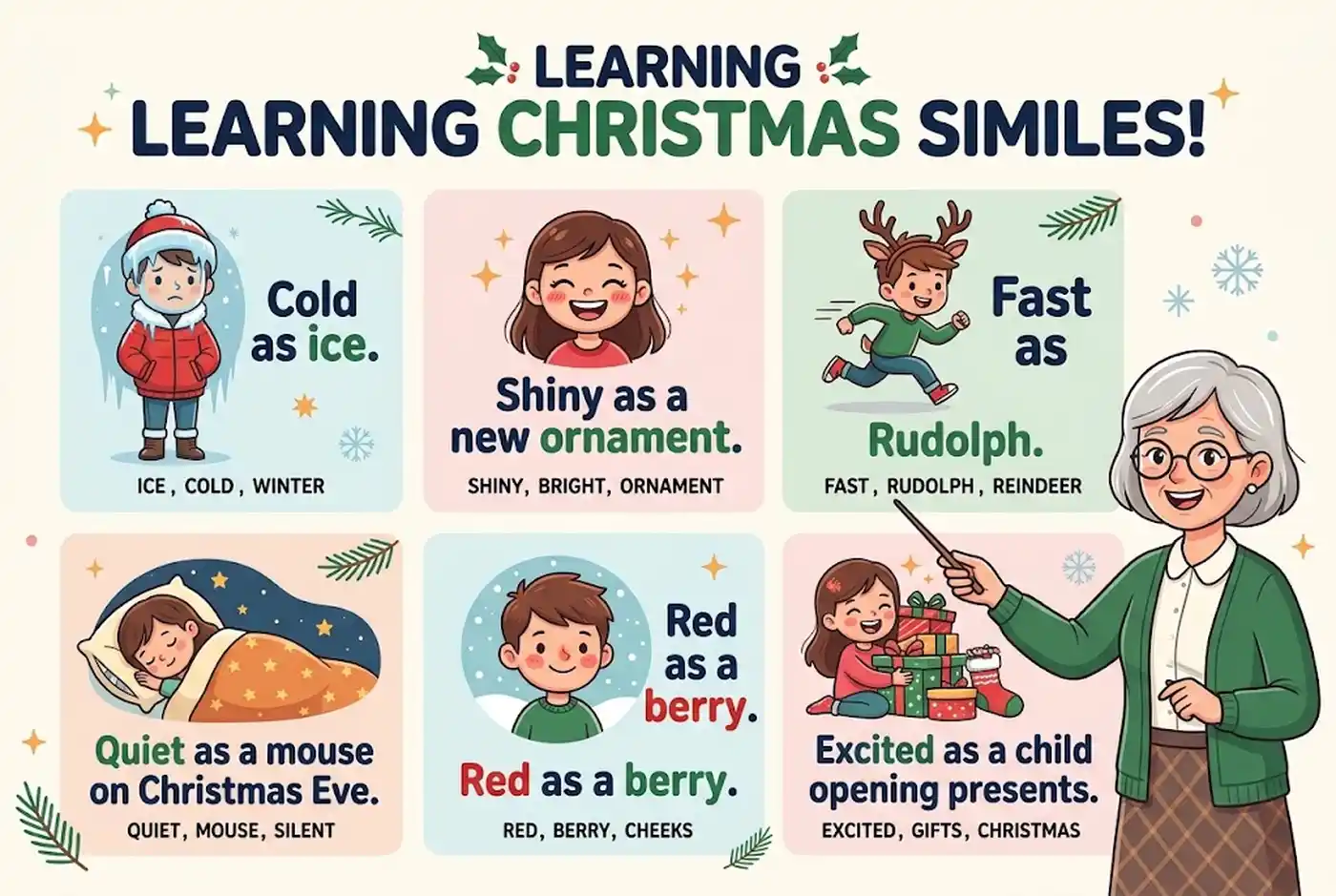
Christmas similes is a wonderful time to make your writing feel warm, cheerful, and full of life. Imagine writing a Christmas card, a school essay, a holiday story, or a message to a friend. You want to describe the sparkling lights, falling snow, cozy fireplaces, and joyful celebrations in a way that helps readers picture the scene. A good simile can make those ordinary descriptions much more memorable.
Christmas similes compare two different things using words such as like or as. They help readers imagine the beauty of a decorated tree, the softness of fresh snow, or the excitement of opening presents on Christmas morning. Instead of saying that the lights are bright, you could say that the Christmas lights sparkle like tiny stars.
What Are Christmas Similes?
These are comparisons that describe holiday objects, people, places, feelings, or experiences by showing how they resemble something else. They usually use the words like or as to connect two different things.
For example:
- The Christmas lights twinkled like stars in the night sky.
- The snow was as soft as a feather.
- The children were as excited as puppies on Christmas morning.
How is a simile different from a regular description?
A regular description tells readers what something is like in a direct way. A simile adds an imaginative comparison.
| Regular description | Simile | What the simile adds |
|---|---|---|
| The snow was white. | The snow was as white as cotton. | A familiar picture of whiteness. |
| The tree was bright. | The tree shone like a beacon. | A strong sense of light. |
| The house was warm. | The house felt as cozy as a blanket. | A feeling of comfort. |
| The children were happy. | The children were as happy as birds in spring. | A lively sense of joy. |
| The bells rang loudly. | The bells rang like thunder. | A powerful sound. |
What Is the Origin of Similes?
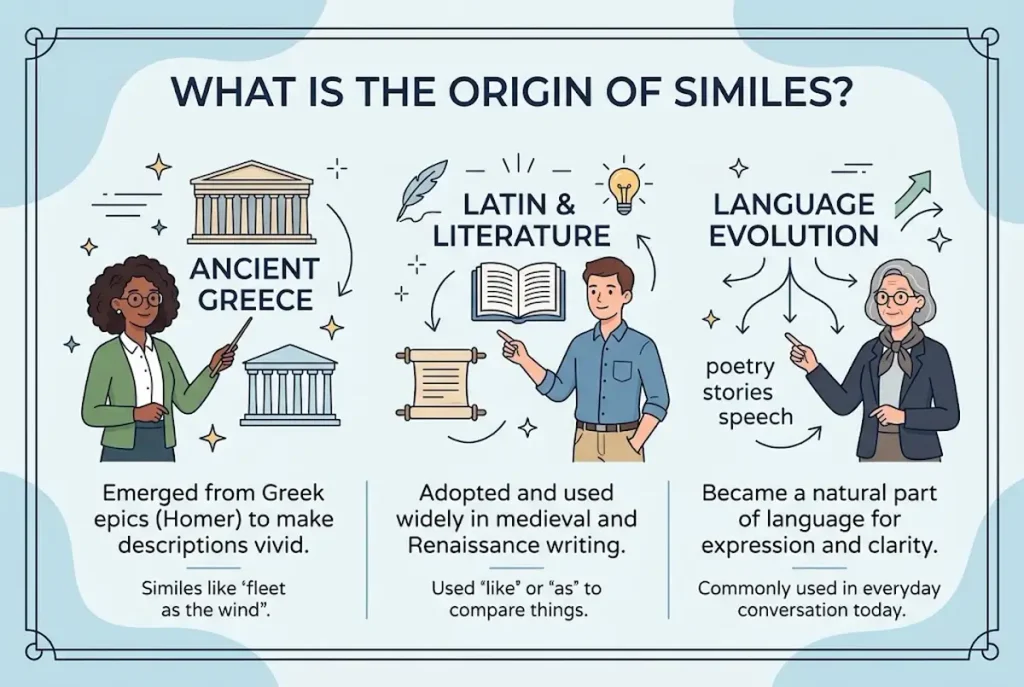
The word simile comes from the Latin word similis, which means similar or like. The term describes a figure of speech that shows a resemblance between two things.
People have used comparisons in spoken language, storytelling, poetry, and written literature for centuries. Comparing an unfamiliar experience with something familiar helps listeners understand it more easily.
Christmas provides many opportunities for this kind of language. People recognize the glow of candles, the scent of pine, the crunch of snow, and the comfort of a warm home. Writers can use those familiar experiences to describe holiday scenes in fresh ways.
For instance, a writer could describe a Christmas tree as tall as a tower. Most readers understand the comparison immediately, even though a decorated tree and a tower are very different objects.
Why do writers use similes at Christmas?
Holiday writing often focuses on sensory details and strong emotions. Similes help writers communicate both.
- Visual details make lights, ornaments, snow, and decorations easier to picture.
- Sounds become more memorable when bells, laughter, and music are compared with familiar noises.
- Smells and tastes feel more vivid when food, cinnamon, pine, and hot chocolate are described through comparison.
What Are the Best Word Use?
The following examples cover common holiday scenes and different writing styles. Some are simple enough for young students, while others work well in creative writing and poetry.
Similes for Christmas Lights
Christmas lights create some of the easiest and most memorable comparisons because their brightness and colors resemble things found in nature.
- The Christmas lights twinkled like stars scattered across the sky.
- The golden bulbs glowed like tiny suns.
- The colorful decorations shone as brightly as a rainbow.
- The fairy lights sparkled like diamonds on a velvet blanket.
- The candles flickered like fireflies on a winter night.
Similes for Christmas Trees
A Christmas tree can be described through its shape, color, ornaments, fragrance, and overall appearance.
- The Christmas tree stood as tall as a giant.
- Its branches spread like the arms of a welcoming friend.
- The ornaments glittered like colorful jewels.
- The pine needles smelled as fresh as a forest after rain.
- The tree shone like a green mountain covered in stars.
Similes for Christmas Snow and Winter Weather
Snow can make a holiday scene feel peaceful, magical, or even frightening when a storm arrives. The right comparison helps establish the mood.
- The snow fell like feathers from the clouds.
- The ground was as white as a sheet of paper.
- Snowflakes drifted like tiny dancers through the air.
- The frozen pond shone like a sheet of glass.
- The snow-covered rooftops looked like frosted cakes.
What Are Some Words Use for Students?
Students often need clear, easy examples for homework, classroom activities, short paragraphs, and creative writing assignments. The following sentences use familiar words and straightforward comparisons.
| Topic | Simple simile | Meaning |
|---|---|---|
| Snow | Snow was as white as milk. | The snow looked very white. |
| Tree | The tree stood like a giant. | The tree was very tall. |
| Lights | The lights shone like stars. | The lights were bright. |
| Presents | The presents were stacked like bricks. | The gifts formed a tall pile. |
| Cookies | The cookies were as sweet as sugar. | The cookies tasted sweet. |
| Bells | The bells rang like tiny chimes. | The bells made a clear sound. |
| Family | Our family was as close as peas in a pod. | The family members were close. |
| Fire | The fire glowed like gold. | The fire gave off a golden light. |
| Wind | The wind howled like a wolf. | The wind made a loud sound. |
| Joy | She was as happy as a child at play. | She felt very happy. |
How can you use a simile in a Christmas paragraph?
Start with a simple sentence about something you see, hear, smell, taste, or feel. Then add a comparison that makes the detail more vivid.
Plain sentence: The snow covered the garden.
Improved sentence: The snow covered the garden like a soft white blanket.
You can continue the paragraph by describing the other details.
Example paragraph:
On Christmas Eve, snow covered our garden like a soft white blanket. The lights on our tree twinkled like stars, and the cinnamon cookies smelled as sweet as honey. My little brother ran around the living room like a playful puppy. Outside, the wind howled like a wolf, but our home felt as cozy as a warm nest. We gathered around the fireplace and listened to Christmas songs until bedtime.
This paragraph uses several comparisons, but each one describes a different detail. That variety helps the scene feel complete rather than repetitive.
How Do Words Change From Mild to Strong?
The intensity of a simile depends on the image it creates. A mild comparison can suggest a gentle quality, while a strong comparison creates a more dramatic effect.
| Intensity | Example | Best use |
|---|---|---|
| Mild | The lights shone like candles. | A quiet scene. |
| Gentle | The lights glowed like fireflies. | A peaceful outdoor setting. |
| Moderate | The lights sparkled like diamonds. | A festive display. |
| Strong | The lights blazed like a thousand suns. | An exaggerated, dramatic scene. |
| Very strong | The lights exploded across the darkness like fireworks. | An energetic or magical scene. |
The same approach works for snow.
| Intensity | Example | Feeling created |
|---|---|---|
| Mild | Snow fell like dust. | Light and subtle. |
| Gentle | Snow drifted like feathers. | Soft and peaceful. |
| Moderate | Snow covered the ground like a blanket. | Comforting and familiar. |
| Strong | Snow swept across the fields like a white wave. | Powerful movement. |
| Very strong | The blizzard charged through the town like a roaring beast. | Danger and urgency. |
Strong comparisons aren’t always better. If every sentence contains a dramatic image, the reader may struggle to identify the most important details. Save the strongest comparisons for moments that deserve extra attention.
Can Be Grouped by Part of Speech?
Similes are figures of speech rather than a single part of speech. However, you can organize them by the grammatical role of the word or phrase they describe.
Adjective based comparisons
These describe qualities such as color, size, temperature, or emotion.
- The snow was as white as cotton.
- The room was as warm as toast.
- The children were as cheerful as songbirds.
The adjective tells readers what quality the subject shares with the comparison.
Verb based comparisons
These focus on actions and movement.
- The snowflakes danced like ballerinas.
- The lights shimmered like stars.
- The bells rang like thunder.
Verb based comparisons help scenes feel active. They’re useful when describing a busy Christmas morning or a stormy winter night.
Noun based comparisons
These compare one thing with another to create a recognizable image.
- The Christmas tree was a tower of green, tall as a giant.
- The fireplace was like a small sun in the living room.
- The blanket felt like a cloud against my skin.
The word or phrase following like or as provides the image. A noun based comparison is especially effective when the reader needs a clear visual reference.
Are these Different in American and British English?
The basic rules for similes are the same in American and British English. Both varieties use like and as to make comparisons, and the same general principles apply to creative writing.
However, the words used to describe Christmas traditions can differ by region.
| American English | British English | Example |
|---|---|---|
| Santa Claus | Father Christmas is also widely used | Santa was as cheerful as a child on Christmas morning. |
| Cookies | Biscuits | The cookies were as crisp as autumn leaves. |
| Sweater | Jumper | His Christmas jumper was as bright as a rainbow. |
| Candy | Sweets | The candy was as colorful as a garden of flowers. |
| Vacation | Holiday | The holiday felt as peaceful as a quiet forest. |
These differences affect the vocabulary around a simile, not the structure of the comparison itself.
For a US audience, terms such as Santa Claus, cookies, candy canes, and Christmas morning will usually feel familiar. For a UK audience, Father Christmas, biscuits, sweets, and Christmas jumper may fit more naturally.
The best choice is the wording that feels natural to your intended readers. You don’t need to change a simile’s grammatical structure to make it sound American or British.

Which Christmas Simile Works Best in Different Writing Situations?
The right comparison depends on what you’re writing and who will read it. A school assignment usually needs clarity, while a poem can make room for more imaginative language.
For Essays
An essay benefits from clear comparisons that support the topic without distracting from the main point.
Example: The town square looked like a winter postcard, with snow-covered roofs and sparkling decorations.
This sentence helps readers picture the setting while remaining easy to understand. If you’re writing an informative essay about holiday traditions, use comparisons sparingly and keep factual statements accurate.
For Greeting Cards
Greeting cards often express affection, gratitude, warmth, and good wishes.
Example: May your Christmas be as bright as the stars and as warm as a hug from someone you love.
This comparison works because it connects familiar holiday images with positive feelings. Keep card messages short enough to read easily, especially when the card already contains printed text.
For Text Messages
Text messages usually sound more natural when the comparisons are brief and conversational.
Example: Our Christmas tree looks like a little forest of lights.
Another example: I’m as excited as a kid waiting for presents.
These sentences sound casual and friendly. You can use them in messages to family members, friends, or classmates without making the conversation feel overly formal.
What Are Some Original Words for Real Life?
The most useful similes often come from everyday experiences. Instead of relying only on familiar images of stars, blankets, and rainbows, think about what people actually do during the holiday season.
At a Christmas market
- The market buzzed like a busy train station.
- The smell of roasted nuts drifted through the crowd like a warm invitation.
- The wooden stalls stood like little cabins in a snowy village.
While decorating the house
- The tangled string of lights looked like a bowl of colorful spaghetti.
- The shiny baubles rolled across the table like tiny planets.
- The wreath rested on the door like a green welcome sign.
During a family dinner
- The dining table was as crowded as a school bus at dismissal time.
- The gravy poured over the potatoes like a golden river.
- The cousins talked like a flock of excited parrots.
What Is the Difference Between a Christmas Simile and a Metaphor?
A simile and a metaphor both compare things, but they do it in different ways.
A simile uses like or as to show a resemblance. A metaphor describes one thing as another without using those comparison words.
| Simile | Metaphor | Difference |
|---|---|---|
| The lights shone like stars. | The lights were stars across the tree. | The simile signals a comparison. |
| The snow was as soft as cotton. | The snow was a blanket of cotton. | The metaphor gives the snow a new identity. |
| Her smile was like sunshine. | Her smile was sunshine. | The metaphor is more direct. |
| The room was as cozy as a nest. | The room was a cozy nest. | The metaphor makes the comparison more firmly. |
| The bells rang like silver rain. | Silver rain filled the air. | The metaphor creates a more poetic image. |
What Common Mistakes Should You Avoid When Writing Words?
Similes are easy to create, but a few common problems can make them less effective.
Using a comparison that doesn’t make sense
A comparison should connect two things through a recognizable quality.
Unclear: The Christmas tree was as loud as a green shoe.
Better: The Christmas tree was as tall as a tower.
The first sentence offers no obvious reason to connect loudness with a shoe. The second uses height, a quality that makes sense for a tree and a tower.
Using too many similes in one paragraph
A paragraph filled with comparisons can feel crowded.
Overloaded: The lights shone like stars, the tree stood like a giant, the snow fell like feathers, the bells rang like thunder, and the children jumped like frogs.
Improved: The lights shone like stars above the tree. Outside, snow fell softly while the children hurried to open their presents.
The revised version keeps a strong comparison and lets the rest of the scene develop naturally.
Choosing a comparison that doesn’t fit the mood
A peaceful Christmas scene may not need a violent or frightening image.
Poor fit: The quiet family gathering roared like an angry battlefield.
Better: The quiet family gathering felt as peaceful as a snowy forest.
The stronger image might work in a scene involving an argument, but it doesn’t match a calm gathering.
What Are the Antonyms of Similes?
Simile doesn’t have a direct antonym in the usual sense because it names a figure of speech rather than a quality such as hot or cold.
However, if you want to describe a style of writing that avoids comparisons, these terms may help.
| Term | Meaning | Example |
|---|---|---|
| Literal language | Words express their direct meaning. | The snow covered the lawn. |
| Direct description | A subject is described without an explicit comparison. | The Christmas lights were bright. |
| Plain language | Clear wording with little figurative expression. | The room was warm and quiet. |
| Factual statement | A statement that gives information or reports a fact. | The tree was six feet tall. |
How Can You Create Your Own Words?
You don’t need a large vocabulary or special writing skills to create an original simile. Start with an object or feeling, identify its most noticeable quality, and compare it with something familiar.
Step 1. Choose a Christmas detail
Pick one subject that you want to describe.
Examples include:
- A Christmas tree.
- Falling snow.
- A plate of cookies.
Step 2. Identify its strongest quality
Ask yourself what makes the subject noticeable.
A Christmas tree might be tall, green, fragrant, or covered in decorations. Snow might be soft, cold, bright, or silent. A family gathering might feel warm, noisy, peaceful, or joyful.
One clear quality is usually enough to begin.
Step 3. Think of something familiar
Choose an object, person, animal, or natural feature that shares that quality.
| Subject | Quality | Possible comparison |
|---|---|---|
| Tree | Tall | A tower |
| Snow | Soft | A feather |
| Lights | Bright | Stars |
| Cookies | Sweet | Honey |
| Children | Energetic | Puppies at play |
| Fireplace | Warm | A cozy blanket |

What Are the Quick Tips for Choosing the Right Christmas Simile?
Use these guidelines when writing a poem, paragraph, story, or holiday message.
- Match the comparison to the subject. Use images of height for a tall tree, brightness for lights, and warmth for a cozy room.
- Choose familiar images for young readers. Feathers, stars, blankets, flowers, and animals are easy to picture.
- Match the mood. Use gentle images for peaceful scenes and energetic images for exciting moments.
- Vary your comparisons. Don’t compare every object to a star, blanket, or rainbow.
- Use sensory details. Think about what readers can see, hear, smell, taste, and feel.
Conclusion
Christmas writing becomes more vivid when you compare familiar holiday details with images readers can easily picture. The best Words describe more than decorations. They can capture the warmth of a family gathering, the excitement of opening presents, the quiet beauty of falling snow, and the comforting smell of freshly baked cookies.
Start by identifying one clear quality, such as brightness, softness, warmth, or happiness. Then compare it with something familiar using like or as. Choose a comparison that matches the mood and purpose of your writing, and avoid filling every sentence with figurative language.
Whether you’re writing a school paragraph, a Christmas poem, a greeting card, or a short story, a thoughtful comparison can help readers experience the scene instead of simply hearing about it. Practice with ordinary holiday moments, experiment with original images, and keep the meaning clear. The most memorable similes are often the ones that make a simple moment feel special.
Frequently Asked Questions
What is a simile for Christmas?
A Christmas simile is a comparison that describes a holiday scene using like or as. For example, The Christmas lights twinkled like stars compares the lights with stars to show how brightly they shine.
What are five examples of keyword?
Five examples are The snow fell like feathers, the tree stood as tall as a tower, the lights sparkled like diamonds, the cookies were as sweet as honey, and the children were as excited as puppies at play. Each sentence compares a holiday detail with something familiar.
What are some easy words for kids?
Easy examples include Snow is as white as cotton, the tree shines like a star, and the house feels as warm as a blanket. These comparisons use familiar words and clear images that children can understand.
What’s another way to describe Christmas using a simile?
You could say Christmas felt like a warm hug on a cold winter day. This comparison expresses comfort, affection, and the feeling of being welcomed.
How do you write a simile about Christmas lights?
Choose a quality of the lights, such as brightness, color, or movement, and compare it with something similar. For example, The colorful Christmas lights glittered like jewels in the night.

Daniel Grammarfield — The Language Learner
Age: 28Occupation: ESL Learner & Digital Professional
Bio:Daniel is a non-native English speaker who wants to communicate more confidently at work and online. He uses Synotrench to improve grammar, understand confusing words, learn correct sentence structures, and build everyday English skills. He prefers simple explanations with practical examples.
Goals:
Master English grammar rules
Avoid common language mistakes
Improve professional communication
Learn English through real-life examples
Quote:“Learning English is not about memorizing rules — it’s about expressing ideas clearly.”
3 thoughts on “Christmas Similes: Best Examples for Festive Writing (2026)”