Imagine you’re writing an email, finishing a school essay, or updating your resume. You type a sentence like, “I am chosing the best candidate for the job.” It looks reasonable, but something about the word may seem wrong. Should you write “choosing” or “chosing”?
This spelling question is easy to answer once you understand how the verb “choose” changes when you add the ending “-ing.” Many English words follow spelling patterns, but some require you to keep a letter that people often forget.
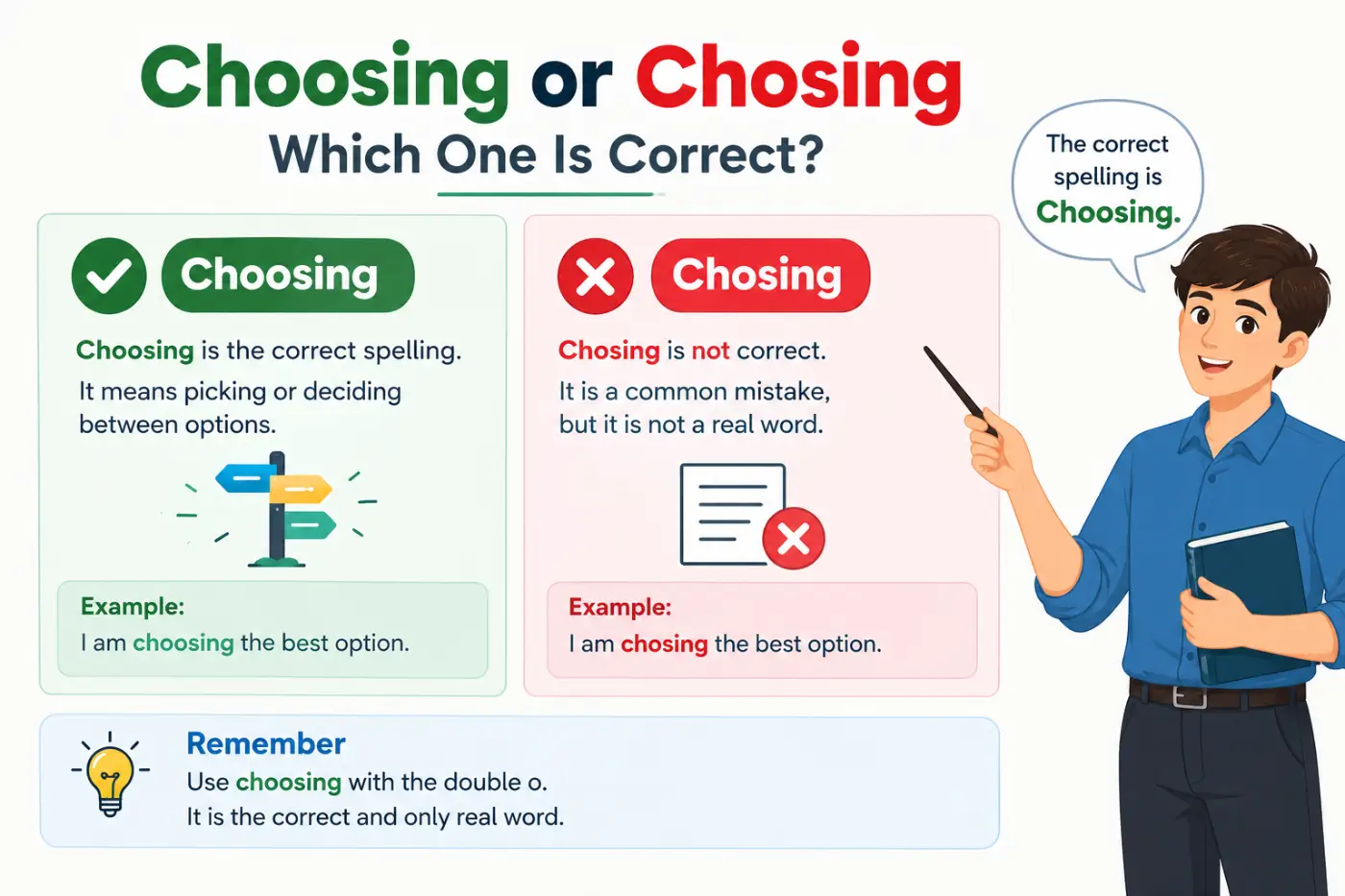
The correct spelling is choosing. The word “chosing” is a misspelling in standard English. You use “choosing” when you talk about selecting a person, an object, an idea, or an action from two or more possibilities.
Understanding the spelling rule will help you write more accurately in school assignments, professional documents, emails, and everyday messages. This guide explains the meaning and origin of the word, the spelling rule behind it, useful synonyms, real examples, common mistakes, and answers to frequently asked questions.
Is Choosing or Chosing the Correct Spelling?
Choosing is the correct spelling in standard English. Chosing is incorrect because it leaves out the second letter o from the base verb choose.
The verb “choose” becomes “choosing” when you add “-ing.” You keep the final e in this case because the word ends with “oo” followed by “se,” and the spelling changes by removing only the final e.
| Spelling | Correct or incorrect | Explanation |
|---|---|---|
| Choosing | Correct | The standard present participle of choose. |
| Chosing | Incorrect | Missing the second o in the original word. |
| Choose | Correct | The base form of the verb. |
| Chose | Correct | The simple past tense of choose. |
| Chosen | Correct | The past participle of choose. |
| Chooses | Correct | The third person singular present tense. |
Why do people write chosing instead of choosing?
People often misspell the word because they remember its pronunciation but not its complete spelling. When speaking quickly, the two vowel letters in “choose” can feel like one sound. This makes it easy to leave out one o while typing.
Another reason is confusion about how English verbs change before the ending “-ing” is added. Some verbs drop a final e, while others double a consonant. Writers may remember one of these rules but apply it incorrectly.
For example, “make” becomes “making,” but “choose” becomes “choosing.” Both words lose a final e, yet the letters before that e are different.
The safest approach is to remember the complete base word first. Once you know that “choose” contains two o’s, you can build the correct spelling of “choosing” from it.

What Does Choosing Mean in Simple English?
Choosing means selecting something or someone from the available options. It describes the action of making a decision or expressing a preference.
For example:
- I am choosing a book to read.
- She is choosing a college for next year.
- We are choosing a new name for our business.
In each sentence, someone makes a decision or selects a possible course of action.
What is the difference between choosing and deciding?
These words are closely related, but they don’t always mean exactly the same thing.
Choosing usually focuses on selecting one option from several possibilities. Deciding focuses more broadly on reaching a conclusion or making up your mind.
Consider these examples:
| Word | Example | Main idea |
|---|---|---|
| Choosing | I am choosing a blue shirt. | Selecting one item. |
| Deciding | I am deciding what to wear. | Reaching a decision. |
| Selecting | She is selecting three applicants. | Picking according to a purpose or standard. |
Where Does the Word Choosing Come From?
The word “choosing” comes from the verb “choose,” which has a long history in English. Its older forms developed from Germanic languages, including Old English, where related forms carried the idea of selecting, deciding, or testing options.
Over time, the spelling and pronunciation changed, but the basic meaning remained connected to making a selection.
The ending “-ing” is used in English to form a present participle and a gerund. It helps express an action in progress or turn an action into the subject of a sentence.
Look at these examples:
- Present participle: She is choosing a dress.
- Gerund: Choosing the right dress takes time.
- Part of a descriptive phrase: The choosing process was difficult.
How is choosing formed from choose?
The word follows a straightforward spelling pattern.
| Step | Form | What happens |
|---|---|---|
| 1 | Choose | Start with the base verb. |
| 2 | Choosing | Remove the final e and add -ing. |
| 3 | Choosing a course | Use the resulting form in a sentence. |
What Is the Spelling Rule for Adding ING to Choose?
To form “choosing,” remove the final e from “choose” and add “-ing.” Do not remove either of the two o’s.
The word contains the letters c, h, o, o, s, and e. When the final e is removed and the ending is added, the result is c, h, o, o, s, i, n, g.
This gives you the correct form: choosing.
How does choosing compare with other ING words?
English verbs can change in several ways when “-ing” is added. Understanding the differences can help you avoid spelling errors.
| Base verb | ING form | Spelling pattern |
|---|---|---|
| Choose | Choosing | Remove final e. |
| Write | Writing | Remove final e. |
| Make | Making | Remove final e. |
| Take | Taking | Remove final e. |
| Read | Reading | Add -ing without removing a letter. |
| Help | Helping | Add -ing without removing a letter. |
| Run | Running | Double the final consonant. |
| Sit | Sitting | Double the final consonant. |
| Lie | Lying | Change ie to y before adding -ing. |
Why doesn’t choosing have one o?
The two o’s belong to the base word “choose.” They represent the vowel spelling used in the word. Removing one of them would change the spelling of the original verb.
English spelling doesn’t work by removing whichever letters seem unnecessary. Each word has an established spelling that must be preserved unless a recognized spelling rule changes it.
For this reason, “chosing” isn’t a shorter accepted version. It’s simply an error.
What Are the Best Synonyms for Choosing?
The best synonym depends on what you’re trying to say. “Selecting” works well in formal situations, “picking” sounds natural in everyday conversation, and “opting” emphasizes making a preference or decision.
The following table provides 28 useful alternatives, grouped by tone and context. Some words are close synonyms, while others describe a particular kind of selection.
Simple synonyms for choosing
| Word | Meaning | Tone | Example |
|---|---|---|---|
| Picking | Taking one option | Casual | I’m picking a movie. |
| Taking | Accepting or selecting something | Everyday | She’s taking the blue folder. |
| Deciding | Reaching a conclusion | Neutral | We’re deciding what to eat. |
| Going with | Selecting one option | Casual | I’ll go with the first design. |
| Keeping | Retaining one option | Neutral | He’s keeping the original plan. |
| Favoring | Showing a preference | Neutral | The teacher is favoring the simpler answer. |
| Preferring | Liking one option more | Neutral | I’m preferring the quieter room in this situation. |
Everyday synonyms for choosing
| Word | Meaning | Tone | Example |
|---|---|---|---|
| Selecting | Picking from available options | Neutral | She is selecting a new phone. |
| Opting | Making a particular choice | Neutral | He’s opting for a later flight. |
| Settling on | Finally deciding after consideration | Conversational | We’ve settled on a restaurant. |
| Going for | Choosing something appealing | Informal | She’s going for the green dress. |
| Naming | Identifying a person or item for a role | Neutral | They’re naming a team captain. |
| Preferring over | Favoring one option compared with another | Neutral | He prefers walking over driving. |
| Nominating | Putting forward a candidate | Formal or neutral | They’re nominating a new chairperson. |
Formal synonyms for choosing
| Word | Meaning | Tone | Example |
|---|---|---|---|
| Electing | Selecting by voting | Formal | Members are electing a president. |
| Appointing | Assigning someone to a position | Formal | The board is appointing a director. |
| Designating | Officially identifying for a purpose | Formal | The city is designating a new site. |
| Determining | Establishing a decision or outcome | Formal | Researchers are determining the best method. |
| Identifying | Recognizing or specifying an option | Professional | The team is identifying suitable candidates. |
| Shortlisting | Reducing a group to leading candidates | Professional | HR is shortlisting applicants. |
| Prioritizing | Giving something greater importance | Professional | We’re prioritizing customer needs. |
Which Synonyms for Choosing Are Mild and Which Are Strong?
Words for selecting can communicate different levels of commitment, effort, or authority. Some describe a simple preference, while others suggest a final decision or an official appointment.
The following scale is a practical guide rather than a strict ranking. The intensity of a word depends on its context.
| Intensity | Word | What it suggests | Example |
|---|---|---|---|
| Mild | Considering | Exploring possible options | I’m considering another course. |
| Mild | Preferring | Leaning toward one option | She is preferring the earlier time. |
| Mild | Favoring | Showing a tendency toward something | The team is favoring the second plan. |
| Moderate | Picking | Making a straightforward selection | He’s picking a seat. |
| Moderate | Selecting | Choosing from available options | They’re selecting new members. |
| Moderate | Opting for | Making a deliberate preference | I’m opting for the smaller package. |
| Firm | Settling on | Reaching a decision after thought | We’ve settled on a title. |
| Firm | Deciding on | Reaching a conclusion | She’s deciding on a university. |
| Strong | Committing to | Making a firm decision | They’re committing to the new schedule. |
| Strong | Locking in | Confirming a choice | We’re locking in the date. |
| Official | Appointing | Assigning an official role | The board is appointing a manager. |
| Official | Electing | Selecting through a vote | Voters are electing a representative. |
If you’re still weighing alternatives, “considering” or “favoring” may be more accurate than “choosing.” If the decision is final, “settling on” or “committing to” may communicate that clearly.
Be careful with words that suggest official authority. You can choose a team leader informally, but appointing a department head may require authorization.
Can Choosing Be Used as Different Parts of Speech?
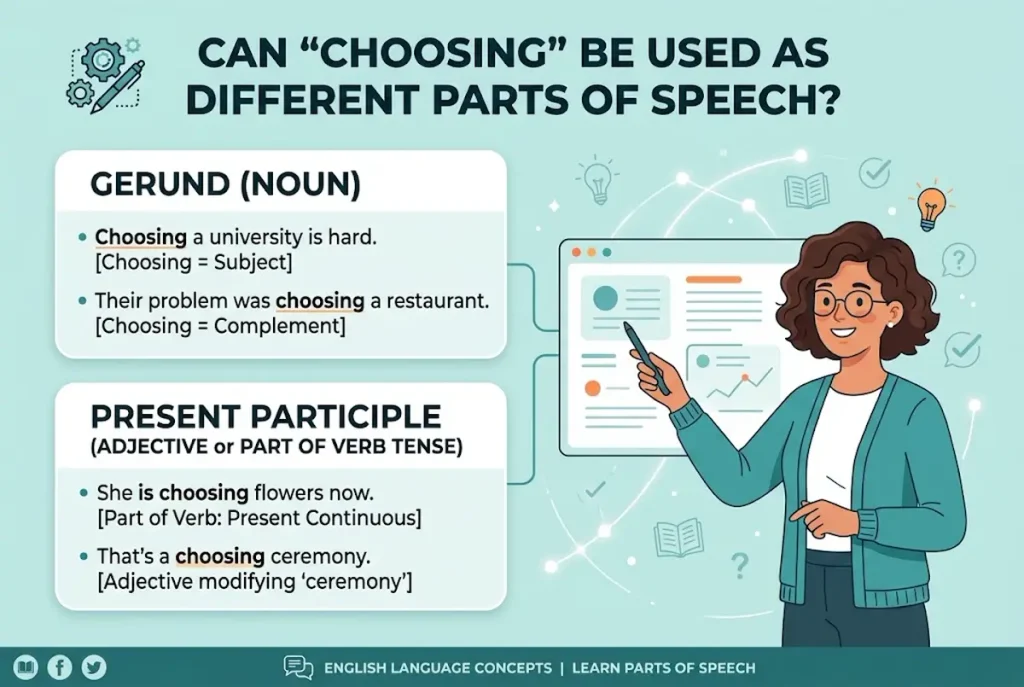
Yes. “Choosing” can function as a present participle or a gerund. Its grammatical role depends on how it appears in the sentence.
Choosing as a present participle
A present participle commonly appears with a form of “be” to describe an action in progress.
Examples:
- I am choosing a new laptop.
- They are choosing their representatives.
- She was choosing a topic when the teacher arrived.
In these sentences, the word helps form a continuous verb phrase.
Choosing as a gerund
A gerund is a verb form ending in “-ing” that functions as a noun.
Examples:
- Choosing takes patience.
- She enjoys choosing outfits.
- Choosing carefully can prevent mistakes.
Here, the word names an activity rather than simply describing an action in progress.
Choosing as part of a phrase
The word can also appear in a phrase that describes how someone makes a selection.
Examples:
- We are choosing between two apartments.
- He is choosing from several candidates.
- They are choosing according to the budget.
These examples show that the grammar around the word can change, but the spelling remains the same.
Is Choosing Spelled Differently in American and British English?
No. “Choosing” is spelled the same way in American English and British English. The incorrect form “chosing” isn’t a standard regional alternative in either variety.
American and British English differ in many spellings. For example, Americans usually write “color,” while British writers usually write “colour.” Both use “choosing.”
| Word or phrase | American English | British English |
|---|---|---|
| Choosing | Choosing | Choosing |
| Choose | Choose | Choose |
| Chose | Chose | Chose |
| Chosen | Chosen | Chosen |
| Color | Color | Colour |
| Traveling | Traveling | Travelling |
| Organize | Organize | Organise, also accepted variants depending on style |
What Is the Best Word for Choosing in Different Contexts?
The right word depends on the audience, purpose, and tone of your writing. A resume may call for “selected,” while a text message may sound more natural with “picked.” The original word is still perfectly suitable in many situations.
What word should you use for choosing on a resume?
On a resume, use “selected,” “appointed,” “identified,” or “prioritized” when the word accurately describes your responsibilities or achievements.
Professional writing benefits from specific verbs that explain what you did and why it mattered.
Example:
- Basic: I was choosing suitable candidates for interviews.
- Stronger: I selected qualified candidates for interviews.
What word should you use for choosing in an essay?
For an academic essay, “selecting,” “deciding,” “opting for,” and “determining” may work well, depending on the meaning.
Example:
“Students are choosing their research topics based on personal interest.”
You could write:
“Students are selecting research topics based on personal interest.”
Both sentences are correct. “Selecting” may sound slightly more formal, but “choosing” is not too informal for academic writing.
If you’re explaining a process, “determining” may be appropriate. If you’re describing a preference, “opting for” may be more accurate.
What word should you use for choosing in a text message?
For texting, “picking,” “going with,” and “settling on” sound natural.
Examples:
- I’m picking the blue one.
- Let’s go with pizza.
- I’ve settled on the earlier time.
You don’t need a formal synonym in a casual conversation. The simplest word is often the clearest.
If you’re asking someone to make a decision, you could write:
“Have you picked a place for dinner yet?”
This sounds natural and friendly.
What word should you use for choosing in an email?
In an email, the best alternative depends on the recipient and the purpose of the message.
For a coworker, “selecting” or “going with” may be appropriate. For a formal business email, “selected,” “decided on,” or “identified” may sound more precise.
Example:
“We are choosing the final design this afternoon.”
A more polished version could be:
“We will select the final design this afternoon.”
Both are correct. The second version places slightly more emphasis on the planned selection.
For a completed decision, you could write:
“We have selected the final design for the campaign.”
This makes it clear that the decision is complete.
What word should you use for choosing in everyday speech?
In everyday conversation, “choosing,” “picking,” and “going with” are all useful.
Examples:
- I’m choosing the chicken sandwich.
- I’m picking the chicken sandwich.
- I’ll go with the chicken sandwich.
The third sentence is especially natural when ordering food or making a quick decision.
What Are 12 Correct Example Sentences With Choosing?
Examples make spelling rules easier to remember because they show how a word works in different situations.
- I am choosing a new notebook for my English class.
- She is choosing between two job offers.
- We are choosing a date for the family reunion.
- The committee is choosing a leader for the next project.
- He spent the afternoon choosing photos for his portfolio.
Notice that the word appears in different sentence structures. It can describe an action happening now, an activity, or a selection process.
How do you use choosing in a question?
You can use the word naturally in questions about decisions and preferences.
- Are you choosing a major this semester?
- Why are they choosing that location?
- Have you finished choosing the songs?
These questions are useful in conversations, schoolwork, and professional settings.
How do you use choosing in negative sentences?
To make a negative sentence, use the appropriate form of “be” or another helping verb.
Examples:
- I am not choosing the expensive option.
- She isn’t choosing a college yet.
- They weren’t choosing randomly.
The spelling doesn’t change in negative sentences. Only the surrounding words change.
What Is the Difference Between Choosing and Selecting?
“Choosing” and “selecting” both describe picking an option, but “selecting” can sound more systematic or formal.
| Choosing | Selecting |
|---|---|
| Common in everyday conversation. | Common in professional and technical settings. |
| Can emphasize personal preference. | Can emphasize criteria or a process. |
| Works in casual and formal writing. | Often sounds more formal. |
| Example: I’m choosing a movie. | Example: The panel is selecting a winner. |
What Is the Difference Between Choosing and Deciding?
“Choosing” usually highlights the selection of an option. “Deciding” emphasizes reaching a conclusion, although the two words often overlap.
| Choosing | Deciding |
|---|---|
| Focuses on selecting an option. | Focuses on reaching a conclusion. |
| Often used with available alternatives. | Can involve a broad question or course of action. |
| Example: I’m choosing a dress. | Example: I’m deciding what to wear. |
| Example: She’s choosing a new phone. | Example: She’s deciding if she needs a new phone. |
What Are the Common Mistakes With Choosing?
The most common mistake is writing “chosing” instead of “choosing.” However, there are other errors related to the base verb and its different forms.
Leaving out one o
Incorrect: I am chosing a topic for my essay.
Correct: I am choosing a topic for my essay.
The correct form retains both o’s from “choose.”
Confusing choosing with chose
Incorrect: Yesterday, I am choosing a new phone.
Correct: Yesterday, I chose a new phone.
“Chose” is the simple past tense. “Choosing” is an “-ing” form used in continuous verb phrases and other grammatical structures.
Confusing choosing with chosen
Incorrect: I have choosing the final design.
Correct: I have chosen the final design.
“Chosen” is the past participle used with helping verbs such as “have,” “has,” and “had.”
What Are the Antonyms of Choosing?
An antonym is a word with an opposite or contrasting meaning. Since choosing involves selecting or making a decision, its opposites often describe refusing, rejecting, or avoiding a selection.
| Antonym or contrasting phrase | Meaning | Example |
|---|---|---|
| Rejecting | Refusing to accept an option | She is rejecting the first offer. |
| Declining | Politely refusing | He is declining the invitation. |
| Refusing | Saying no to something | They are refusing the proposal. |
| Avoiding | Staying away from a decision or option | I’m avoiding that route. |
| Discarding | Removing an option from consideration | We’re discarding the outdated design. |
| Postponing | Delaying a decision | She’s postponing the final selection. |
| Remaining undecided | Not reaching a conclusion | I’m remaining undecided until Friday. |

How Can You Remember the Correct Spelling of Choosing?
A simple memory technique can prevent this spelling mistake.
Remember the base word
Start with “choose.” Notice the two o’s. Then remove the final e and add “-ing.”
Choose → Choosing.
This is the most reliable way to remember the spelling because it connects the longer form to the original verb.
Compare the word with chose
The words “choose” and “chose” look similar, but they have different vowel patterns.
- Choose: present or base form.
- Chose: simple past tense.
- Chosen: past participle.
Learning the full set makes it easier to recognize the correct form in a sentence.
Read the complete sentence
Before correcting a spelling error, check the verb tense and grammar.
For example:
- I choose my clothes every morning.
- I chose my clothes yesterday.
- I have chosen my clothes already.
Each form has a different role, but none is spelled “chosing.”
Conclusion
The correct spelling is “choosing,” and the incorrect form “chosing” should be avoided in standard English. The difference comes down to keeping the two o’s in the base verb “choose” while removing the final e before adding “-ing.”
Once you understand this pattern, it’s easier to distinguish “choosing” from related forms such as “chose” and “chosen.” You can also select useful alternatives such as “picking,” “selecting,” or “deciding,” depending on the situation and tone.
For school assignments, professional documents, and everyday messages, focus on the meaning you want to express. Use the simplest word that communicates your idea accurately. If you’re ever unsure about the spelling, return to the base verb and build the correct form from there. A small proofreading habit can help you catch this mistake before it reaches your reader.
Frequently Asked Questions
Is choosing or chosing correct?
Choosing is correct, while chosing is a misspelling. The correct form keeps both o’s in the base word choose.
Why does choosing have two o’s?
Choosing retains the two o’s from the base verb choose. You remove only the final e before adding “-ing.”
What’s another way to say choosing?
You can use selecting, picking, deciding, opting for, or settling on. The best alternative depends on the situation and the exact meaning you want.
Is choosing a real English word?
Yes, choosing is a standard English word. It can function as a present participle in a continuous verb phrase or as a gerund that names an activity.
What is the past tense of choosing?
The simple past tense of choose is chose. For example, “I chose the blue shirt yesterday.”

Daniel Grammarfield — The Language Learner
Age: 28Occupation: ESL Learner & Digital Professional
Bio:Daniel is a non-native English speaker who wants to communicate more confidently at work and online. He uses Synotrench to improve grammar, understand confusing words, learn correct sentence structures, and build everyday English skills. He prefers simple explanations with practical examples.
Goals:
Master English grammar rules
Avoid common language mistakes
Improve professional communication
Learn English through real-life examples
Quote:“Learning English is not about memorizing rules — it’s about expressing ideas clearly.”
3 thoughts on “Choosing or Chosing: The Best Spelling Guide (2026)”