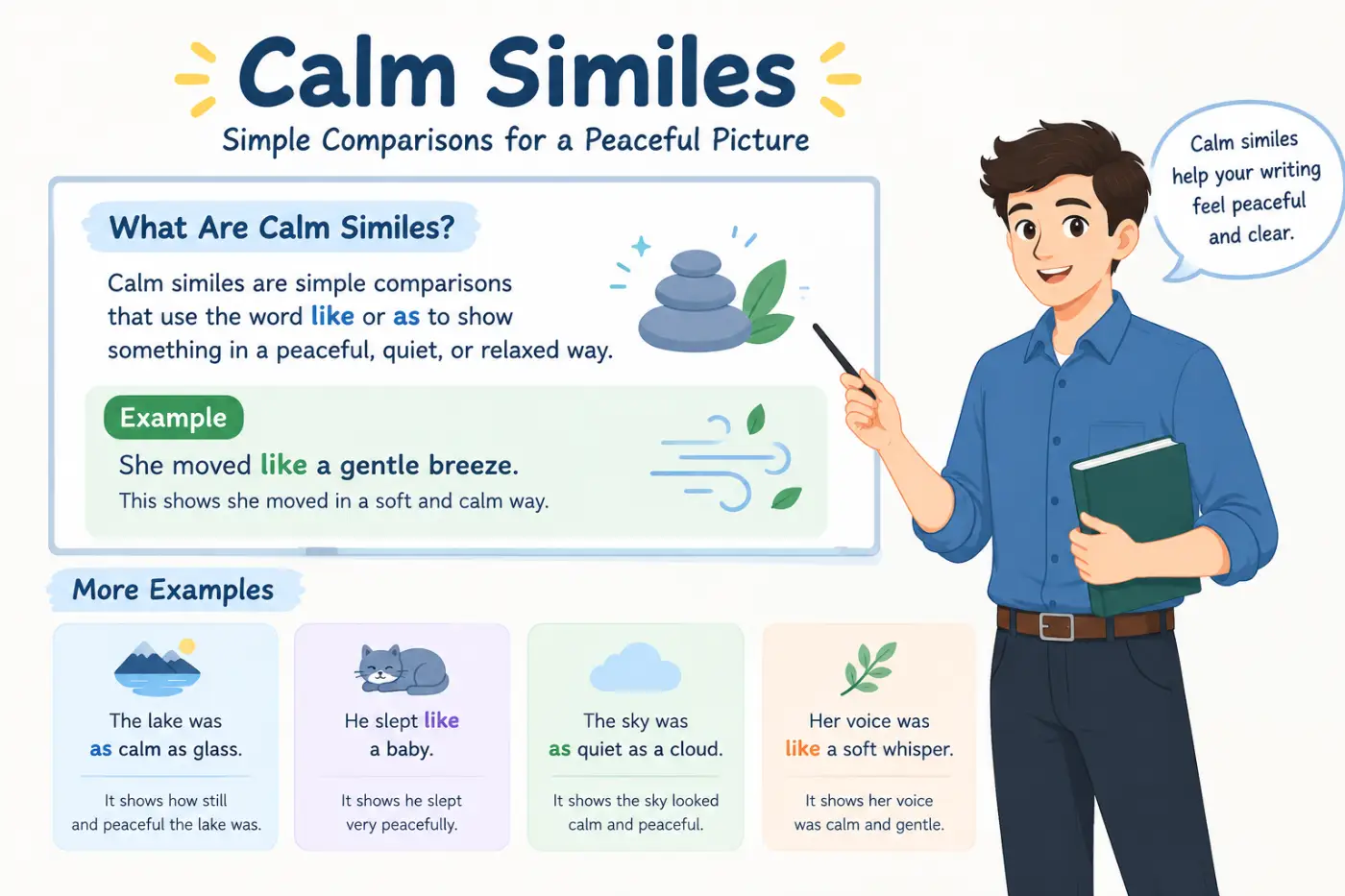
When you’re writing an email, essay, resume, text, or story, you may want to describe a peaceful feeling without repeating words like calm, quiet, or relaxed. A well chosen comparison can make your writing feel more natural and vivid. Calm Similes help readers picture a peaceful person, place, moment, sound, or mood.
A simile compares two different things by using words such as like or as. For example, you can say, “She was as calm as a still lake.” The reader immediately gets a picture of someone who is peaceful, steady, and not easily disturbed.
These are comparisons that describe peace, quietness, relaxation, patience, emotional control, or stillness. They can make simple writing more descriptive without making it complicated.
This guide explains the meaning and origin of calm comparisons, gives you more than 30 useful alternatives, organizes them by tone and intensity, and shows how to use them in essays, emails, resumes, texts, stories, and everyday speech.
What are calm similes?
Calm similes are comparisons that show a peaceful, relaxed, quiet, or emotionally steady quality. They usually connect a person, place, action, sound, or feeling to something that naturally suggests peace.
For example:
He was as calm as a lake at dawn.
The person is not literally a lake. The comparison tells us that he was quiet, steady, and peaceful.
Another example is:
Her voice was as soft as a summer breeze.
This comparison describes a gentle voice without simply saying that the voice was quiet.
Similes work because they give readers something familiar to picture. Instead of only telling someone that a person is calm, a comparison can show what that calmness feels like.
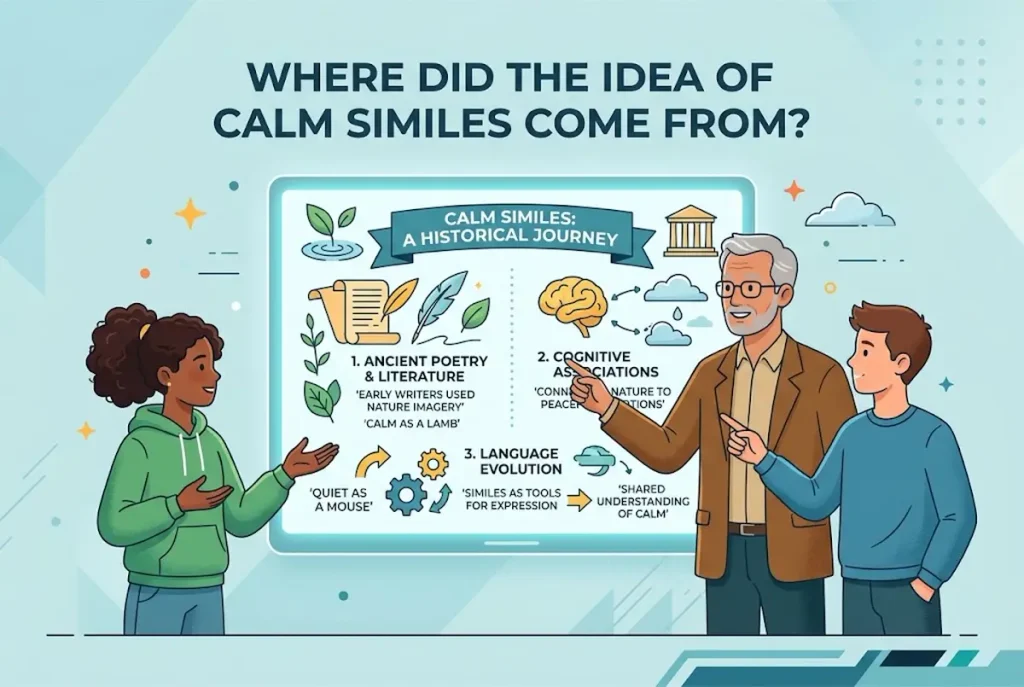
Where did the idea of calm similes come from?
The word simile comes from the Latin word similis, meaning similar or like. English writers have used comparisons for centuries to make descriptions clearer and more memorable.
Comparisons are especially common in poetry, stories, speeches, and everyday conversation. Writers have long compared peaceful scenes to nature because nature gives us many familiar examples of stillness.
A quiet lake, gentle breeze, sleeping child, soft cloud, peaceful garden, and calm sea can all suggest different forms of peace.
The basic structure is simple:
| Pattern | Example |
|---|---|
| as + adjective + as | as calm as a lake |
| like + noun | peaceful like a quiet garden |
| as + adjective + as + image | as still as a pond at sunrise |
| verb + like + noun | she moved like a gentle breeze |
Not every comparison has to use the exact word calm. A writer can communicate calmness through ideas such as stillness, softness, patience, silence, balance, or peace.
What is the plain meaning of words?
In plain English, a calm simile is a comparison that helps someone imagine peace or emotional control.
For example:
| Sentence | What it means |
|---|---|
| He was as calm as a still pond. | He was very peaceful and controlled. |
| Her voice was like a soft breeze. | Her voice was gentle and soothing. |
| The room was as quiet as a sleeping village. | The room was extremely quiet. |
| She sat like a statue. | She remained very still. |
| His mind was as peaceful as a quiet garden. | He felt relaxed and free from stress. |
The best comparison depends on the kind of calm you want to describe.
A person who stays calm during an emergency is showing self control. A quiet lake represents stillness. A soft breeze represents gentleness. A sleeping child can represent peacefulness.
That difference matters because not every peaceful comparison creates the same image.
What are the best calm similes?
The best comparison depends on your audience, purpose, and tone. Some are simple enough for everyday conversation, while others work better in creative writing.
Here is a broad list of useful choices.
| Word or phrase | Meaning | Tone | Example |
|---|---|---|---|
| peaceful | free from disturbance | Simple | The park felt peaceful. |
| quiet | making little noise | Simple | The room was quiet like a library. |
| still | without movement | Simple | The water was as still as glass. |
| relaxed | free from tension | Simple | He looked relaxed like someone on vacation. |
| gentle | soft and mild | Simple | Her voice was gentle like a breeze. |
| serene | deeply peaceful | Everyday | The lake looked serene at sunrise. |
| tranquil | calm and undisturbed | Everyday | The garden was tranquil like a hidden retreat. |
| restful | helping someone relax | Everyday | The beach was as restful as a quiet dream. |
| soothing | making someone feel calm | Everyday | His voice was soothing like rain. |
| composed | emotionally controlled | Formal | She remained composed during the interview. |
| collected | calm and organized | Formal | He stayed collected during the discussion. |
| quiet as a mouse | very quiet | Everyday | The children became quiet as mice. |
| soft as a cloud | gentle and soft | Everyday | Her voice was soft as a cloud. |
| calm as the sea | peaceful and steady | Everyday | He looked calm as the sea. |
| cool as a cucumber | relaxed under pressure | Everyday | She stayed cool as a cucumber. |
| smooth as glass | completely smooth or undisturbed | Everyday | The water was smooth as glass. |
Some of these are traditional simile patterns. Others are flexible creative comparisons. You can adapt them to fit your sentence instead of copying them word for word.
Which are mild and which are strong?
Not every peaceful comparison has the same emotional strength. Choosing the right level makes your writing sound more natural.
Mild calm
Use mild comparisons when someone is relaxed but still active.
Examples:
- He was relaxed like a Sunday morning.
- Her voice was gentle like a light breeze.
- The baby was peaceful as a sleeping child.
- She spoke quietly like someone in a library.
These comparisons suggest ordinary peace rather than complete silence.
Moderate calm
Use stronger images when you want the reader to notice a deeper sense of peace.
Examples:
- He was as calm as a still lake.
- Her mind was peaceful like a quiet garden.
- The room was quiet as snowfall.
- The river rested smooth as glass.
These create a clearer visual picture.
Very strong calm
For extreme stillness or emotional control, use powerful images.
Examples:
- He remained as calm as a mountain during the storm.
- She was as still as a statue.
- His expression stayed as peaceful as a moonlit lake.
- The village became as silent as an empty field at midnight.
Strong comparisons should be used carefully. If every sentence describes extreme calm, the writing can feel dramatic or unnatural.
Which calm comparisons work as different parts of speech?
Similes are usually full phrases rather than single synonyms, but the word surrounding the comparison can change its grammatical role.
Adjectives
Adjectives describe a person, place, thing, or feeling.
Examples:
- calm
- peaceful
- serene
- tranquil
- composed
- relaxed
- still
Sentence:
She looked as serene as a quiet lake.
Adverbs
Adverbs describe how someone performs an action.
Examples:
- calmly
- peacefully
- quietly
- gently
- steadily
Sentence:
He answered as calmly as a teacher explaining an easy lesson.
Nouns
Nouns can name the quality itself.
Examples:
- peace
- stillness
- serenity
- tranquility
- quietness
Sentence:
The stillness of the forest felt like a peaceful dream.
Verb phrases
Some comparisons describe an action rather than a person or object.
Examples:
The leaves moved like a gentle wave.
She breathed like someone waking from a peaceful sleep.
He waited like a statue.
The grammatical choice depends on what you want the comparison to describe.
Are words different in American and British English?
The basic idea is the same in American and British English. Similes such as “as calm as a lake” and “as quiet as a mouse” are understood in both varieties.
The main difference may come from vocabulary, cultural references, and preferred expressions.
For example, “cool as a cucumber” is familiar in both American and British English. Casual expressions can vary more by region, especially slang.
For American readers, simple nature based comparisons usually work well:
- as calm as a lake
- as quiet as snowfall
- like a gentle breeze
- as still as a statue
- relaxed like a Sunday morning
If you are writing for a broad English speaking audience, choose a comparison that most readers can understand immediately.
Avoid highly local slang unless you know your audience well.
What is the best calm simile for a resume?
A resume usually needs professional language, so creative comparisons should be used sparingly. A resume is not normally the place for phrases such as “as peaceful as a sleeping garden.”
Professional terms such as composed, steady, patient, and calm are usually better.
For example:
I remain composed and focused during demanding situations.
Or:
I maintain a calm and professional approach when handling customer concerns.
If you use a comparison in a personal profile, keep it subtle:
I bring the steady focus of a lighthouse to challenging projects.
This can work in creative industries, but a direct professional description is safer for most resumes.
What is the best calm simile for an essay?
Essays can use more descriptive language, especially personal essays, literature assignments, and creative nonfiction.
Good choices include:
The lake was as still as glass before sunrise.
Her voice was soft like falling rain.
He remained as calm as a mountain while everyone else panicked.
For an academic essay, make sure the comparison supports your point. Don’t add a poetic sentence simply to make the paragraph sound fancy.
What is the best calm simile for texting?
Text messages usually work best with short, familiar comparisons.
Examples:
I was calm as a cucumber during the whole thing.
He was chill like it was nothing.
The place was quiet as a library.
I feel relaxed like it’s Sunday morning.
Casual texting allows more creativity than formal writing. Slang can work when it matches the people and situation.
What is the best calm simile for email?
For professional emails, keep the comparison clear and restrained.
Instead of:
I was calm as a sleeping cat during the meeting.
Try:
I remained as calm as possible during the discussion.
For a friendly personal email, you can be more expressive:
After the trip, I felt relaxed like it was a quiet Sunday morning.
The relationship with the reader should guide your choice.
What is the best calm simile for speaking?
In conversation, familiar comparisons sound the most natural.
Good examples include:
She stayed cool as a cucumber.
He was calm as a lake.
The baby was quiet as a mouse.
I felt relaxed like it was Sunday morning.
Short comparisons are easier to understand when spoken. Avoid very elaborate images unless you’re telling a story or joking with friends.

What are some original examples of calm similes?
The following examples show how comparisons can work in different situations.
Calm people
- He stayed as calm as a still lake while everyone else rushed around.
- She was cool as a cucumber during the difficult interview.
- My father remained steady as a lighthouse when the family needed help.
- The teacher was as composed as a statue during the noisy meeting.
- He answered the difficult question as calmly as someone reading a bedtime story.
Calm places
- The small village was as quiet as snowfall before sunrise.
- The garden felt peaceful like a hidden corner of the countryside.
- The beach was as still as glass early in the morning.
- The library was quiet as a sleeping house.
- The forest felt peaceful like a room filled with soft music.
These examples show an important point: calmness can describe behavior, sound, movement, emotion, or surroundings.
Calm as a lake vs calm as a mountain
Both comparisons suggest peace, but they create different images.
| Comparison | Main idea | Best use |
|---|---|---|
| as calm as a lake | peaceful, smooth, quiet | emotions, places, faces |
| as calm as a mountain | strong, stable, unaffected | people under pressure |
Consider these sentences:
She was as calm as a lake.
This suggests softness and peacefulness.
She was as calm as a mountain.
This suggests strength and stability.
Choose the lake when you want gentle peace. Choose the mountain when you want emotional strength.
Quiet as snowfall vs quiet as a library
Both comparisons describe low noise, but they feel different.
| Comparison | Feeling | Example |
|---|---|---|
| quiet as snowfall | poetic, natural, soft | The forest was quiet as snowfall. |
| quiet as a library | familiar, direct, practical | The classroom became quiet as a library. |
“Quiet as snowfall” creates an image. “Quiet as a library” communicates the idea quickly.
For creative writing, the first may be more effective. For everyday communication, the second is often clearer.
What are common mistakes?
Using a comparison that does not match the meaning
A writer may choose a strong image that suggests something different from calmness.
For example, “as calm as a roaring waterfall” is confusing because a roaring waterfall is powerful and noisy.
Choose an image that naturally supports the feeling you want.
Mixing two comparisons
Avoid sentences like:
She was as calm as a lake like a quiet breeze.
Two separate comparisons have been forced into one sentence.
Use one:
She was as calm as a lake.
Or:
Her voice was gentle like a breeze.
Using too many poetic comparisons
Creative writing can become difficult to read if every sentence contains a simile.
Compare:
The room was as quiet as snowfall. The chairs were like sleeping animals. The light was as soft as a cloud. The walls stood like silent mountains.
This may feel overloaded.
A better paragraph mixes direct description with one or two strong comparisons.
Using slang in formal writing
Expressions such as “chill as a lazy afternoon” may work in a text message but sound too casual in a business report.
Always consider your audience.
Choosing a cliché when a fresh image would be better
Some comparisons are so familiar that they may feel ordinary. Familiar expressions are not wrong, but creative writing sometimes benefits from a more specific image.
Instead of:
He was as quiet as a mouse.
You could write:
He sat as quietly as a leaf resting on still water.
The second comparison creates a more specific picture.
When should you not use a calm simile?
You don’t need a simile every time you describe peace.
Use direct language when clarity matters most.
For example, in an emergency report:
The employee remained calm during the incident.
This is clearer than:
The employee was as calm as a quiet lake during the incident.
In a technical document, a direct statement is usually better.
In a poem or story, the comparison may be more useful.
The goal is not to make every sentence colorful. The goal is to choose the clearest language for the situation.
What are the antonyms of calm?
Understanding opposites can help you choose the right comparison.
| Calm quality | Opposite |
|---|---|
| peaceful | disturbed |
| quiet | noisy |
| relaxed | tense |
| serene | troubled |
| composed | upset |
| still | moving |
| gentle | rough |
| patient | impatient |
| steady | unstable |
| tranquil | chaotic |
For example, if a scene changes from calm to chaotic, you can make the contrast stronger:
The lake was as calm as glass before the storm arrived.
Then:
Minutes later, the water became wild and restless.
The contrast makes both descriptions more effective.
How do you choose the right calm simile?
Start by asking what kind of calmness you mean.
Choose a nature comparison for peaceful settings
Use lakes, gardens, clouds, rain, rivers, forests, and breezes.
Example:
The morning was peaceful like a quiet garden.
Choose a strong object for emotional control
Use mountains, lighthouses, statues, or solid structures.
Example:
She remained steady as a lighthouse during the crisis.
Choose a soft image for a gentle voice
Use rain, clouds, breezes, or morning light.
Example:
His voice was soft like falling rain.
Choose an everyday comparison for conversation
Use familiar expressions.
Example:
She stayed cool as a cucumber.
Choose a professional word for formal writing
Use composed, steady, controlled, or collected.
Example:
He remained composed throughout the interview.
What makes a calm simile effective?
A strong comparison usually has three qualities.
First, the image is easy to understand.
Second, the image matches the exact kind of calmness you want to show.
Third, the comparison fits the tone of the writing.
For example, “as calm as a lake” is simple and clear. “As calm as an empty mountain temple before dawn” is more literary. Both can work, but they belong in different contexts.
Specific details can also make comparisons stronger.
Instead of:
The lake was calm.
Try:
The lake was as smooth as glass beneath the early morning sky.
The reader can now picture the surface.
Why do words make writing stronger?
A direct adjective tells the reader something.
A good simile lets the reader picture it.
Compare:
The room was quiet.
with:
The room was quiet as snowfall.
The first sentence gives information. The second creates an image.
This doesn’t mean the second sentence is always better. Direct writing is often more effective. Similes are most useful when the image adds something meaningful.
They can also create mood.
A lake suggests peacefulness. A sleeping child suggests innocence. A lighthouse suggests stability. A gentle breeze suggests softness.
The image carries an emotional meaning beyond the basic adjective.

Quick tips for choosing the right comparison
- Decide what kind of calmness you mean.
- Think about the reader and the situation.
- Use familiar comparisons in everyday writing.
- Use stronger imagery in stories and creative essays.
- Keep professional writing direct.
- Avoid mixing unrelated comparisons.
- Don’t use several similes in every sentence.
- Make sure the image actually feels calm.
- Match the strength of the comparison to the emotion.
- Read the sentence aloud to see if it sounds natural.
- Choose a fresh image when a common cliché feels dull.
- Let the comparison support the sentence instead of taking over the paragraph.
Conclusion
The best calm simile does more than replace the word calm. It gives the reader an image that shows exactly what the calmness feels like. A lake can suggest peaceful stillness, a mountain can suggest strength, a breeze can suggest gentleness, and snowfall can suggest quietness.
Choose your comparison based on the situation. Use simple expressions in everyday speech and texts. Use vivid images in stories and descriptive essays. For resumes, reports, and professional emails, direct words such as composed, steady, and relaxed are often stronger choices.
The key is to make the comparison feel natural. A clear, well chosen image can turn an ordinary sentence into one that readers remember.
Frequently Asked Questions
What’s another way to say calm in a simile?
You can say “as calm as a still lake,” “as peaceful as a sleeping garden,” or “as quiet as snowfall.” The best choice depends on the type of calmness you want to show.
What is a good simile for a calm person?
A good example is “He was as calm as a still lake.” For someone who stays calm under pressure, “She was as steady as a lighthouse” is also effective.
What is a simile for a peaceful place?
A peaceful place can be described as “quiet as snowfall” or “peaceful like a sleeping garden.” These comparisons create a soft and quiet mental image.
What is a simile for a calm voice?
A calm voice can be described as “soft like falling rain” or “gentle like a summer breeze.” Both suggest a soothing and quiet sound.
Can I use word in an essay?
Yes, you can use them in personal, descriptive, and creative essays when the comparison supports your idea. In formal academic writing, use them only when they add meaning rather than decoration.
Is “cool as a cucumber” a simile for calm?
Yes. “Cool as a cucumber” is a familiar English simile meaning calm and relaxed, especially when someone remains calm under pressure.
What is the strongest simile for being calm?
There is no single strongest comparison. “As calm as a mountain” suggests powerful emotional stability, while “as still as a statue” suggests almost complete lack of movement.

Daniel Grammarfield — The Language Learner
Age: 28Occupation: ESL Learner & Digital Professional
Bio:Daniel is a non-native English speaker who wants to communicate more confidently at work and online. He uses Synotrench to improve grammar, understand confusing words, learn correct sentence structures, and build everyday English skills. He prefers simple explanations with practical examples.
Goals:
Master English grammar rules
Avoid common language mistakes
Improve professional communication
Learn English through real-life examples
Quote:“Learning English is not about memorizing rules — it’s about expressing ideas clearly.”