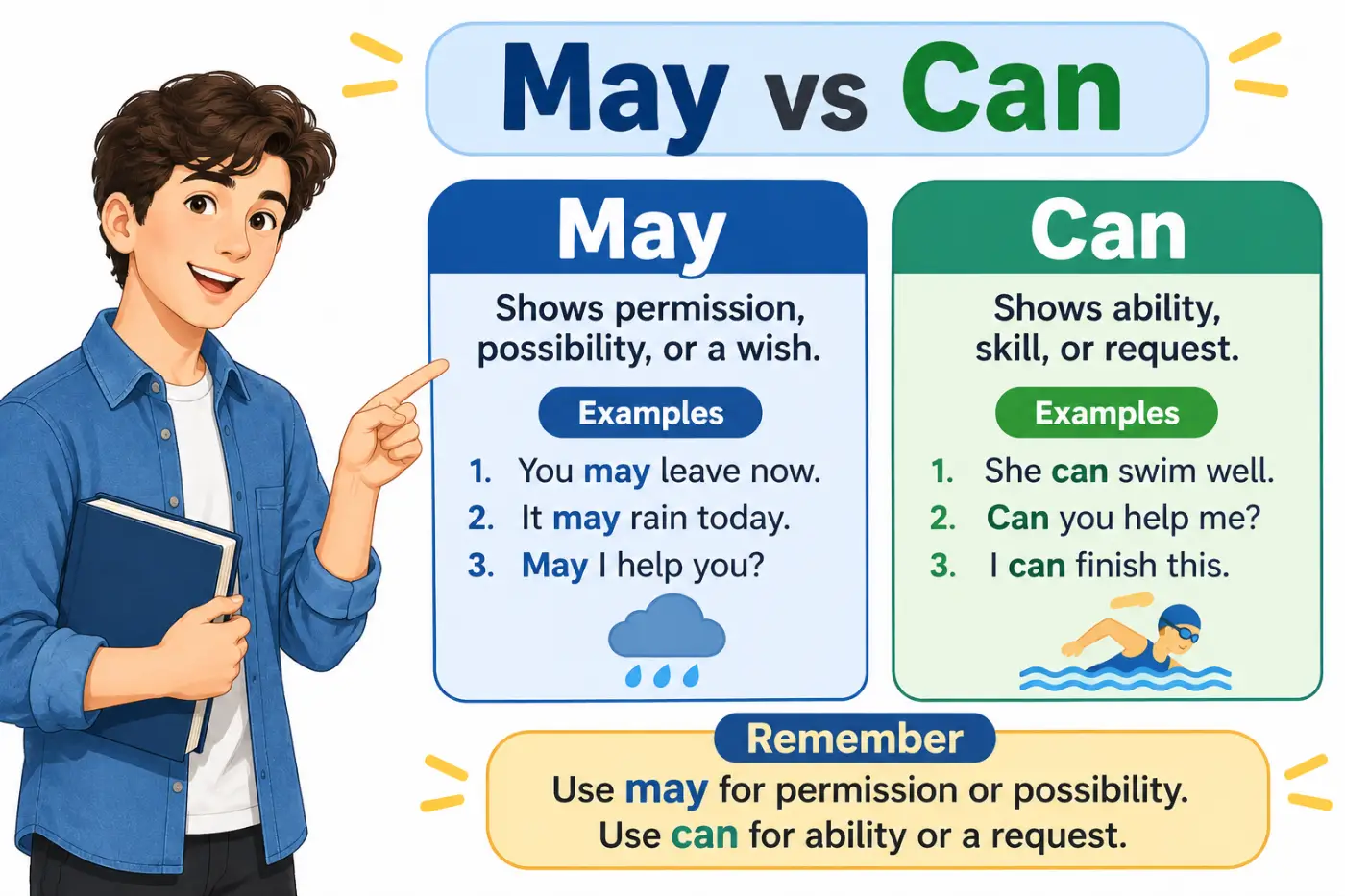
When writing May vs Can an email, completing a school assignment, or asking someone for permission, you may wonder which word sounds right: may or can. Both words are common in American English, but they don’t always express the same idea. Choosing the wrong one can make your sentence sound unclear or change its meaning.
The main difference is that may often expresses permission or possibility, while can usually expresses ability or possibility. For example, May I leave the classroom? asks for permission. Can I leave the classroom? can ask about permission in everyday conversation, but it can also refer to someone’s ability to leave.
May is commonly used to ask for or give permission and to express possibility. Can is mainly used to express ability and possibility, although people also use it to ask for permission in everyday English.
Understanding these differences will help you choose the right word in formal writing, casual conversations, professional emails, school essays, and daily communication. This guide explains their meanings, origins, examples, synonyms, common mistakes, and the situations in which each word works best.
What Do May and Can Mean in Simple English?
May and can are modal verbs. Modal verbs work with other verbs to express ideas such as ability, permission, possibility, advice, and obligation.
Although both words can express possibility, they have different common uses.
What Does May Mean?
May is a modal verb that commonly expresses permission or possibility. It can also introduce a polite request or a wish.
Examples:
- You may leave the room after finishing your work.
- It may rain this afternoon.
- May I borrow your notebook?
- She may join us for dinner.
- May your dreams come true.
What Does Can Mean?
Can is a modal verb that mainly expresses ability, permission, or possibility. It tells us that someone has the skill, power, or opportunity to do something.
Examples:
- I can speak three languages.
- Can you help me with this project?
- You can use my computer.
- We can finish the assignment today.
- Anyone can learn to write better.
What Is the Main Difference Between May and Can?
The main difference depends on what you want to communicate.
| Word | Main meaning | Common purpose | Example |
|---|---|---|---|
| May | Permission or possibility | Polite requests and uncertain situations | May I come in? |
| Can | Ability or possibility | Skills, opportunities, and everyday requests | Can you swim? |
What Is the Origin of May and Can?
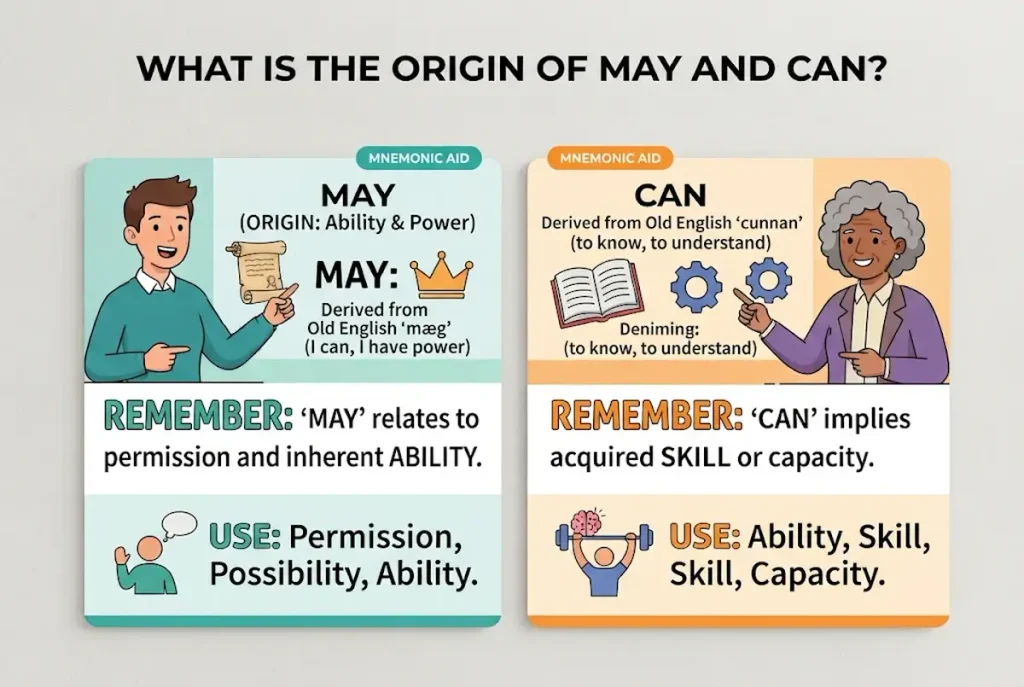
Understanding the history of these words makes their modern meanings easier to understand. Both have roots in Old English and have developed over many centuries.
Where Does the Word May Come From?
The word may comes from the Old English verb magan, which expressed ideas such as being able, having power, or having the ability to do something.
Over time, its meaning developed. It became associated with permission, possibility, and uncertainty.
Today, speakers use may in several ways:
- To ask for permission: May I ask a question?
- To give permission: You may enter the building.
- To express possibility: The package may arrive tomorrow.
Where Does the Word Can Come From?
Can comes from the Old English verb cunnan, which meant to know or understand how to do something.
Its original connection to knowledge and skill explains its modern use for expressing ability.
For example:
- I can drive a car.
- She can solve difficult problems.
- They can speak English fluently.
How Have Their Meanings Changed Over Time?
Both words once had stronger connections to ability and power. However, their modern meanings have expanded.
| Word | Historical connection | Modern use |
|---|---|---|
| May | Power and ability | Permission and possibility |
| Can | Knowledge and skill | Ability, permission, and possibility |
What Are the Best Synonyms for May and Can?
May and can have several related words, but no single synonym works in every sentence. The best replacement depends on the meaning, tone, and situation.
The following words are grouped by style to help you choose an appropriate alternative.
Simple Synonyms for May and Can
| Word | Meaning | Tone | Example |
|---|---|---|---|
| Able | Having the ability | Simple | I am able to finish the task. |
| Could | Having an opportunity or possibility | Simple | Could I use your phone? |
| Might | A possible but uncertain event | Simple | It might rain tonight. |
| Allowed | Having permission | Simple | Students are allowed to leave. |
| Possible | Something that can happen | Simple | It is possible to win. |
| Free | Having permission or no restriction | Casual | You are free to go. |
Everyday Synonyms for May and Can
| Word | Meaning | Tone | Example |
|---|---|---|---|
| Capable | Having the skill to do something | Everyday | She is capable of managing the team. |
| Permitted | Having official permission | Everyday | Visitors are permitted to enter. |
| Likely | Having a good chance of happening | Everyday | He is likely to arrive soon. |
| Perhaps | Possibly or maybe | Everyday | Perhaps we can meet tomorrow. |
| Maybe | Something that might happen | Everyday | Maybe she will call later. |
| Could possibly | Having a possible opportunity | Everyday | We could possibly finish early. |
| Have the ability | Possessing a skill | Everyday | I have the ability to solve this problem. |
Formal Synonyms for May and Can
| Word | Meaning | Tone | Example |
|---|---|---|---|
| Authorized | Officially given permission | Formal | Employees are authorized to enter. |
| Permissible | Allowed under rules | Formal | Such actions are permissible. |
| Competent | Having the required skill | Formal | She is competent to lead the project. |
| Potentially | Having the possibility of happening | Formal | The change could potentially improve results. |
| Feasible | Possible and practical | Formal | The proposal is feasible. |
| Eligible | Meeting the conditions for something | Formal | Applicants are eligible to apply. |
| Entitled | Having a right to something | Formal | Members are entitled to vote. |
How Do May and Can Differ by Intensity?
The two words can express different levels of certainty. This difference matters when you describe something that might happen or something that is generally possible.
Mild Possibility
Use may when you want to describe an uncertain situation without suggesting that it is likely to happen.
Examples:
- The teacher may cancel the meeting.
- I may visit my grandparents this weekend.
- She may not attend the event.
These sentences describe possible events, but the speaker isn’t certain about them.
General or Strong Possibility
Use can when you describe something that is generally possible or can happen under certain conditions.
Examples:
- Driving in heavy rain can be dangerous.
- Exercise can improve your mood.
- Learning a new language can take time.
Comparing the Levels of Possibility
| Expression | Meaning | Example |
|---|---|---|
| May happen | An uncertain event | It may snow tonight. |
| Might happen | A less certain possibility | It might snow tonight. |
| Can happen | Something possible in general | Snow can fall in April. |
| Cannot happen | Something impossible or not allowed | This cannot happen without approval. |
Are May and Can the Same Part of Speech?
Yes. Both may and can are modal auxiliary verbs. They help the main verb express meaning instead of describing an action by themselves.
How Does May Work in a Sentence?
May comes before the base form of the main verb. It doesn’t take an additional to before that verb.
Correct examples:
- She may come tomorrow.
- They may visit the museum.
- You may ask another question.
- He may need some help.
Incorrect examples:
- She may comes tomorrow.
- They may to visit the museum.
- He may needs some help.
The main verb stays in its base form after may.
How Does Can Work in a Sentence?
Can follows the same basic grammatical pattern. It comes before the base form of the main verb.
Correct examples:
- I can drive.
- She can dance.
- They can understand the instructions.
- We can complete the work.
Incorrect examples:
- I can to drive.
- She can dances.
- They can understands the instructions.
Can May and Can Change Their Forms?
Both verbs have special grammatical forms.
| Form | May | Can |
|---|---|---|
| Present | May | Can |
| Negative | May not | Cannot / Can’t |
| Past-related form | Might | Could |
| Question | May I go? | Can I go? |
Is There a Difference Between May and Can in American and British English?
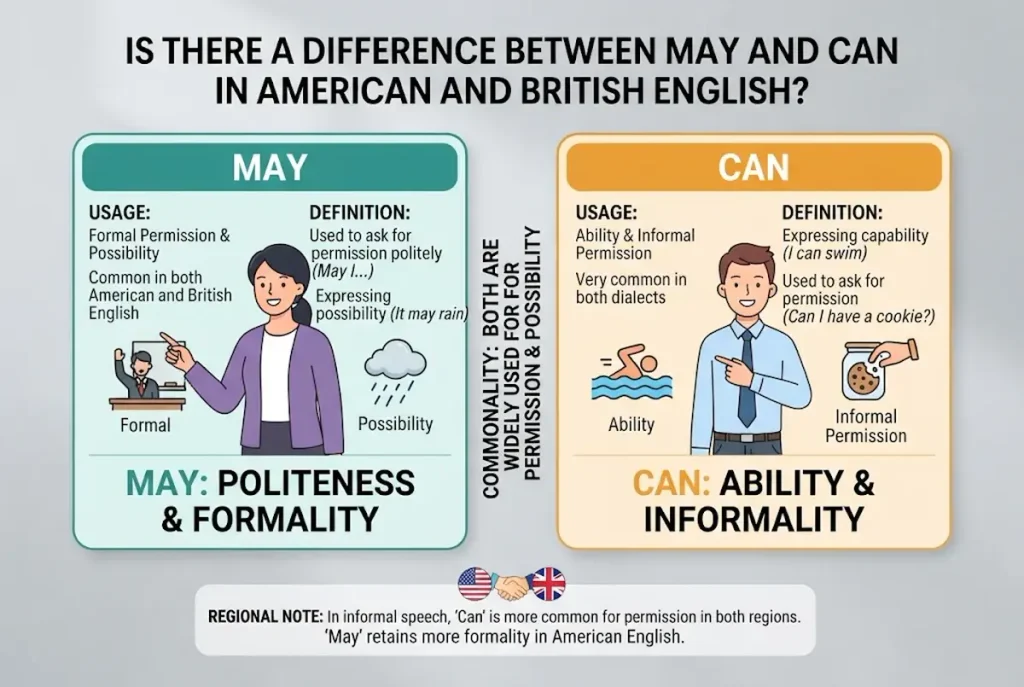
Both words are standard in American and British English. Their basic meanings and grammatical rules remain largely the same.
However, their use can depend on the speaker, situation, and level of formality.
How Do Americans Use May and Can?
In American English, people commonly use can when asking for permission in everyday conversations.
Examples:
- Can I sit here?
- Can I borrow your charger?
- Can we leave early?
These questions sound natural and polite in most casual situations.
May is also common, especially in schools, professional settings, official announcements, and more formal conversations.
Examples:
- May I speak with the manager?
- You may enter the office now.
- Employees may take a short break.
How Do British Speakers Use May and Can?
British English follows the same general rules. May often sounds more formal when someone requests permission, while can is common in ordinary conversation.
Examples:
- Can I use your phone?
- May I come in?
- Visitors may enter through the main gate.
Neither variety treats can as incorrect when someone asks for permission.
Are There Any Regional Differences?
There isn’t a major difference in the basic grammar between the two varieties. However, personal preference and social setting can affect which word sounds most natural.
| Situation | American English | British English |
|---|---|---|
| Casual permission | Can I leave? | Can I leave? |
| Formal permission | May I leave? | May I leave? |
| Expressing ability | I can swim. | I can swim. |
| Expressing uncertainty | It may rain. | It may rain. |
| General possibility | It can happen. | It can happen. |
Which Word Should You Use in Different Situations?
The right choice depends on your audience and purpose. A casual text message doesn’t need the same level of formality as a business email or academic essay.
Which Word Is Better for a Resume?
Use can when describing your skills, abilities, and professional strengths.
A resume should clearly explain what you are capable of doing.
Examples:
- I can manage multiple projects at the same time.
- I can communicate effectively with clients.
- I can organize documents and maintain accurate records.
However, you can make resume statements stronger by using specific action verbs instead of relying on can.
Better examples:
- Managed multiple projects successfully.
- Communicated with clients across different departments.
- Organized company records and improved document accuracy.
Which Word Is Better for an Essay?
Use both words, depending on your argument.
Can works well when discussing general facts, abilities, or situations that are possible.
Examples:
- Regular exercise can improve physical health.
- Technology can make education more accessible.
- Poor communication can create misunderstandings.
May works well when discussing uncertain results, possible explanations, or academic arguments.
Examples:
- Climate change may affect agricultural production.
- This discovery may lead to further research.
- The results may indicate a connection between the two factors.
Which Word Is Better for Texting?
Can is usually the more natural choice in casual messages.
Examples:
- Can you call me later?
- Can we meet after school?
- Can I come over?
- Can you send me the pictures?
May is also correct, but it can sound more formal than necessary.
For example:
– May I call you later?
This sentence is grammatically correct, but it may sound unusually formal in a message to a close friend.
Which Word Is Better for an Email?
Both words work in emails. Choose according to the message and the person receiving it.
Use may for formal permission requests or uncertain situations.
Examples:
- May I request an extension for the assignment?
- The delivery may arrive by Friday.
- You may contact our support team for further assistance.
Use can for ability, availability, and direct requests.
Examples:
- Can you review the attached document?
- I can complete the report by Monday.
- Can we schedule a meeting for next week?
For a more polite professional request, could is often a better choice than can.
Example:
Could you please review the attached document when you have time?
Which Word Is Better When Speaking?
In everyday conversation, can is generally the easiest choice for talking about ability or asking for permission.
Examples:
- Can you hear me?
- Can I get a glass of water?
- Can we go now?
May is useful when you want to sound more formal or express uncertainty.
Examples:
- May I have your attention?
- We may need another hour.
- You may find this information useful.
The best choice is the one that communicates your meaning naturally.
What Are 12 Examples of May and Can in Everyday English?
The following examples show how both words work in different real-life situations.
| No. | Situation | Example sentence | Meaning |
|---|---|---|---|
| 1 | Classroom | May I ask a question? | Polite permission request |
| 2 | Classroom | Can you explain this lesson? | Request for help |
| 3 | Workplace | You may leave after the meeting. | Permission |
| 4 | Workplace | I can finish this report today. | Ability |
| 5 | Weather | It may rain this evening. | Uncertain possibility |
| 6 | Travel | We can reach the airport by bus. | Available option |
| 7 | Family | Can I use your laptop? | Casual permission |
| 8 | Health | Exercise can reduce stress. | General possibility |
| 9 | Education | Students may submit their work online. | Permission |
| 10 | Shopping | You can pay by card. | Available option |
| 11 | Social plans | She may join us for dinner. | Uncertain possibility |
| 12 | Technology | This software can store large files. | Capability |
More Examples in Different Sentence Patterns
Positive sentences
- You may use the library after class.
- My brother can repair computers.
- We may visit New York next month.
- She can finish the assignment without help.
Negative sentences
- You may not enter this area.
- I can’t attend the meeting today.
- He may not know the correct answer.
- They cannot complete the project without additional resources.
Questions
- May I speak to the director?
- Can you open the door?
- May we use this room?
- Can she drive a car?
What Is the Difference Between May I and Can I?
Both expressions can ask for permission, but their tone is different.
| May I | Can I |
|---|---|
| More formal | More conversational |
| Often sounds especially polite | Sounds natural and direct |
| Common in formal requests | Common in everyday requests |
| Often used in official situations | Often used with friends and family |
Examples:
- May I leave the office early today?
- Can I leave the office early today?
May vs Might vs Can: What Is the Difference?
May, might, and can can all express possibility, but they don’t always communicate the same idea.
| Word | Main use | Example |
|---|---|---|
| May | Uncertain possibility or permission | It may rain tomorrow. |
| Might | More tentative possibility | It might rain tomorrow. |
| Can | Ability or general possibility | Heavy rain can cause flooding. |
When Should You Use May Instead of Might?
May often expresses a possible event, while might can make that possibility sound more tentative.
Examples:
- She may come to the party.
- She might come to the party.
When Should You Use Can Instead of May?
Use can for abilities and general possibilities.
Examples:
- I can speak Spanish.
- Too much sunlight can damage your skin.
Use may when describing an uncertain event.
Example:
– I may speak to the manager tomorrow.
This sentence describes a possible future action, not a general ability.
May vs Can in Permission Questions: Which Is More Polite?
Both expressions can be used to request permission, but may usually carries a more formal tone.
Consider these examples:
| Situation | Natural expression |
|---|---|
| Asking a teacher | May I leave early? |
| Asking a friend | Can I borrow your pen? |
| Asking a company manager | May I schedule an appointment? |
| Asking a family member | Can I use your car? |
| Speaking at a formal event | May I have your attention? |
What Are the Common Mistakes When Using May and Can?
Even experienced English learners sometimes confuse these modal verbs. Most mistakes happen when writers use the wrong meaning or add an unnecessary verb ending.
Using Can Only for Physical Ability
A common mistake is thinking that can always describes physical or mental ability.
Incorrect understanding:
Can I borrow your book? only asks if you have the ability to borrow it.
Correct understanding:
Can I borrow your book? is a normal everyday request for permission.
Can has more than one use.
Using May for Every Request
May is not the right choice for every type of request.
For example:
- Incorrect: May you open the window?
- Correct: Can you open the window?
- More polite: Could you open the window?
May I open the window? is correct because the speaker is asking permission to perform an action.
However, May you open the window? is not the normal way to ask another person to do something.
Adding To After May or Can
Modal verbs take the base form of the main verb without to.
Incorrect:
- I may to visit tomorrow.
- She can to sing.
Correct:
- I may visit tomorrow.
- She can sing.
Adding S to the Main Verb
Don’t add s or es to the verb after may or can.
Incorrect:
- He may arrives late.
- She can speaks English.
Correct:
- He may arrive late.
- She can speak English.
Using Do or Does in Questions
May and can form questions without do or does.
Incorrect:
- Do I may leave?
- Does she can swim?
Correct:
- May I leave?
- Can she swim?
Confusing Permission With Possibility
Look at the meaning before choosing a word.
Compare:
- You may enter the building. (You have permission.)
- You can enter the building through the main gate. (The entrance is available or possible.)
The context helps the reader understand the intended meaning.
What Are the Antonyms of May and Can?
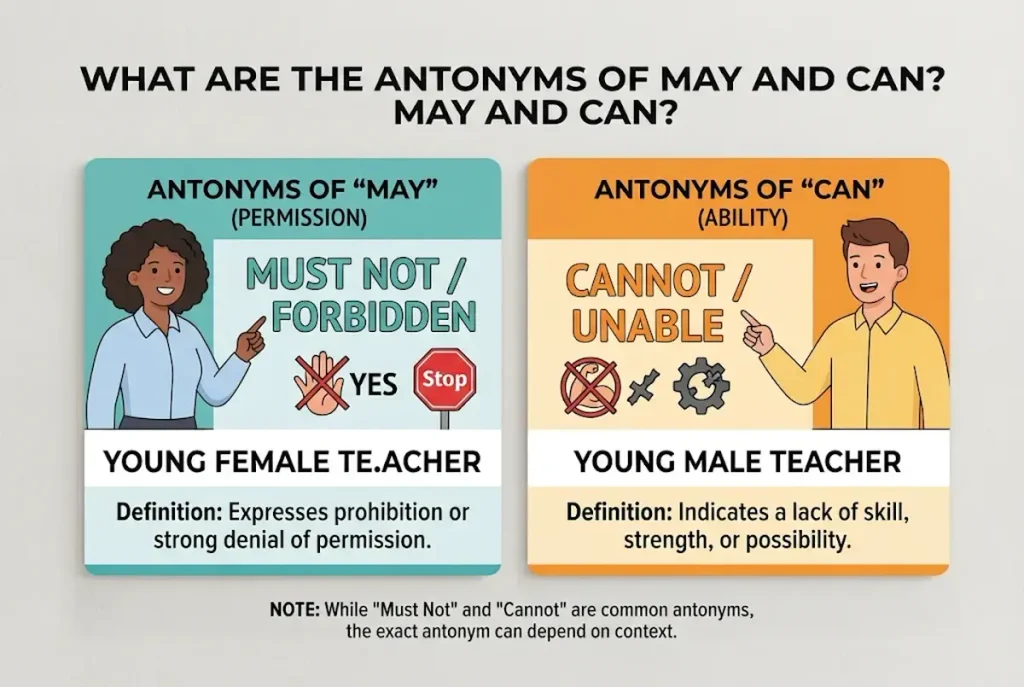
Antonyms are words with opposite meanings. Since may and can have several uses, their opposites depend on the context.
| Original meaning | Opposite expression | Example |
|---|---|---|
| May (permission) | May not | You may not enter. |
| Can (ability) | Cannot | I cannot swim. |
| May (possibility) | Cannot be | That cannot be true. |
| Can (permission) | Cannot / Can’t | You can’t park here. |
| Can (possibility) | Impossible | This result is impossible. |
What Are the Quick Tips for Choosing Between May and Can?
Use these simple tips whenever you’re unsure which word belongs in your sentence.
- For ability: Choose can. Example: I can cook dinner.
- For formal permission: Choose may. Example: May I enter?
- For casual permission: Can is perfectly acceptable. Example: Can I sit here?
- For uncertain events: Choose may. Example: It may rain tomorrow.
- For general possibilities: Choose can. Example: Exercise can improve your health.
- For professional writing: Use may when expressing uncertainty and can when describing ability or general facts.
- For polite requests: Consider could when asking someone to perform an action. Example: Could you help me?
- For negative sentences: Use may not or cannot according to your intended meaning.
- For questions: Put may or can before the subject. Example: Can you help?
- For correct grammar: Always use the base form of the main verb after either modal.
Conclusion
Choosing the right modal verb depends on the meaning and tone of your sentence. May is especially useful when asking for formal permission, expressing uncertainty, or making a polite statement.
Can works best when describing skills, abilities, available options, and general possibilities. However, modern English allows can in everyday permission questions, so you don’t need to treat it as incorrect.
The easiest way to remember the difference is to focus on your purpose before writing. Think about what you want to communicate, consider your audience, and choose the word that sounds natural in that situation. With regular practice, using both words correctly will become much easier.
Frequently Asked Questions
What Is the Main Difference in may vs can?
May usually expresses permission or uncertain possibility, while can commonly expresses ability, permission, or general possibility. May often sounds more formal when asking for permission.
Is May More Polite Than Can?
Yes, may generally sounds more formal and polite when asking for permission. However, can is also considered polite in everyday conversations.
Can I Use Can Instead of May?
Yes, you can use can instead of may when asking for permission in ordinary conversations. However, may is often a better choice in formal situations.
Is May Used for Possibility?
Yes, may expresses an uncertain possibility about the present or future. For example, The teacher may cancel the class tomorrow.
Can May and Might Be Used Interchangeably?
Yes, may and might can often express similar possibilities. However, might can sound more tentative or uncertain than may.
What’s Another Way to Say Can?
You can use able to, capable of, or permitted to, depending on the meaning. For example, I can swim becomes I am able to swim.
Is Can Grammatically Correct When Asking for Permission?
Yes, can is grammatically correct when asking for permission. For example, Can I use your phone? is natural and widely accepted in modern English.
Should I Use May or Can in Formal Writing?
Use may for formal permission requests and uncertain possibilities. Use can when describing skills, abilities, or general facts.

Daniel Grammarfield — The Language Learner
Age: 28Occupation: ESL Learner & Digital Professional
Bio:Daniel is a non-native English speaker who wants to communicate more confidently at work and online. He uses Synotrench to improve grammar, understand confusing words, learn correct sentence structures, and build everyday English skills. He prefers simple explanations with practical examples.
Goals:
Master English grammar rules
Avoid common language mistakes
Improve professional communication
Learn English through real-life examples
Quote:“Learning English is not about memorizing rules — it’s about expressing ideas clearly.”
2 thoughts on “May vs Can: Best Guide to Using Them Correctly”