
Have you ever written an email, school assignment, or text message and paused because you couldn’t decide between may and might? Both words talk about possibility, but they don’t always express the same meaning. Choosing the right one can make your sentences clearer and more natural.
The main difference is that may often expresses a possibility or permission, while might usually expresses a possibility with more uncertainty. However, modern English sometimes uses them in similar ways, so the situation matters.
Understanding these words will help you write better sentences in emails, essays, reports, and everyday conversations. This guide covers their meanings, origins, examples, synonyms, grammar rules, common mistakes, and the best ways to use each word.
What Is the Difference Between May and Might?
May and might are modal auxiliary verbs. They work with the base form of another verb to express possibility, permission, or a situation that isn’t certain.
The main difference is their typical use.
- May expresses possibility, permission, or something that could happen.
- Might expresses possibility, often with greater uncertainty or caution.
Consider these examples:
- It may rain this afternoon.
- It might rain this afternoon.
When Should You Use May?
Use may when you want to express a possibility or give permission.
Examples:
- We may visit our grandparents this weekend.
- The teacher may cancel the class tomorrow.
- This medicine may cause mild side effects.
When Should You Use Might?
Use might when you want to express a possibility, often with a more cautious or uncertain tone.
Examples:
- I might attend the meeting tomorrow.
- She might forget to bring her notebook.
- We might travel to California next summer.
- The new plan might improve the results.
These sentences describe events that are possible but not certain.
Might is also useful when you want to sound polite or avoid making a strong statement.
For example:
- I might need some extra time to finish the report.
- You might want to check the final paragraph again.
What Is the Origin of May and Might?
Understanding the history of these words helps explain why they have similar meanings.
Where Does the Word May Come From?
May comes from the Old English word mæg, which was connected to the idea of having power or being able to do something.
It developed from an older Germanic language form and eventually became the modern English modal verb may.
Over time, its meaning expanded. Today, English speakers use it to express:
- Possibility.
- Permission.
- Formal requests.
- Potential outcomes.
Examples:
- You may enter the building.
- The weather may improve later.
- May I ask you a question?
Where Does the Word Might Come From?
Might developed from the Old English word meahte, an earlier past form related to may.
Historically, might expressed past ability or possibility. In modern English, it has developed several uses, including present and future possibilities.
For example:
- She said she might visit us.
- I might buy a new laptop next month.
- They might arrive before sunset.
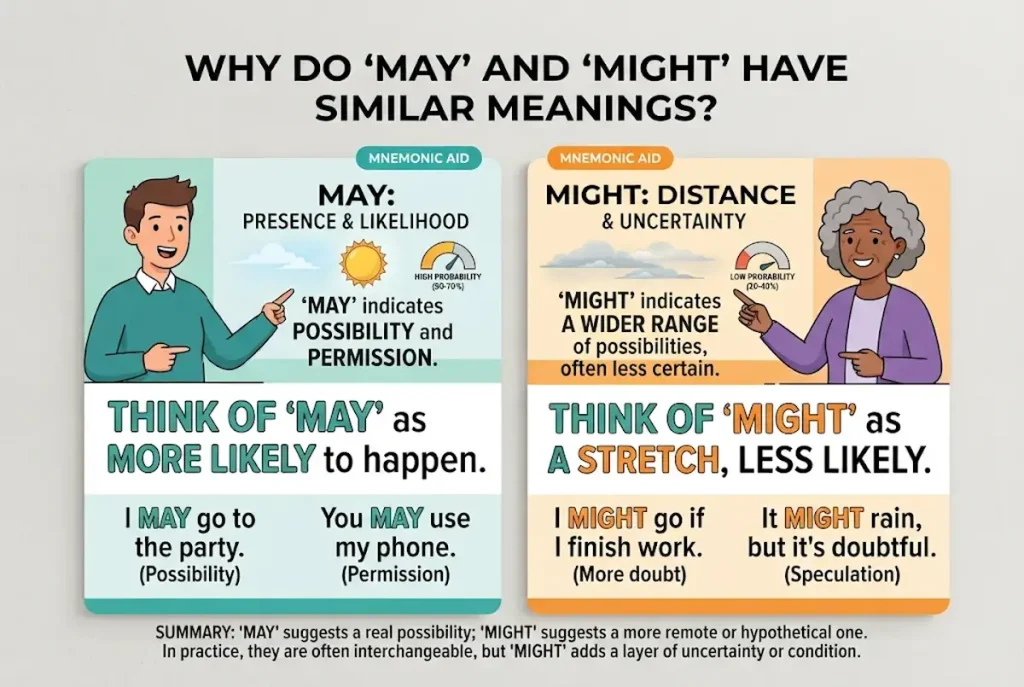
Why Do May and Might Have Similar Meanings?
Both words belong to the same modal verb family. Their shared history explains why they can sometimes replace each other.
However, they have developed different common uses.
May is frequently used for permission and possibility. Might is often preferred when the speaker wants to express a more uncertain possibility.
For example:
- I may join the event.
- I might join the event.
What Are the Best Synonyms for May and Might?
May and might are modal verbs, so they don’t have perfect synonyms that work in every sentence. Their alternatives depend on the meaning you want to express.
For example, may can express permission or possibility. The word can may sometimes replace it, but it doesn’t always communicate the same level of formality.
The following alternatives are grouped by tone and everyday use.
Simple Synonyms for May and Might
| Word | Meaning | Tone | Example |
|---|---|---|---|
| Can | Have the ability or possibility | Simple | We can visit tomorrow. |
| Could | Something is possible | Simple | It could rain tonight. |
| Maybe | Perhaps something will happen | Simple | Maybe she will call. |
| Possibly | Something might happen | Simple | We could possibly finish today. |
| Perhaps | It is possible | Simple | Perhaps he will come. |
| Might | Could happen | Simple | I might stay home. |
| Can possibly | Have a possible chance | Simple | We can possibly complete the task. |
| Be able to | Have the ability | Simple | She may be able to help. |
Everyday Synonyms for May and Might
| Word | Meaning | Tone | Example |
|---|---|---|---|
| Could be | Something is possible | Everyday | It could be a mistake. |
| Have a chance | Have a possibility | Everyday | We have a chance of winning. |
| Be possible | Have the potential to happen | Everyday | A visit may be possible. |
| Seem likely | Appear possible or probable | Everyday | He seems likely to arrive early. |
| Have a possibility | Have some chance of happening | Everyday | The project has a possibility of success. |
| Be allowed to | Have permission | Everyday | You may be allowed to enter. |
| Be permitted to | Have official permission | Everyday | Students may be permitted to leave early. |
| Stand a chance | Have some possibility of success | Everyday | Our team stands a chance of winning. |
Formal Synonyms for May and Might
| Word | Meaning | Tone | Example |
|---|---|---|---|
| Potentially | Having the possibility of happening | Formal | The change could potentially improve safety. |
| Conceivably | Something can reasonably be imagined | Formal | The results could conceivably change. |
| Presumably | Something is believed to be true | Formal | The committee may presumably review the proposal. |
| Feasibly | In a way that is possible or practical | Formal | The work might feasibly finish by Friday. |
| Permissible | Allowed under rules | Formal | Early departure is permissible. |
| Probable | Likely to happen | Formal | A delay is probable. |
| Plausible | Reasonable or believable | Formal | The explanation might be plausible. |
| Possible | Capable of happening | Formal | A solution may be possible. |
How Do May and Might Differ by Level of Certainty?
May and might can both express uncertainty, but speakers often choose between them to show how confident they feel.
There isn’t a fixed percentage that separates the two. The difference depends on context, tone, and the speaker’s intention.
Low Possibility or Greater Uncertainty
Might often works well when you want to suggest a possibility without sounding confident.
Examples:
- I might visit the museum if I have enough time.
- The package might arrive tomorrow.
- We might need another meeting.
Moderate Possibility
May often expresses a possible event without suggesting that it is especially unlikely.
Examples:
- The manager may approve your request.
- We may visit our relatives next weekend.
- The weather may improve by evening.
Stronger Possibility
When you want to express a stronger expectation, words such as probably or likely may be more suitable.
Examples:
- She will probably attend the meeting.
- The package is likely to arrive today.
- We are almost certain to finish the project.
How Do May and Might Work as Different Parts of Speech?
May and might are modal auxiliary verbs. They don’t normally function as ordinary nouns, adjectives, or adverbs.
However, they can appear in different grammatical structures depending on the sentence.
May and Might as Modal Verbs
Both words work with the base form of a main verb.
Examples:
- She may come tomorrow.
- He might call tonight.
- We might visit the park.
May and Might in Negative Sentences
Add not after the modal verb to make a negative sentence.
Examples:
- I may not attend the event.
- She might not understand the instructions.
- They may not finish the work today.
May and Might in Questions
Place the modal verb before the subject when forming a question.
Examples:
- May I come inside?
- Might we discuss this issue later?
- May I borrow your notebook?

Is There a Difference Between May and Might in American and British English?
American and British English use both words with almost the same basic meanings.
However, some differences appear in everyday preferences and levels of formality.
| Situation | American English | British English |
|---|---|---|
| Expressing possibility | May or might | May or might |
| Asking permission | May I leave? | May I leave? |
| Casual possibility | I might go later. | I might go later. |
| Formal writing | May be required | May be required |
| Polite suggestions | You might want to check. | You might want to check. |
There isn’t a major grammatical difference between the two varieties.
One useful point is that may is sometimes associated with more formal speech when asking permission. In casual American conversations, people also use can or could for permission.
For example:
- Formal: May I use your computer?
- Casual: Can I use your computer?
- Polite: Could I use your computer?
Which Word Should You Use in Different Writing Situations?
The right choice depends on the message you want to communicate. A formal application, school essay, and casual text don’t always require the same language.
Which Word Is Best for a Resume?
May and might are not especially common in resume bullet points because resumes usually describe completed achievements, skills, and responsibilities.
However, they can appear in professional summaries or descriptions of possible future plans.
Examples:
- I may pursue additional training to improve my technical skills.
- The proposed strategy might increase customer engagement.
- This role may provide opportunities for professional development.
For stronger resume writing, use direct action verbs whenever possible.
Instead of writing:
I might help the company improve its sales.
Write:
I helped improve the company’s sales through customer outreach.
The second sentence describes an actual contribution rather than an uncertain possibility.
Which Word Is Best for an Essay?
Both words are useful in academic writing.
Use may to explain possible causes, results, or explanations. Use might when discussing a less certain outcome or a possible alternative.
Examples:
- Climate change may affect agricultural production.
- The findings might suggest a connection between sleep and memory.
- This approach may improve student performance.
- Other factors might explain the unexpected results.
Academic writing should avoid presenting uncertain ideas as proven facts. These modal verbs help you communicate your level of confidence accurately.
Which Word Is Best for Texting?
In text messages, both words sound natural.
Use may when expressing a possibility or asking permission. Use might when you’re unsure about your plans.
Examples:
- I may come over this evening.
- I might be late today.
- We may watch a movie tonight.
- I might call you after dinner.
In casual texting, maybe is also common.
For example:
Maybe I’ll join you later.
This sounds relaxed and conversational.
Which Word Is Best for Professional Emails?
May is useful for formal possibilities and polite permission requests. Might works well for cautious suggestions and uncertain plans.
Examples:
- We may need to reschedule the meeting.
- The manager might approve your request by Friday.
- You may contact our support team for assistance.
- You might want to review the attached document.
If you’re making a formal request, may can sound respectful.
For example:
May I request an extension for the submission deadline?
For a gentle suggestion, might is often a better choice.
You might consider reviewing the proposal before sending it.
Which Word Is Best for Speaking?
Both words are natural in spoken English.
Choose may when you want to express a possibility or permission. Choose might when you want to sound less certain or more cautious.
Examples:
- I may go shopping after work.
- We might visit the beach this weekend.
- You may use my phone.
- She might know the answer.
In everyday conversations, speakers often use could, maybe, and probably as alternatives.
The most important thing is to match your words to the meaning you want to express.
What Are 15 Examples of May and Might in Sentences?
The following examples show how these modal verbs work in real situations.
Examples of May
- My brother may visit us during the summer vacation.
- The teacher may give students an extra day to complete their assignments.
- You may use this computer after finishing your work.
- The company may open a new office next year.
- It may snow in the northern areas tonight.
- This new exercise routine may improve your fitness.
- The doctor may recommend another test.
- Students may enter the library after showing their identification.
These examples show possibility, permission, and potential results.
Examples of Might
- I might attend the wedding if my schedule allows.
- She might forget to bring the documents.
- We might order pizza instead of cooking dinner.
- The new website might attract more visitors.
- He might be waiting outside the classroom.
- They might change their travel plans because of the weather.
- My parents might visit us next weekend.
- The meeting might take longer than expected.
These examples show uncertainty, possible plans, and cautious expectations.
Examples Using Both Words
- The manager may approve the proposal, but the finance team might request changes.
- We may finish the project today, although we might need another hour.
Using both words in one sentence can help communicate different levels of confidence or separate possibilities.
What Is the Difference Between May Have and Might Have?
May have and might have are used to discuss possible events in the past.
Both structures follow this pattern:
May or might + have + past participle.
Examples:
- She may have forgotten her keys.
- He might have missed the train.
- They may have completed the assignment.
- We might have taken the wrong road.
May have often suggests a possible past event without confirming it. Might have can express a similar meaning, sometimes with greater uncertainty.
May Have in a Sentence
Use may have when you think something possibly happened.
Examples:
- The teacher may have left the classroom.
- John may have sent the email already.
- The company may have changed its policies.
Might Have in a Sentence
Use might have when discussing an uncertain past possibility.
Examples:
- She might have lost her phone.
- We might have misunderstood the instructions.
- He might have forgotten about the appointment.
Both forms are grammatically correct when used with the past participle.
May vs Might vs Could: What Is the Difference?
May, might, and could all express possibility. However, they can communicate slightly different meanings.
| Word | Main Meaning | Example |
|---|---|---|
| May | Possibility or permission | She may arrive late. |
| Might | Possibility with uncertainty | She might arrive late. |
| Could | A possible event or outcome | She could arrive late. |
May vs Could
May often expresses a possibility or permission. Could expresses possibility, ability, or a potential outcome.
Examples:
- It may rain tomorrow.
- It could rain tomorrow.
Both sentences are correct. However, could can sometimes focus more on what is possible under certain conditions.
Might vs Could
Might often presents an uncertain possibility. Could highlights something that is possible or could happen.
Examples:
- I might join the team.
- I could join the team.
The first suggests uncertainty about your decision. The second can suggest that joining is an available option.
What Are the Common Mistakes When Using May and Might?
Although these words are easy to understand, certain grammar mistakes can make your sentences incorrect.
Using To After May or Might
Modal verbs take the base form of the main verb without to.
Incorrect: She may to visit us tomorrow.
Correct: She may visit us tomorrow.
Incorrect: He might to call later.
Correct: He might call later.
Adding S or ES to the Main Verb
Don’t add s or es to a verb after may or might.
Incorrect: She may goes to school.
Correct: She may go to school.
Incorrect: He might visits his parents.
Correct: He might visit his parents.
The modal verb carries the grammatical structure, so the main verb stays in its base form.
Confusing May With Maybe
May is a modal verb, while maybe is an adverb meaning perhaps.
Compare:
- She may come to the party.
- Maybe she will come to the party.
Both sentences express possibility, but their grammatical structures are different.
Using Might for Permission in Every Situation
Might can appear in formal permission questions, but it isn’t the usual choice in everyday English.
Less natural: Might I use your pencil?
More common: May I use your pencil?
Casual: Can I use your pencil?
The first sentence isn’t grammatically wrong, but it may sound unusually formal.
Treating May and Might as Completely Different Levels of Certainty
Some grammar explanations suggest that may always means a higher possibility than might. This is too strict.
In real English, the two words often overlap.
For example:
- It may happen tomorrow.
- It might happen tomorrow.
Both communicate an uncertain future event. The speaker’s tone and context help determine the intended meaning.
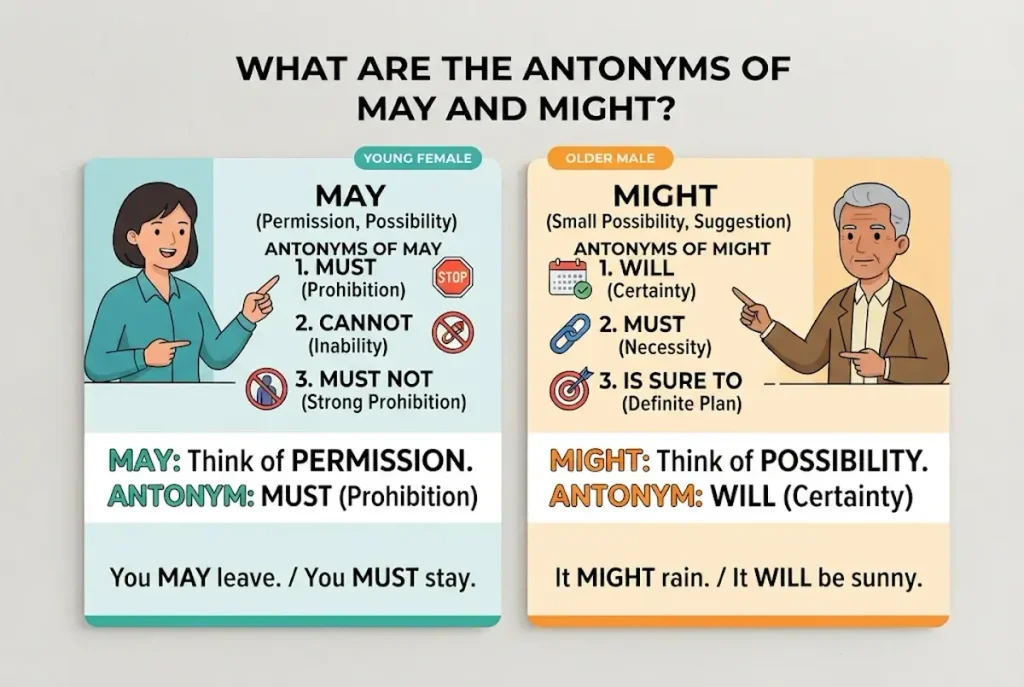
What Are the Antonyms of May and Might?
May and might don’t have exact antonyms because their meanings depend on the sentence. However, some expressions communicate the opposite idea.
| Word or Expression | Opposite Meaning | Example |
|---|---|---|
| Must not | Not allowed | You must not enter this area. |
| Cannot | Not possible or not permitted | We cannot attend the meeting. |
| Will not | Something won’t happen | She will not join us. |
| Definitely | Without uncertainty | He will definitely arrive. |
| Certainly | Without doubt | The plan will certainly work. |
| Impossible | Cannot happen | It is impossible to finish today. |
| Forbidden | Not allowed | Parking is forbidden here. |
| Unlikely | Not expected to happen | Rain is unlikely tomorrow. |
Remember that these expressions aren’t direct replacements in every situation.
For example, must not usually expresses prohibition, while may not can express either a lack of permission or the possibility that something won’t happen.
What Are the Quick Tips for Choosing Between May and Might?
Use these practical tips to make the right choice.
- Use may for possibility. Example: We may travel tomorrow.
- Use may for permission. Example: May I enter the room?
- Use might for greater uncertainty. Example: I might attend the event.
- Use might for cautious suggestions. Example: You might want to check your work.
- Use may have for possible past events. Example: She may have forgotten.
- Use might have for uncertain past events. Example: He might have missed the bus.
- Use the base verb after both words. Example: She may come, not she may comes.
- Don’t treat their certainty levels as fixed percentages. Context matters.
- Use maybe when you want an adverb meaning perhaps. Example: Maybe we can go tomorrow.
- Read the sentence aloud. Choose the word that sounds natural and expresses your intended meaning.
Conclusion
The main difference between may and might is their use in expressing possibility and permission. May commonly describes something that is possible or gives someone permission to do something. Might often describes a more uncertain possibility or a cautious suggestion.
For example, you can say that a friend may visit tomorrow or might visit tomorrow. Both sentences are correct, but might can sound less certain.
Remember that these words sometimes overlap in everyday American English. You don’t need to follow a strict rule about how likely an event must be. Instead, consider your meaning, the situation, and your audience. With regular practice, you’ll find it easier to use both modal verbs naturally in conversations and writing.
Frequently Asked Questions
Is may stronger than might?
May can sound slightly more confident than might, but the difference isn’t fixed. Both words express possibility, and their meaning depends on context.
Can I use may and might in the same sentence?
Yes, you can use both words in one sentence when describing different possibilities. For example, She may attend the event, but her brother might stay home.
Is might the past tense of may?
Might historically developed as the past form of may. However, modern English also uses might to express present and future possibilities.
What’s another word?
Could, possibly, perhaps, and maybe can express similar meanings. The best alternative depends on the sentence and whether you’re describing possibility or permission.
What is the difference between may have and might have?
Both structures describe possible past events. May have can sound slightly more confident, while might have often communicates greater uncertainty.
Can might be used to ask for permission?
Yes, but it usually sounds very formal or old-fashioned. May I and Could I are more common choices for polite permission requests.

Daniel Grammarfield — The Language Learner
Age: 28Occupation: ESL Learner & Digital Professional
Bio:Daniel is a non-native English speaker who wants to communicate more confidently at work and online. He uses Synotrench to improve grammar, understand confusing words, learn correct sentence structures, and build everyday English skills. He prefers simple explanations with practical examples.
Goals:
Master English grammar rules
Avoid common language mistakes
Improve professional communication
Learn English through real-life examples
Quote:“Learning English is not about memorizing rules — it’s about expressing ideas clearly.”
1 thought on “May or Might: The Ultimate Guide to the Difference”