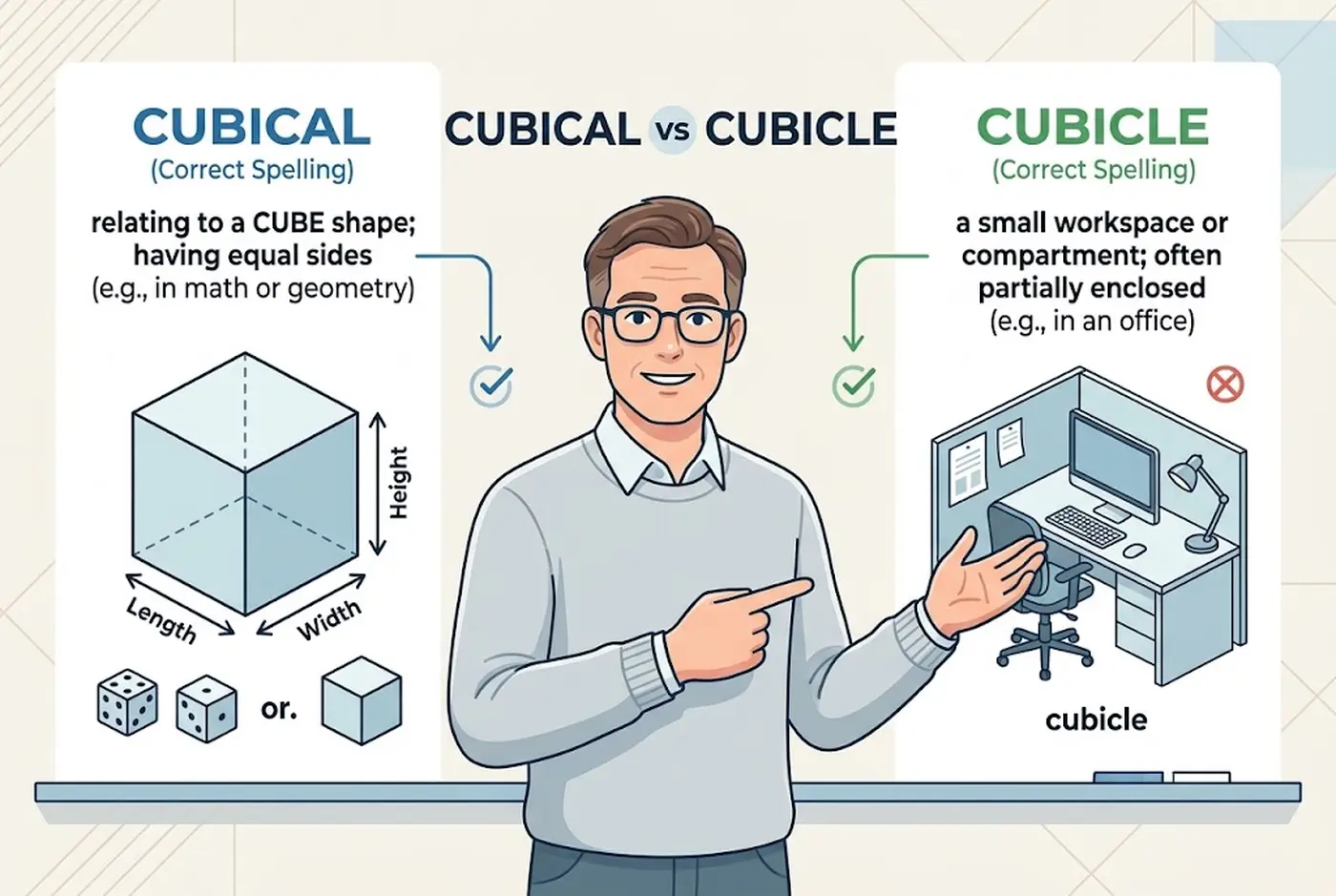
The confusion between Cubical vs Cubicle is common because the words share almost the same spelling. However, they describe different things. One refers to a geometric shape, while the other describes a small, separated space.
Cubical is an adjective that describes something shaped like a cube. Cubicle is a noun that means a small, enclosed or partly enclosed space, often used as an office workspace.
Understanding this difference makes your writing clearer and more accurate. This guide explains their meanings, word origins, synonyms, grammar rules, everyday examples, common mistakes, and practical tips for choosing the correct word.
What Is the Difference Between Cubical and Cubicle?
The main difference is simple. Cubical describes a shape, while cubicle names a physical space.
Although these words share a similar spelling, they have different grammatical functions and meanings.
| Feature | Cubical | Cubicle |
|---|---|---|
| Part of speech | Adjective | Noun |
| Main meaning | Shaped like a cube | A small separated space |
| Common use | Geometry and design | Offices and changing rooms |
| Related word | Cube | Compartment |
| Example | A cubical container | An office cubicle |
| Describes | Shape | A place or structure |
| Plural form | Not normally plural | Cubicles |
What Does Cubical Mean in Simple English?
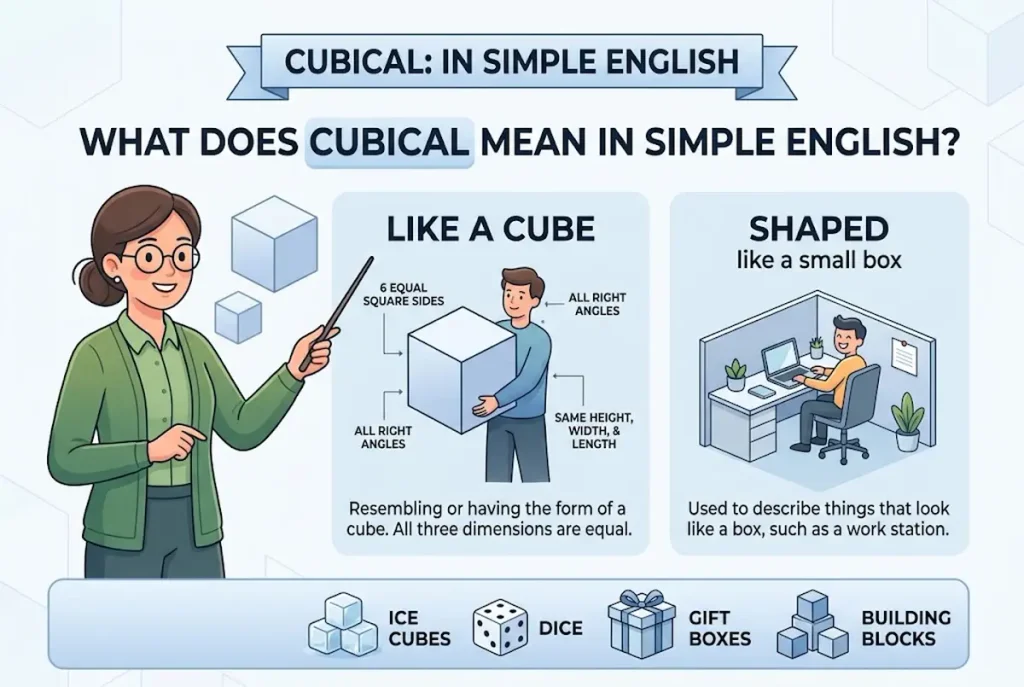
Cubical is an adjective used to describe something that has the shape of a cube.
A cube is a three-dimensional object with six equal square faces. A cubical object has that same basic shape.
For example, a box with equal length, width, and height can be described as cubical.
Examples of Cubical in Sentences
- The artist created a cubical sculpture for the exhibition.
- We placed a cubical container on the kitchen shelf.
- The architect designed a cubical building.
- The students examined a cubical model during math class.
- A small cubical package arrived this morning.
- The laboratory uses cubical blocks for testing.
- The designer preferred a cubical structure over a rectangular one.
In each example, cubical describes the physical form of an object.
Where Is Cubical Commonly Used?
You may encounter this word in several fields.
| Field | Example | Purpose |
|---|---|---|
| Mathematics | Cubical figure | Describes a geometric shape |
| Architecture | Cubical building | Explains a building’s form |
| Engineering | Cubical component | Describes a designed object |
| Art | Cubical sculpture | Identifies a three-dimensional form |
| Science | Cubical crystal | Describes a crystal’s shape |
| Packaging | Cubical box | Explains a package’s dimensions |
What Does Cubicle Mean in Simple English?
A cubicle is a small area separated from a larger room by walls, panels, partitions, or other barriers.
The word is especially common in office settings, where employees work at individual desks surrounded by partitions.
However, cubicles aren’t limited to offices.
They can also appear in changing rooms, public facilities, medical buildings, and other places where people need a small separate area.
Examples of Cubicle in Sentences
- James works in a cubicle near the office entrance.
- She decorated her cubicle with plants and photographs.
- The company installed twenty new office cubicles.
- Please leave your bag inside the changing cubicle.
- His cubicle is next to the meeting room.
Notice that cubicle refers to an actual space rather than its geometric shape.
A cubicle doesn’t have to be cube-shaped. Many office cubicles are rectangular or have open entrances.
Where Is Cubicle Commonly Used?
| Setting | Meaning |
|---|---|
| Office | A separated workspace |
| Changing room | A private area for changing clothes |
| Public restroom | An individual enclosed compartment |
| Medical facility | A small separated treatment or examination area |
| Workplace | A personal working space divided by partitions |
| Public facility | A small compartment designed for individual use |
Where Do Cubical and Cubicle Come From?
Understanding word origins can make confusing vocabulary easier to remember.
Both words are connected to Latin, but they developed through different paths.
Origin of Cubical
Cubical comes from cube, which traces back through Latin cubus to the Greek word kybos, meaning a cube or die.
The suffix al helps turn the word into an adjective.
Therefore, cubical means having the form or characteristics of a cube.
Its history explains why the word appears frequently in mathematical, scientific, and architectural descriptions.
Origin of Cubicle
Cubicle comes from the Latin word cubiculum, meaning a bedroom or sleeping chamber.
This word is connected to cubare, meaning to lie down.
Over time, cubicle developed into a term for a small, separate room or compartment.
Today, it commonly refers to an individual office workspace.
An interesting detail is that cubicle didn’t originally come from cube, even though the two English words look closely related.
Their similar spelling is one reason people confuse them.
Cubical vs Cubicle Synonyms and Related Words
Choosing an alternative depends on the meaning you want to express.
Cubical describes shape, so its alternatives usually relate to geometry. Cubicle describes a separated space, so its alternatives relate to rooms, compartments, and work areas.
Not every word below is an exact synonym. Some are useful related terms that fit particular situations.
Simple Synonyms
These alternatives are easy to understand and work well in everyday writing.
| Word | Meaning | Tone | Example |
|---|---|---|---|
| Cube-shaped | Having the shape of a cube | Simple | The gift came in a cube-shaped box. |
| Box-shaped | Shaped like a box | Simple | We bought a box-shaped container. |
| Square | Having a square form | Everyday | The table has a square top. |
| Block-like | Resembling a solid block | Simple | The building has a block-like design. |
| Small room | A limited enclosed space | Simple | He entered a small room. |
| Workspace | An area used for working | Everyday | Her workspace is organized. |
| Booth | A small separated area | Everyday | The worker entered the booth. |
| Compartment | A divided section of a larger space | Neutral | Each passenger had a compartment. |
Everyday Synonyms
These words sound natural in conversations, emails, and ordinary descriptions.
| Word | Meaning | Tone | Example |
|---|---|---|---|
| Workstation | A place equipped for working | Professional | My workstation is near the window. |
| Desk area | Space surrounding a desk | Casual | Keep your desk area clean. |
| Office space | An area used for office work | Neutral | The company added more office space. |
| Partitioned area | Space separated by barriers | Neutral | She works in a partitioned area. |
| Enclosure | A space surrounded by barriers | Neutral | The equipment sits inside an enclosure. |
| Changing booth | A private place for changing clothes | Everyday | The changing booth is available. |
| Stall | A small divided compartment | Everyday | The restroom has four stalls. |
| Section | One part of a larger area | General | Each employee has a separate section. |
Formal Synonyms
These alternatives are useful in technical reports, architecture, academic writing, and workplace documentation.
| Word | Meaning | Tone | Example |
|---|---|---|---|
| Cuboid | A three-dimensional solid with rectangular faces | Technical | The package forms a cuboid. |
| Cubiform | Having a cube-like shape | Technical | The object has a cubiform structure. |
| Cubic | Related to cubes or three-dimensional measurement | Technical | The tank holds several cubic meters. |
| Three-dimensional | Having length, width, and height | Academic | The model is three-dimensional. |
| Geometric | Related to mathematical shapes | Formal | The building has a geometric design. |
| Rectangular prism | A solid with six rectangular faces | Mathematical | The object is a rectangular prism. |
| Partitioned workspace | A work area divided by barriers | Professional | The building contains partitioned workspaces. |
| Individual workstation | A work area assigned to one person | Professional | Each employee receives an individual workstation. |
| Enclosed compartment | A separate area surrounded by barriers | Formal | The equipment occupies an enclosed compartment. |
| Modular workspace | A work area built from adjustable sections | Professional | The office uses modular workspaces. |
Which Synonyms Are Stronger or More Specific?
Unlike emotional words such as angry or furious, cubical and cubicle don’t have natural intensity levels.
Their alternatives differ mainly in precision, enclosure, and technical detail.
| Level | Word | Meaning |
|---|---|---|
| General | Box-shaped | Resembles a box |
| More descriptive | Block-like | Looks like a solid block |
| More precise | Cube-shaped | Has the form of a cube |
| Technical | Cubical | Having the shape of a cube |
| Specialized | Cubiform | Resembling a cube |
For cubicle, the distinction often concerns how separate or enclosed the space is.
| Description | Word | Typical meaning |
|---|---|---|
| General | Area | Any defined space |
| Work-related | Workspace | A place used for work |
| Divided | Partitioned area | Space separated by barriers |
| More specific | Cubicle | A small individual compartment |
| Fully surrounded | Enclosed compartment | A space enclosed by barriers |
These aren’t strict rankings. Choose the term that describes the actual object or space.
How Do Cubical and Cubicle Work in Grammar?
Grammar provides one of the easiest ways to remember the difference.
The two words belong to different parts of speech.
Cubical as an Adjective
An adjective describes a noun.
Cubical usually appears before the object it describes.
Examples:
- The architect designed a cubical house.
- We purchased a cubical storage container.
- The sculpture has a cubical form.
You can also use it after a linking verb.
Example:
The structure is cubical.
In that sentence, cubical describes the structure.
Cubicle as a Noun
A noun names a person, place, thing, or idea.
Cubicle names a small separated space.
Examples:
- My cubicle is beside the printer.
- The office contains thirty cubicles.
- She moved into a larger cubicle.
The plural form is cubicles.
You can also combine cubicle with other nouns.
Examples include:
- Cubicle wall
- Cubicle desk
- Cubicle partition
- Cubicle decoration
- Cubicle layout
Can Cubical Be Used as a Noun?
In ordinary modern English, cubical is an adjective, not a noun.
If you want to name a shape, use cube.
If you want to name a small workplace, use cubicle.
Incorrect: I returned to my cubical after lunch.
Correct: I returned to my cubicle after lunch.
Is Cubical or Cubicle More Common in American English?
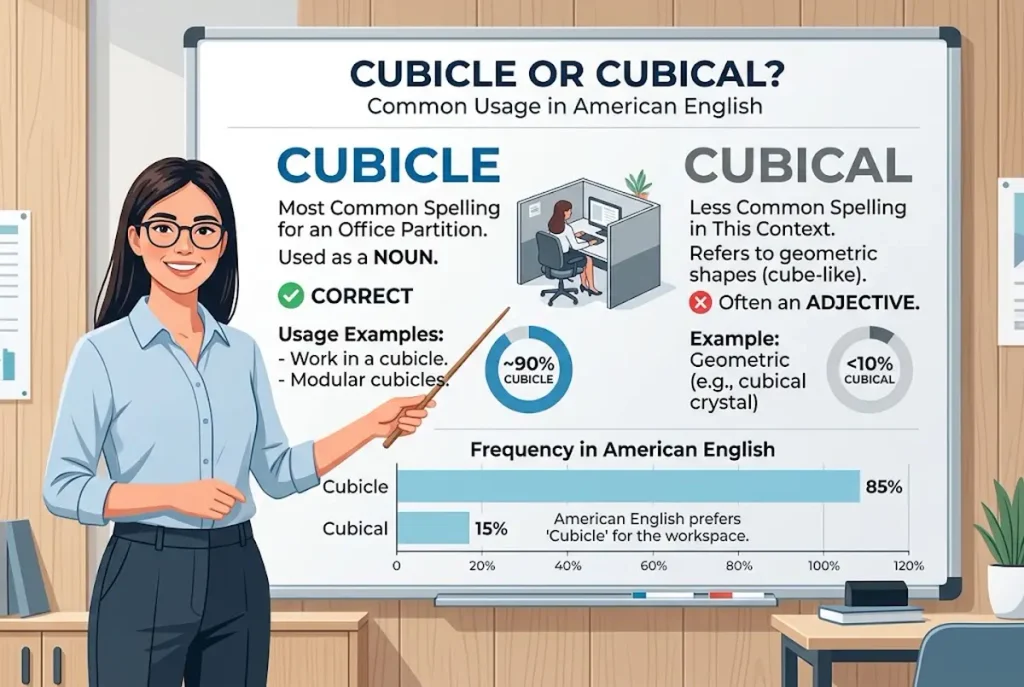
Cubicle is much more familiar in everyday American workplace conversations.
Americans frequently use office cubicle to describe a desk area separated by partitions.
Cubical is less common because it usually appears in discussions involving geometry, architecture, mathematics, or design.
American and British English Differences
Both words exist in American and British English, and their basic meanings remain the same.
However, some related vocabulary differs.
| Situation | American English | British English |
|---|---|---|
| Individual office workspace | Cubicle | Cubicle or workstation |
| Public restroom compartment | Stall | Cubicle |
| Place for changing clothes | Changing room or fitting room | Changing room or changing cubicle |
| Cube-shaped object | Cubical or cube-shaped | Cubical or cube-shaped |
| Office desk location | Workspace | Workspace or workstation |
Which Word Should You Use in Different Situations?
The best choice depends on what you’re describing and the type of writing you’re doing.
Which Word Is Better for a Resume?
Use cubicle only when the physical workspace matters. In most resumes, workstation, office environment, or workspace sounds more relevant.
Cubical is appropriate only when discussing the shape of an object, such as a product or engineering design.
Examples:
- Managed equipment across fifteen individual workstations.
- Designed a cubical storage unit for laboratory materials.
Avoid mentioning your cubicle merely to describe where you sat. A resume should focus on responsibilities, skills, and achievements.
Which Word Is Better for an Essay?
Both words work in essays, but they serve different purposes.
Use cubical when discussing shapes, geometry, architecture, or physical design.
Example:
The architect used cubical structures to create a balanced appearance.
Use cubicle when discussing workplaces, privacy, office design, or individual spaces.
Example:
The traditional office cubicle provides employees with a partially separated working environment.
In academic writing, accuracy matters more than choosing a complicated word.
Which Word Is Better for Texting?
Cubicle is natural when talking about your workplace.
Example:
I’m still in my cubicle finishing some work.
In casual American workplace conversations, some people shorten cubicle to cube.
Example:
I’ll meet you near my cube.
For geometric descriptions, cube-shaped usually sounds more natural than cubical in a casual message.
Example:
I bought a cute cube-shaped lamp.
Cubical vs Cubicle Example Sentences in Real Situations
Looking at both words in different settings helps you understand their correct use.
| Situation | Correct sentence | Explanation |
|---|---|---|
| Office | My cubicle is on the second floor. | Names a workspace |
| Geometry | The teacher displayed a cubical model. | Describes a shape |
| Architecture | The building has a cubical design. | Describes its form |
| Workplace | Every employee has a separate cubicle. | Names an individual work area |
| Shopping | I purchased a cubical storage box. | Describes the box’s shape |
| Changing room | She entered an empty changing cubicle. | Names a private compartment |
| Engineering | The machine contains a cubical component. | Describes a component |
| Office management | We need six additional cubicles. | Refers to workspaces |
| Art | The sculpture consists of several cubical forms. | Describes geometric forms |
| Conversation | I’ll meet you outside my cubicle. | Identifies a location |
| Science | The researcher examined a cubical crystal. | Describes a crystal’s shape |
| Interior design | The company replaced its old cubicle partitions. | Refers to office structures |
What’s the Difference: Cubical vs Cubic?
Cubical and cubic are closely related adjectives, but they aren’t always interchangeable.
Cubical usually describes the shape of an object.
Cubic can describe something related to cubes, especially three-dimensional measurements, volume, and mathematical expressions.
| Cubical | Cubic |
|---|---|
| Describes a cube-like shape | Often relates to cubes or volume |
| Common in shape descriptions | Common in mathematics and measurements |
| Cubical container | Cubic meter |
| Cubical building | Cubic equation |
| Focuses on physical form | Has broader technical uses |
Examples:
- The designer created a cubical container.
- The room has a volume of thirty cubic meters.
- The students studied cubic equations.
You wouldn’t normally say cubical meters when describing volume.
Cubic is the correct word in that measurement.
Similarly, cubic equation is a standard mathematical term, while cubical equation isn’t the usual expression.
Cubicle vs Workstation: What’s the Difference?
These two words are often used in office conversations, but they don’t mean exactly the same thing.
A cubicle is a small workspace separated by partitions.
A workstation is a place equipped for work. It may include a desk, computer, chair, tools, or other equipment.
A workstation doesn’t need walls or partitions.
| Cubicle | Workstation |
|---|---|
| Refers to a separated physical area | Refers to a place equipped for work |
| Usually has partitions | May be open or enclosed |
| Common in traditional offices | Used in offices, laboratories, and factories |
| Emphasizes the workspace layout | Emphasizes the working setup |
Compare these examples:
My cubicle is near the conference room.
My workstation has two monitors and an adjustable desk.
The first sentence identifies a separated space. The second describes a working setup.
A workstation can be located inside a cubicle.
Cubicle vs Compartment: Are They the Same?
Cubicle and compartment both describe divided spaces, but compartment has a broader meaning.
A cubicle often provides a small space for an individual person.
A compartment can be any separate section within a larger structure.
| Cubicle | Compartment |
|---|---|
| Often designed for a person | Can hold people, objects, or equipment |
| Common in offices and changing rooms | Common in vehicles, bags, and storage units |
| Usually provides some separation | May be open, closed, or built into something |
Examples:
The employee entered her office cubicle.
The suitcase contains three separate compartments.
Calling every compartment a cubicle would be incorrect because many compartments aren’t designed for people.
Common Mistakes When Using Cubical and Cubicle
Several mistakes happen because the words look similar or because writers assume they share the same meaning.
Mistake 1: Using Cubical for an Office Workspace
Incorrect: She decorated her cubical with colorful posters.
Correct: She decorated her cubicle with colorful posters.
An office workspace is a cubicle, not cubical.
Mistake 2: Using Cubicle to Describe Shape
Incorrect: The designer created a cubicle sculpture.
Correct: The designer created a cubical sculpture.
The corrected sentence describes a sculpture shaped like a cube.
The original sentence could suggest a sculpture related to an office cubicle instead.
Mistake 3: Confusing Cubical With Cubic
Incorrect: The swimming pool holds fifty cubical meters of water.
Correct: The swimming pool holds fifty cubic meters of water.
Cubic is the standard adjective for three-dimensional units of volume.
When Should You Avoid Using These Words?
Sometimes neither word is the best choice.
Avoid cubical when you only mean that an object has a square face. A square is a flat shape, while a cube has three dimensions.
Avoid cubicle when describing an ordinary desk in an open office without partitions. Workspace or desk area may be more accurate.
Also, avoid calling a rectangular object cubical unless its overall form genuinely resembles a cube.
Here are some better choices:
| Intended meaning | Better word |
|---|---|
| A flat shape with four equal sides | Square |
| A three-dimensional cube shape | Cubical or cube-shaped |
| A rectangular solid | Cuboid |
| An open office desk | Workstation |
| A small separated office space | Cubicle |
| A private room | Room or office |
| A divided storage section | Compartment |
Choosing the most accurate word is better than choosing one simply because it sounds formal.
What Are the Opposites of Cubical and Cubicle?
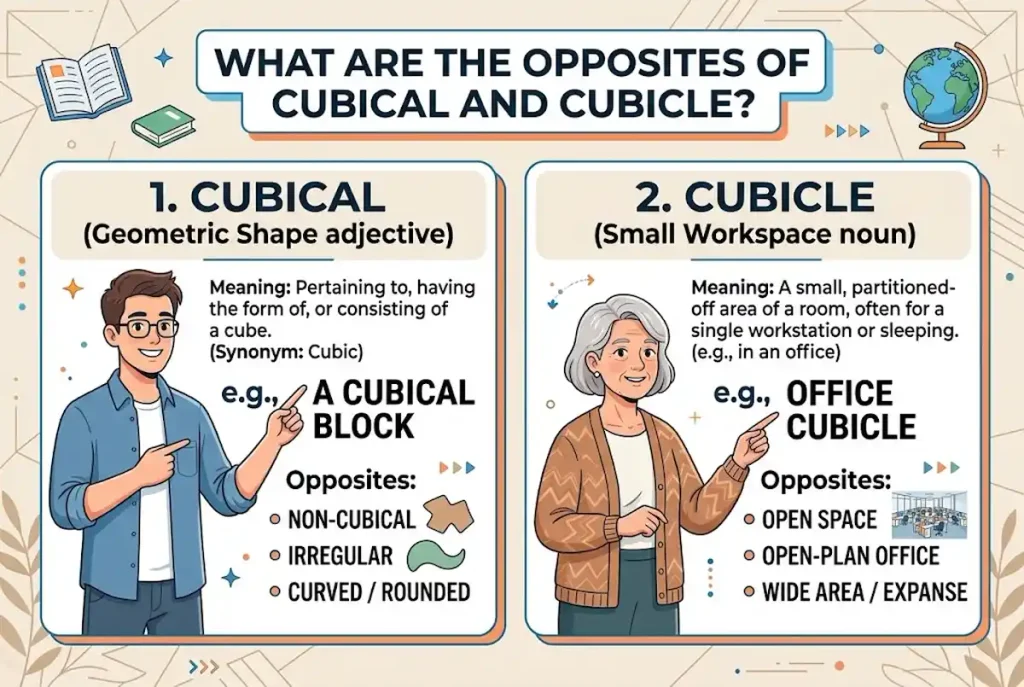
Neither word has one perfect antonym that works in every situation.
Their opposites depend on context.
Opposites of Cubical
| Word | Meaning |
|---|---|
| Spherical | Shaped like a ball |
| Rounded | Having a curved form |
| Cylindrical | Shaped like a cylinder |
| Irregular | Lacking a regular geometric shape |
| Flat | Having little or no depth |
These are contrasting shapes rather than strict dictionary antonyms.
Opposites of Cubicle
| Word or phrase | Meaning |
|---|---|
| Open space | An area without enclosing partitions |
| Open-plan office | A workplace with few internal divisions |
| Shared workspace | An area used by multiple people |
| Undivided room | A room without separate compartments |
| Communal area | A space shared by a group |
Quick Tips for Remembering the Difference
You don’t need to memorize complicated grammar rules to choose the correct word.
Use these practical reminders.
- If you’re describing the shape of an object, choose cubical.
- If you’re naming a small separated workspace, choose cubicle.
- Remember that cubical is an adjective.
- Remember that cubicle is a noun.
- Use cube-shaped when you want a simpler alternative to cubical.
A Simple Memory Trick
Think about the endings of the two words.
Cubical ends in al, a common adjective ending found in words such as musical, physical, and natural.
Cubicle ends in cle and names a physical place.
You can also connect cubicle with the familiar expression office cubicle.
When you’re unsure, ask yourself one question:
Am I describing a shape or naming a space?
That single question will solve most cases.
Test Your Understanding of Cubical and Cubicle
Choose the correct word to complete each sentence.
| Sentence | Correct answer |
|---|---|
| 1. My office ___ is near the window. | Cubicle |
| 2. The engineer designed a ___ container. | Cubical |
| 3. She decorated her ___ with photographs. | Cubicle |
| 4. The building has an unusual ___ structure. | Cubical |
| 5. Every employee received a separate ___. | Cubicle |
| 6. The students examined a ___ wooden block. | Cubical |
| 7. Please leave the documents in my ___. | Cubicle |
| 8. The artist created a large ___ sculpture. | Cubical |
Conclusion
Understanding Cubical vs Cubicle becomes easier once you focus on their grammatical roles and meanings. Cubical is an adjective that describes something shaped like a cube. Cubicle is a noun that refers to a small separated space, especially an individual office workspace.
Although their spelling is similar, the words aren’t interchangeable. One describes physical form, while the other names a particular type of place.
For everyday writing, cube-shaped can be a simple alternative to cubical. In workplace conversations, cubicle is the natural choice when referring to a desk area surrounded by partitions.
The next time you’re writing an email, preparing an essay, or describing a workspace, think about the meaning of your sentence first. Choosing the right word will become much easier with practice.
Frequently Asked Questions
What is the main difference between Cubical vs Cubicle?
Cubical is an adjective describing something shaped like a cube, while cubicle is a noun referring to a small separated space, commonly found in offices.
Is it office cubical or office cubicle?
Office cubicle is correct. It refers to a small workspace separated from the surrounding office by partitions or panels.
Is cubical a real English word?
Yes, cubical is a standard English adjective meaning shaped like a cube. It is commonly used in geometry, architecture, and technical descriptions.
Can cubical and cubicle be used interchangeably?
No. In Cubical vs Cubicle, the grammatical difference matters because cubical describes a shape, while cubicle names a space.
What’s another way to say cubicle?
You can use workstation, workspace, booth, or compartment, depending on the context. Workstation is especially useful in professional settings.
What is another word for cubical?
Cube-shaped is the clearest everyday alternative. Cubiform is another option, although it is less common and more technical.
What is the plural of cubicle?
The plural of cubicle is cubicles. For example, the company installed ten new cubicles for its employees.
Is cubic the same as cubical?
Not exactly. Cubical primarily describes a cube-like shape, while cubic has broader mathematical uses, including measurements such as cubic inches and cubic meters.

Daniel Grammarfield — The Language Learner
Age: 28Occupation: ESL Learner & Digital Professional
Bio:Daniel is a non-native English speaker who wants to communicate more confidently at work and online. He uses Synotrench to improve grammar, understand confusing words, learn correct sentence structures, and build everyday English skills. He prefers simple explanations with practical examples.
Goals:
Master English grammar rules
Avoid common language mistakes
Improve professional communication
Learn English through real-life examples
Quote:“Learning English is not about memorizing rules — it’s about expressing ideas clearly.”