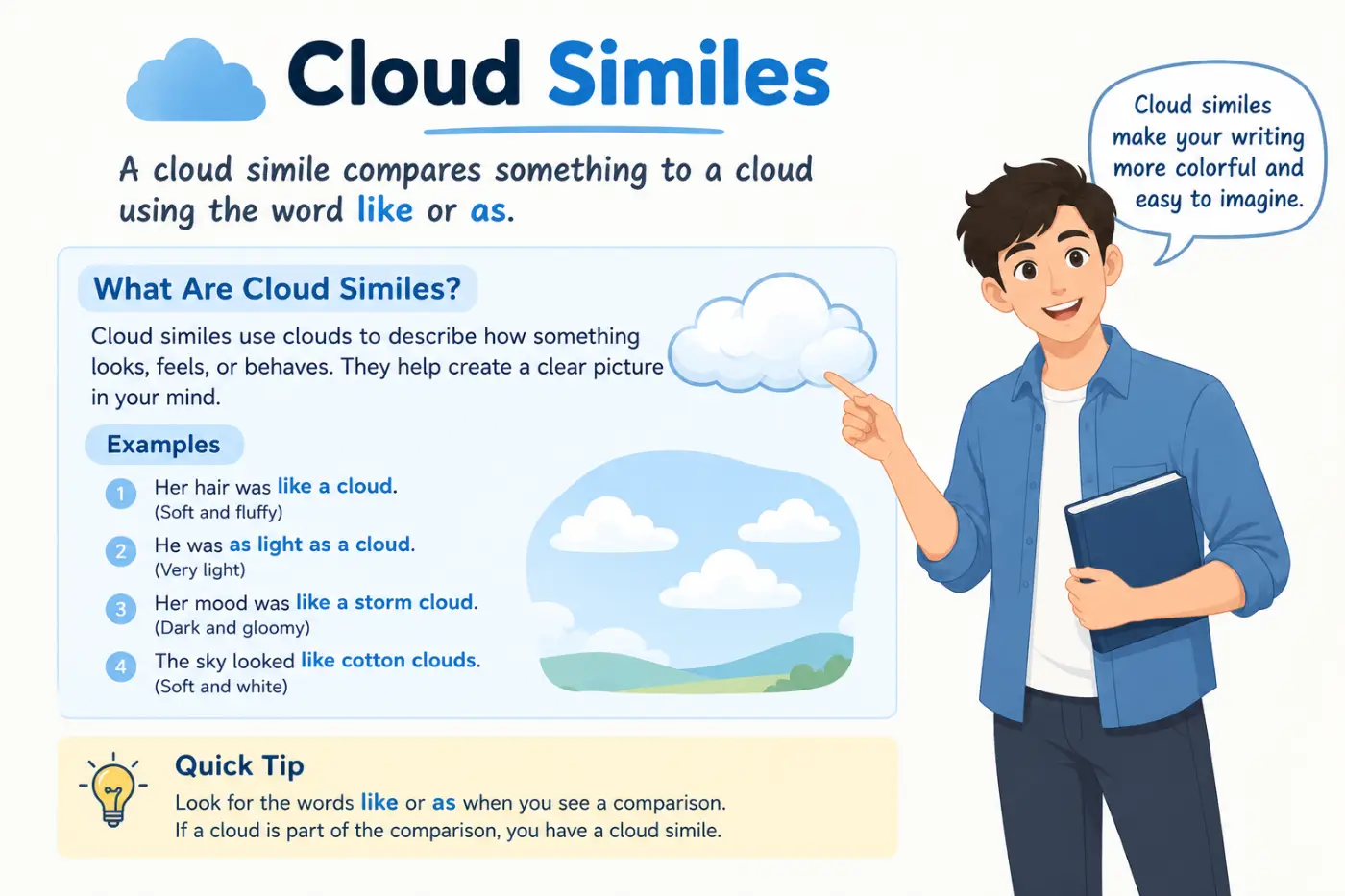
Have you ever been writing a story, school essay, or descriptive paragraph and struggled to explain how beautiful the clouds looked? Maybe they were floating across a bright blue sky, gathering before a storm, or glowing softly during sunset. You could simply write that the clouds were white or dark, but those words don’t always capture the full picture. That’s where Cloud Similes can make your writing more interesting.
These are figures of speech that compare clouds to something else using the words “like” or “as.” For example, “The clouds were as soft as cotton” creates a clear picture of fluffy white clouds.
In this guide, you’ll discover more than 40 creative comparisons, their meanings, original example sentences, related vocabulary, and practical writing tips. You’ll also learn how to describe different cloud types, choose the right comparison for your writing, and avoid common mistakes.
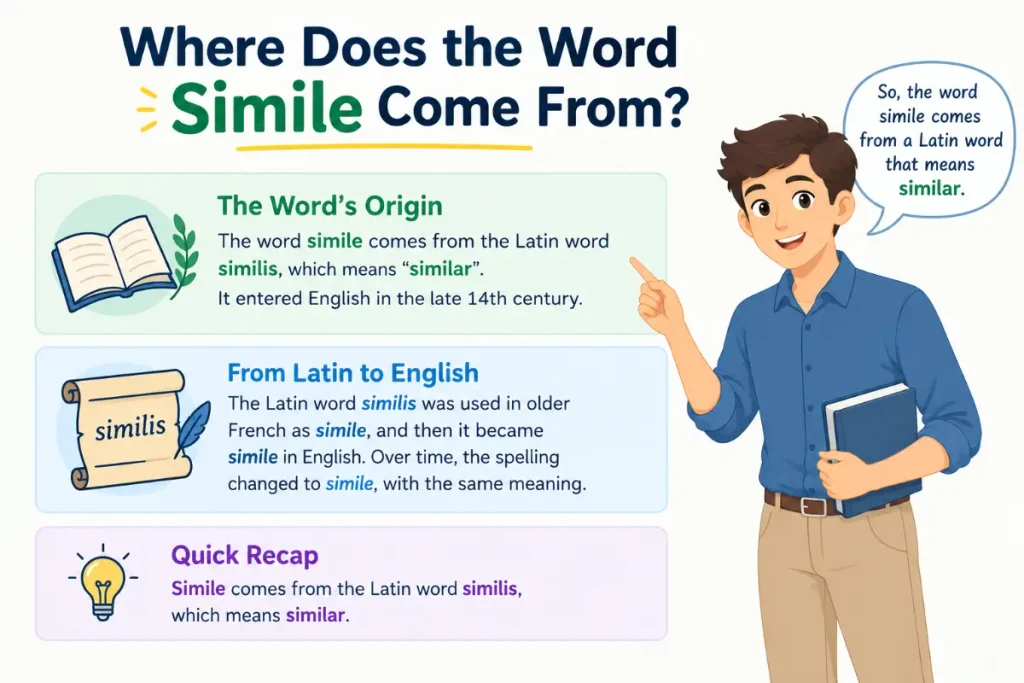
Where Does the Word Simile Come From?
The word “simile” comes from the Latin word “similis,” meaning “like” or “similar.”
Writers have used comparisons for centuries to make descriptions easier to understand. Instead of explaining every detail of an unfamiliar sight, they connect it to something readers already recognize.
For example, most people know what cotton looks like. Comparing clouds to cotton immediately suggests softness, whiteness, and a fluffy appearance.
This technique is especially useful in poetry, storytelling, descriptive essays, and creative writing.
Why Do Writers Compare Clouds to Other Things?
Clouds are useful subjects for figurative language because they constantly change.
Their shapes, colors, sizes, and movements can communicate different emotions.
| Cloud appearance | Suggested feeling | Possible comparison |
|---|---|---|
| White and fluffy | Peaceful | As soft as cotton |
| Thin and scattered | Delicate | Like floating feathers |
| Dark and heavy | Threatening | Like an approaching army |
| Pink at sunset | Romantic | Like rose petals |
| Golden at sunrise | Hopeful | Like scattered gold |
| Gray and motionless | Sad | Like a heavy blanket |
| Fast-moving | Restless | Like racing horses |
| Large and towering | Powerful | Like mountains in the sky |
What Are the Best Similes for Clouds?
The best words describe a clear feature, such as softness, shape, color, movement, or mood.
White clouds often create a peaceful, cheerful, or dreamy atmosphere. These comparisons work well in stories about nature, childhood, pleasant weather, and quiet afternoons.
| Simile | Meaning | Example sentence |
|---|---|---|
| As soft as cotton | Extremely fluffy and gentle-looking | The clouds were as soft as cotton against the morning sky. |
| Like floating pillows | Large, soft, rounded shapes | Floating pillows drifted above the quiet countryside. |
| As white as snow | Bright and pure white | The clouds were as white as snow on a winter morning. |
| Like fluffy sheep | Small, rounded clouds gathered together | The clouds wandered like fluffy sheep across a blue meadow of sky. |
| As light as feathers | Thin and delicate in appearance | The clouds looked as light as feathers above the hills. |
| Like whipped cream | Soft clouds with rounded peaks | White clouds rose like whipped cream over the mountains. |
| Like floating marshmallows | Small, puffy, rounded shapes | The afternoon clouds looked like floating marshmallows. |
| As delicate as lace | Thin clouds with fine patterns | The high clouds were as delicate as lace stretched across the heavens. |
| Like scattered pearls | Small, bright clouds spread apart | Tiny clouds shone like scattered pearls in the sunlight. |
| Like white islands | Separate cloud formations surrounded by blue sky | The clouds rested like white islands in an endless blue ocean. |
Dark Words for Stormy Weather
Dark clouds can suggest danger, sadness, uncertainty, or an approaching storm. Writers often use stronger comparisons to make these scenes feel dramatic.
| Simile | Meaning | Example sentence |
|---|---|---|
| As black as coal | Extremely dark in appearance | The storm clouds looked as black as coal above the valley. |
| Like an approaching army | A large, threatening formation | Dark clouds advanced like an approaching army. |
| As heavy as wet wool | Thick and weighed down in appearance | The gray clouds hung as heavy as wet wool over the town. |
| Like a blanket of smoke | Dark clouds covering a large area | Clouds spread like a blanket of smoke across the horizon. |
| As gloomy as a winter evening | Dark and depressing | The clouds looked as gloomy as a winter evening. |
| Like giant shadows | Large, dark shapes blocking sunlight | Storm clouds moved like giant shadows over the fields. |
| As thick as a fortress wall | Dense and difficult to see through | The clouds stood as thick as a fortress wall before the storm. |
| Like rolling mountains | Large clouds with rising and falling shapes | Thunderclouds rose like rolling mountains above the sea. |
| Like a curtain of darkness | A dark layer hiding the sky | Heavy clouds descended like a curtain of darkness. |
| As threatening as a gathering army | Suggesting approaching danger | The clouds were as threatening as a gathering army before battle. |
Creative Similes for Moving Clouds
Cloud movement can make a scene feel calm, lively, restless, or dramatic.
Different comparisons help readers imagine how quickly the clouds are traveling and how their shapes change along the way.
| Simile | Meaning | Example sentence |
|---|---|---|
| Like drifting boats | Moving slowly and smoothly | The clouds sailed like drifting boats across the afternoon sky. |
| As graceful as dancers | Moving beautifully and gently | The clouds moved as gracefully as dancers above the lake. |
| Like racing horses | Traveling quickly across the sky | Wind-driven clouds raced like horses toward the eastern hills. |
| Like wandering travelers | Moving without an obvious destination | The clouds passed like wandering travelers over the village. |
| As restless as ocean waves | Constantly changing and moving | The clouds were as restless as ocean waves before the storm. |
| Like silent ghosts | Moving quietly with faint shapes | Thin clouds slipped like silent ghosts across the moon. |
| Like leaves carried by the wind | Moving freely and changing direction | The clouds scattered like leaves carried by the wind. |
| As slow as a sleepy turtle | Moving very slowly | A lonely cloud traveled as slowly as a sleepy turtle. |
| Like ships crossing an ocean | Traveling steadily through open space | The clouds moved like ships crossing an endless blue ocean. |
| Like smoke from a chimney | Rising, spreading, or curling | Wispy clouds curled like smoke from a distant chimney. |
What Words Can You Use Instead of Words?
Sometimes a direct adjective or descriptive phrase works better than a full comparison.
For example, instead of writing “The clouds looked like soft pillows,” you could write “Fluffy clouds drifted overhead.”
Neither sentence is automatically better. The right choice depends on how much detail your writing needs.
The following vocabulary table includes 32 words and expressions that can help you describe clouds more precisely.
These are related descriptive terms, not all direct synonyms for the noun “cloud.” Some describe color, shape, movement, texture, or atmosphere.
Simple Words for Describing Clouds
| Word | Meaning | Tone | Example |
|---|---|---|---|
| White | Having a pale, bright color | Simple | White clouds covered the hills. |
| Gray | Having a color between black and white | Simple | Gray clouds filled the sky. |
| Dark | Having little brightness | Simple | Dark clouds gathered overhead. |
| Big | Large in size | Simple | Big clouds blocked the sun. |
| Small | Limited in size | Simple | Small clouds floated above us. |
| Soft | Gentle or smooth in appearance | Simple | Soft clouds surrounded the mountain. |
| Thick | Dense or substantial | Simple | Thick clouds hid the moon. |
| Thin | Having little depth or density | Simple | Thin clouds crossed the sky. |
Everyday Words for Describing Clouds
| Word | Meaning | Tone | Example |
|---|---|---|---|
| Fluffy | Soft and full-looking | Casual | Fluffy clouds floated overhead. |
| Puffy | Rounded and swollen in appearance | Casual | Puffy clouds gathered above the farm. |
| Wispy | Thin and delicate | Descriptive | Wispy clouds stretched across the horizon. |
| Misty | Hazy or covered with fine moisture | Everyday | Misty clouds surrounded the valley. |
| Gloomy | Dark and depressing | Emotional | Gloomy clouds covered the city. |
| Drifting | Moving slowly | Peaceful | Drifting clouds crossed the fields. |
| Towering | Rising to a great height | Dramatic | Towering clouds formed before the storm. |
| Scattered | Spread across different places | Neutral | Scattered clouds appeared after lunch. |
How Do You Choose Cloud Comparisons From Mild to Strong?
Not every cloud description needs to sound dramatic.
A peaceful morning might need gentle language, while a powerful thunderstorm calls for stronger imagery.
Think of descriptive intensity as a scale. Start with ordinary observations and increase the emotional strength only when the scene requires it.
| Intensity | Comparison | Effect on the reader |
|---|---|---|
| Very mild | Like floating cotton | Creates softness |
| Mild | Like drifting feathers | Suggests gentle movement |
| Moderate | Like ships crossing the sky | Adds size and direction |
| Expressive | Like mountains rising overhead | Creates a sense of scale |
| Strong | Like dark waves swallowing the horizon | Suggests approaching danger |
| Very strong | Like an army preparing for battle | Builds tension and fear |
| Intense | Like a monstrous shadow devouring the sun | Creates a frightening atmosphere |
Mild Comparisons for Peaceful Scenes
Gentle comparisons work well when the setting is relaxed.
Example: The clouds drifted like feathers above the quiet lake.
The word “feathers” suggests softness and slow movement. Nothing about the sentence feels threatening.
Moderate Comparisons for Descriptive Writing
Moderate expressions add detail without making the scene overly emotional.
Example: The clouds traveled like ships across a wide blue ocean.
This creates an imaginative picture while keeping the description calm.
How Can You Describe Clouds Using Different Parts of Speech?
Cloud descriptions become more flexible when you understand how nouns, adjectives, and verbs work together.
A simile is a figure of speech, not a separate part of speech. It can appear in different sentence structures.
Nouns That Help Describe Cloud Shapes
Nouns name people, places, things, or ideas.
They are especially useful when comparing clouds to familiar objects.
Common comparison nouns include:
- Cotton.
- Feathers.
- Pillows.
Example: The clouds looked like enormous pillows resting above the valley.
Here, “pillows” provides the central comparison.
Adjectives That Make Cloud Descriptions Clearer
Adjectives describe nouns.
Useful cloud adjectives include fluffy, wispy, billowing, gloomy, luminous, towering, scattered, and delicate.
Compare these sentences:
The clouds moved across the sky.
The delicate clouds moved across the pale evening sky.
The second sentence offers a clearer picture because its adjectives describe both the clouds and their surroundings.
Are These Different in American and British English?
Cloud comparisons generally work the same way in American and British English.
Both varieties use “like” and “as” to introduce similes. Expressions such as “as white as snow” and “like floating cotton” are understandable to readers in both countries.
However, some related vocabulary and spelling conventions differ.
| American English | British English | Meaning |
|---|---|---|
| Gray clouds | Grey clouds | Clouds with a color between black and white |
| Cotton candy sky | Candyfloss sky | A playful description of pink, fluffy clouds |
| Colorful clouds | Colourful clouds | Clouds displaying several colors |
| Colored sky | Coloured sky | A sky showing noticeable colors |
Which Cloud Similes Work Best for Different Writing Situations?
The best comparison depends on your audience, purpose, and tone.
A poetic sentence may sound beautiful in a short story but feel strange in a professional email.
Here are practical ways to choose suitable expressions for different situations.
How Should You Describe Clouds in a Resume?
A resume usually needs direct, professional language. Figurative descriptions of the weather are rarely appropriate unless you’re discussing creative work.
However, if you’re a writer, journalist, photographer, or content creator, you can mention descriptive writing as a skill.
Example:
Created nature-focused articles using descriptive language, visual imagery, and original comparisons.
For a creative writing portfolio attached to your resume, you might include:
The clouds floated like silver feathers above the mountain peaks.
Keep the actual resume focused on your achievements rather than adding decorative descriptions.
What Cloud Comparisons Work Best in an Essay?
Descriptive and narrative essays benefit from clear imagery.
A strong comparison should help the reader picture the scene and understand its atmosphere.
Example:
The afternoon clouds were as soft as cotton, drifting slowly above the quiet countryside.
For a more dramatic essay:
Dark clouds gathered like an approaching army, warning the village of the coming storm.
In an academic or scientific essay, direct descriptions are usually more suitable.
For example:
Dense storm clouds developed during the afternoon.
This is more appropriate for a factual weather report.
What Are Some Original Words for Creative Writing?
Sometimes familiar comparisons such as cotton and pillows don’t fully capture a particular scene.
Creating an original comparison can make your writing more memorable, especially in poems, short stories, and descriptive passages.
The following examples use different settings and emotions.
Cloud Comparisons for Peace and Happiness
- The clouds floated like tiny boats on a quiet blue lake.
- White clouds rested like folded blankets above the sleeping town.
- The morning clouds looked as gentle as a mother’s smile.
These comparisons create a soft atmosphere. They are useful when describing pleasant memories, childhood, or peaceful natural settings.
Cloud Comparisons for Sadness and Loneliness
- Gray clouds hung like unanswered questions above the empty street.
- A lonely cloud drifted like a forgotten letter across the sky.
- The clouds covered the sun like a curtain closing on a happy memory.
These examples connect the appearance of clouds to human emotions.
The cloud itself isn’t sad. The comparison allows readers to understand how the narrator feels while observing it.
What Is the Difference Between Similar Cloud Comparisons?
Two comparisons can describe the same cloud but create very different impressions.
Understanding these small differences helps you choose words more carefully.
Clouds Like Cotton vs Clouds Like Feathers
Both comparisons suggest softness, but they emphasize different features.
| Feature | Like cotton | Like feathers |
|---|---|---|
| Main meaning | Softness and fullness | Lightness and delicacy |
| Typical appearance | Rounded and fluffy | Thin or wispy |
| Suggested movement | Usually gentle | Often floating or drifting |
| Best setting | Clear daytime sky | Calm or breezy sky |
| Example | Clouds rested like cotton above the fields. | Clouds drifted like feathers across the horizon. |
Clouds Like Mountains vs Clouds Like Waves
These expressions both suggest large formations, but they describe different qualities.
| Feature | Like mountains | Like waves |
|---|---|---|
| Main meaning | Height and size | Movement and changing shape |
| Visual effect | Tall and powerful | Rolling and flowing |
| Typical mood | Grand or dramatic | Restless or energetic |
| Best use | Towering clouds | Moving storm clouds |
| Example | Clouds rose like mountains over the sea. | Clouds rolled like waves across the horizon. |
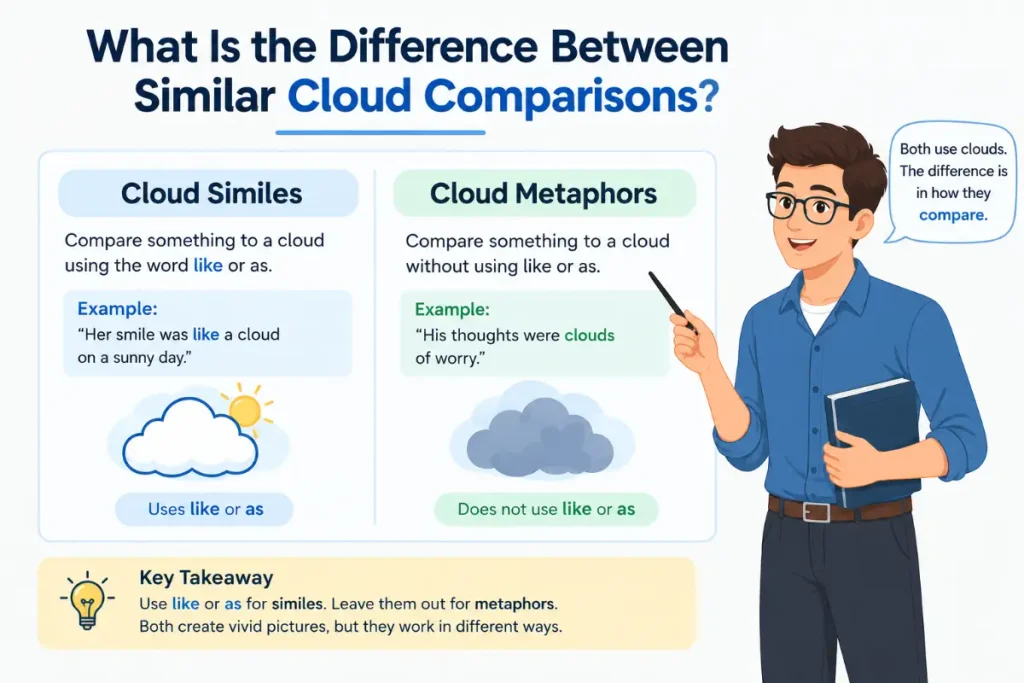
What Is the Difference Between a Cloud Simile and a Metaphor?
Similes and metaphors both create comparisons, but they use different sentence structures.
A simile compares two things using “like” or “as.”
A metaphor describes one thing as though it actually is another.
| Simile | Metaphor |
|---|---|
| The clouds were like cotton. | The clouds were cotton in the sky. |
| The clouds floated like ships. | The clouds were ships crossing the heavens. |
| Dark clouds gathered like an army. | Dark clouds were an army approaching the village. |
| The sunset clouds glowed like fire. | The sunset clouds were fire above the hills. |
| The clouds looked like white blankets. | White blankets covered the sky. |
Can Cloud Descriptions Also Use Personification?
Yes. Personification gives human actions, emotions, or qualities to something that isn’t human.
For example:
The clouds whispered across the evening sky.
Clouds cannot literally whisper. The writer gives them a human action to create a gentle atmosphere.
Another example:
The angry clouds marched toward the sleeping village.
Here, the clouds are described as angry and capable of marching.
You can also combine personification with a simile:
The angry clouds marched like soldiers across the darkening sky.
This sentence uses personification through “angry” and “marched,” while “like soldiers” introduces the simile.
How Can Different Types of Clouds Inspire Better Similes?
Understanding real cloud formations can improve your descriptive writing.
Clouds don’t all have the same shape or appearance. Some form rounded heaps, while others appear as thin streaks or broad layers.
Matching a comparison to the cloud’s actual appearance makes the description more believable.
Cumulus Clouds
Cumulus clouds often have rounded tops and relatively flat bases.
Suitable comparisons:
- Like giant cotton balls.
- Like fluffy sheep.
- Like white mountains.
Example: Cumulus clouds rose like enormous white pillows above the green valley.
Cirrus Clouds
Cirrus clouds are high, thin clouds that often look wispy or feather-like.
Suitable comparisons:
- Like scattered feathers.
- Like delicate brushstrokes.
- As fine as silk threads.
Example: Thin cirrus clouds stretched like delicate brushstrokes across the afternoon sky.
What Are the Most Common Mistakes When Writing Words?
Even a creative comparison can weaken your writing when it feels forced, confusing, or repetitive.
Here are some common problems to avoid.
Using Comparisons That Don’t Match the Scene
A comparison should reflect what the reader is supposed to imagine.
Weak example:
The tiny white clouds looked like enormous black mountains.
This creates a confusing picture because the description contains conflicting details.
Better example:
The tiny white clouds looked like scattered cotton balls.
The revised sentence matches the clouds’ size, shape, and color.
Using Too Many Comparisons in One Sentence
Adding several unrelated comparisons can overwhelm the reader.
Weak example:
The clouds looked like cotton, mountains, feathers, ships, and giant pillows.
Although each comparison might work individually, placing them together makes the image difficult to understand.
Better example:
The clouds floated like giant white pillows above the quiet valley.
One clear comparison is usually stronger than several competing images.
What Are the Opposites of Common Cloud Descriptions?
Words don’t have direct antonyms because they are complete comparisons rather than individual words.
However, many adjectives used to describe clouds have clear opposites.
Understanding these contrasts helps writers show changes in weather, atmosphere, and emotion.
| Cloud description | Opposite | Example |
|---|---|---|
| Bright | Dark | Bright clouds slowly turned dark. |
| Thick | Thin | The thick cloud layer became thinner. |
| Heavy-looking | Light-looking | Heavy-looking clouds gave way to delicate wisps. |
| Gloomy | Cheerful | The gloomy sky gradually became cheerful. |
| Scattered | Gathered | Scattered clouds gathered before the storm. |
| Motionless | Moving | Previously motionless clouds began drifting east. |
| Ominous | Reassuring | The ominous sky became less threatening as the clouds cleared. |
| Dense | Sparse | Dense clouds broke into sparse patches. |
How Do You Write Your Own Cloud Similes?
Creating original words becomes easier when you focus on what you can actually observe.
You don’t need complicated vocabulary or unusual objects. Start with a simple feature and connect it to something familiar.
Step 1: Look at the Cloud’s Appearance
Ask yourself what stands out most.
Is the cloud:
- White or dark?
- Thin or fluffy?
- Small or enormous?
Choose one main feature rather than trying to describe everything at once.
Step 2: Think of Something With a Similar Quality
Connect that feature to a familiar object or experience.
| Cloud feature | Possible comparison |
|---|---|
| Soft and white | Cotton |
| Thin and delicate | Feathers |
| Large and tall | Mountains |
| Dark and spreading | Ink |
| Pink and beautiful | Rose petals |
| Moving quickly | Racing horses |
| Long and narrow | Ribbons |
| Bright and golden | Honey |
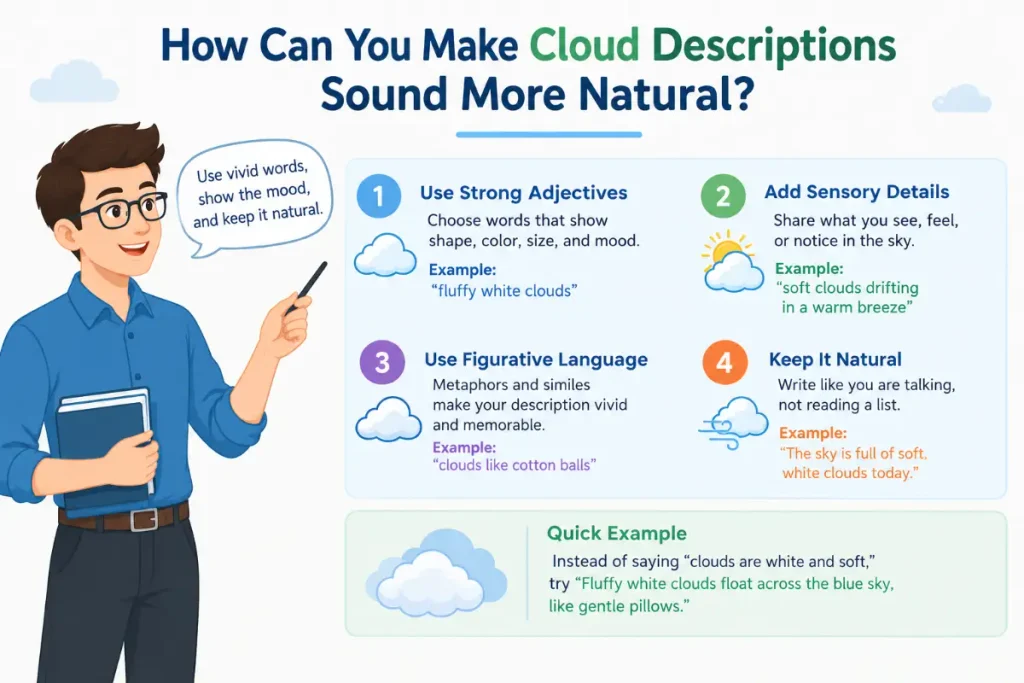
How Can You Make Cloud Descriptions Sound More Natural?
Strong descriptive writing doesn’t depend on using the most unusual comparison. It depends on choosing an image that feels right for the moment.
Here are some practical tips for improving your sentences.
1. Start with the main visual detail. Describe the cloud’s shape, color, or movement before adding extra imagery.
2. Use familiar comparisons when clarity matters. Cotton, feathers, mountains, and blankets are easy for most readers to picture.
3. Choose original imagery when the scene deserves special attention. A memorable sunset might benefit from a comparison involving glowing embers or painted silk.
4. Match your words to the mood. Peaceful scenes usually need gentle imagery, while storm scenes can support stronger language.
5. Avoid unnecessary adjectives. A clear comparison often communicates more than several descriptive words placed together.
Conclusion
Cloud Similes help writers turn ordinary sky descriptions into clear, memorable images. A comparison involving cotton can suggest softness, while mountains can communicate size and power. Feathers create a sense of delicate movement, and dark armies can make approaching storm clouds feel threatening.
When writing a poem, story, essay, or personal description, begin by observing the clouds carefully. Notice their shape, color, movement, and effect on the surroundings. Then connect those details to something familiar. With a little practice, you’ll find that even a simple cloud can inspire a beautiful sentence.
Frequently Asked Questions
What’s another way to say clouds are fluffy?
You can say the clouds look like cotton balls, soft pillows, whipped cream, or floating marshmallows. These comparisons emphasize their rounded, soft appearance.
What is a good simile for dark clouds?
“Dark clouds gathered like an approaching army” is an effective comparison. It suggests a large, threatening formation and works particularly well when describing an approaching storm.
How do you describe clouds in creative writing?
Describe their color, shape, size, and movement, then connect those details to something familiar. For example, “Thin clouds drifted like silver feathers across the evening sky.”
What is a cloud simile for kids?
“The clouds are as fluffy as cotton” is a simple example for children. It uses a familiar object to explain how soft and puffy clouds appear.
What is the difference between a cloud simile and a cloud metaphor?
A cloud simile uses “like” or “as” to compare clouds with something else, while a metaphor makes a direct comparison. “The clouds were like cotton” is a simile, while “The clouds were cotton in the sky” is a metaphor.

Daniel Grammarfield — The Language Learner
Age: 28Occupation: ESL Learner & Digital Professional
Bio:Daniel is a non-native English speaker who wants to communicate more confidently at work and online. He uses Synotrench to improve grammar, understand confusing words, learn correct sentence structures, and build everyday English skills. He prefers simple explanations with practical examples.
Goals:
Master English grammar rules
Avoid common language mistakes
Improve professional communication
Learn English through real-life examples
Quote:“Learning English is not about memorizing rules — it’s about expressing ideas clearly.”
1 thought on “Cloud Similes: 40 Best Examples With Meanings (2026)”