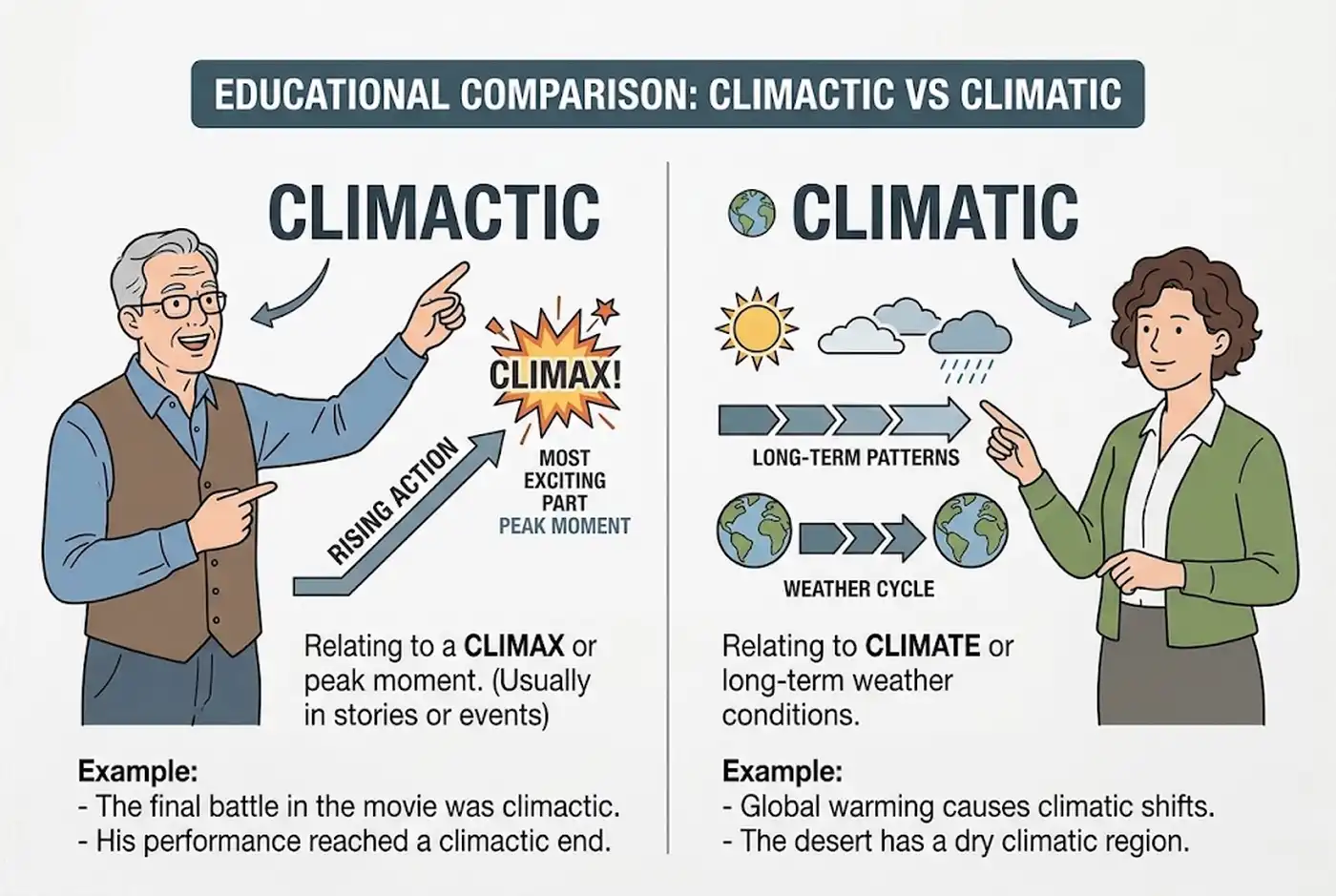
The confusion between climactic vs climatic is common, even among experienced writers. Both words are real English adjectives, and neither is a spelling mistake. However, they describe two very different things. One belongs to exciting moments in stories and real life, while the other relates to climate and weather patterns.
Climactic means relating to a climax or the most exciting or important point of an event. Climatic means relating to climate, including the usual weather conditions of a place over time.
Understanding this small difference can make your writing clearer and more accurate. This guide explains both meanings, their word origins, useful synonyms, real-life examples, common mistakes, and simple tricks for remembering which word to use.
What Is the Difference Between Climactic and Climatic?
The main difference is that climactic describes an important or exciting high point, while climatic describes something connected to climate.
Although these words differ by just one letter, you cannot use them interchangeably.
| Feature | Climactic | Climatic |
|---|---|---|
| Basic meaning | Related to a climax | Related to climate |
| Main idea | An important or exciting high point | Long-term weather conditions |
| Part of speech | Adjective | Adjective |
| Related noun | Climax | Climate |
| Common subjects | Movies, stories, games, arguments | Weather, geography, agriculture, environment |
| Example phrase | A climactic ending | Climatic conditions |
| Common usage | Emotional or dramatic events | Scientific and environmental topics |
Consider these two sentences:
- The movie reached its climactic ending when the hero saved his family.
- The region has unusual climatic conditions that affect farming.

What Does Climactic Mean in Simple English?
Climactic means connected to the most important, intense, or exciting point of something.
It often describes the moment when events reach their highest level of tension or importance.
Writers commonly use climactic when discussing stories, movies, books, speeches, competitions, and major life events.
For example:
- The climactic battle decided the future of the kingdom.
- Everyone waited for the climactic moment of the championship.
- The novel’s climactic scene revealed the killer’s identity.
In each example, something important happens after a period of development or growing tension.
Does Climactic Always Mean Exciting?
No. A climactic moment doesn’t always have to be happy, dramatic, or full of action.
It can also describe a serious, emotional, frightening, or tragic turning point.
For example:
The climactic moment of the documentary came when the survivors shared their experiences.
This sentence describes an important emotional high point rather than an action scene.
Similarly, a climactic event might involve a difficult decision, a surprising discovery, or a major confrontation.
The important feature is its place in the development of events.
Can Climactic Describe Real-Life Events?
Yes. Although climactic is especially common in storytelling, it also works for real situations.
You might describe:
- A climactic moment in a political debate.
- A climactic final round of a competition.
- A climactic confrontation between two business partners.
However, an event should genuinely represent an important high point. Calling every ordinary meeting or conversation climactic can make your writing sound exaggerated.
What Does Climatic Mean in Simple English?
Climatic means related to climate or the usual weather conditions of a particular place over a long period.
Climate includes patterns involving temperature, rainfall, humidity, wind, and other atmospheric conditions.
The word climatic is commonly used in geography, environmental science, agriculture, weather research, and discussions about global warming.
Examples include:
- Climatic conditions affect how crops grow.
- Scientists study climatic changes across different regions.
- The island’s climatic characteristics attract many visitors.
Each sentence describes something related to climate rather than an exciting event.
Does Climatic Mean the Same Thing as Weather?
Not exactly.
Weather describes atmospheric conditions at a particular time or over a short period. Climate describes the usual patterns of weather over many years.
For example:
Weather: It is raining heavily this afternoon.
Climate: The region usually experiences wet winters and dry summers.
Climatic is the adjective connected to the second idea.
You would normally say climatic conditions when discussing the climate of a region, not simply because it happens to be raining today.
Can Climatic Describe Climate Change?
Yes. Climatic is often used in scientific and environmental discussions.
Common expressions include:
- Climatic change
- Climatic variation
However, climate change is generally the more familiar expression in everyday English.
For example:
Correct: Climate change is affecting rainfall patterns.
Also correct: Scientists are studying long-term climatic changes.
Both sentences make sense, but the first sounds more natural in ordinary conversation.
Where Do Climactic and Climatic Come From?
Understanding the origins of these words makes their meanings easier to remember.
Although they share a similar appearance, they developed from different word families.
The Origin of Climactic
Climactic comes from climax, which traces back to the Greek word klimax, meaning ladder or staircase.
The original idea involved a gradual movement upward, like climbing steps.
Over time, climax developed the meaning of a highest or most intense point in a series of events.
This explains why climactic is associated with the peak of a story, argument, performance, or experience.
Think of a movie that gradually builds suspense. Each scene adds tension until the story reaches its biggest moment.
That high point is its climax, and the adjective describing it is climactic.
The Origin of Climatic
Climatic comes from climate, which traces back through Latin to the Greek word klima, meaning inclination or slope.
Historically, this idea was connected to the Earth’s surface and the angle of the sun’s rays.
Over time, climate became associated with the usual weather conditions of different geographical regions.
Today, climatic describes anything connected to those long-term conditions.
How Their Origins Help You Remember
| Word | Related noun | Original idea | Modern meaning |
|---|---|---|---|
| Climactic | Climax | A ladder or rising progression | The highest or most important point |
| Climatic | Climate | Inclination or geographical slope | Conditions related to climate |
What Are the Best Synonyms for Climactic and Climatic?
Choosing a synonym can help you avoid repetition, but it is important to match the original meaning.
A synonym for climactic will not usually work as a synonym for climatic.
For example, dramatic may replace climactic in some sentences, but it cannot replace climatic when discussing rainfall or temperature.
The following master list includes more than 30 useful alternatives and related expressions. They are grouped by tone and everyday usage.
Some are close synonyms, while others work only in particular contexts.
Simple Synonyms
These words are easy to understand and suitable for everyday writing.
| Word | Meaning | Tone | Example |
|---|---|---|---|
| Important | Having great value or meaning | Simple | This was an important moment in the story. |
| Big | Significant or major | Casual | The team prepared for its big moment. |
| Final | Coming at the end | Neutral | The final scene surprised everyone. |
| Major | Having considerable importance | Neutral | The speech marked a major turning point. |
| Exciting | Creating interest or enthusiasm | Positive | The exciting ending pleased the audience. |
| Key | Especially important | Neutral | The key scene explained everything. |
| Peak | The highest point | Neutral | The performance reached its peak. |
| Weather-related | Connected to weather | Simple | The farmers faced weather-related problems. |
Everyday Synonyms
These alternatives sound natural in conversations, articles, and general writing.
| Word | Meaning | Tone | Example |
|---|---|---|---|
| Dramatic | Full of strong emotion or action | Expressive | The film ended with a dramatic confrontation. |
| Decisive | Settling an issue or outcome | Neutral | The decisive goal secured their victory. |
| Pivotal | Extremely important to what happens next | Neutral | It became a pivotal moment in her career. |
| Defining | Giving something its lasting character | Neutral | That was the defining moment of the season. |
| Crucial | Extremely important | Neutral | The final decision was crucial. |
| Turning point | A moment when events change direction | Neutral | The discovery became a turning point. |
| Environmental | Related to the natural surroundings | Neutral | Environmental conditions affect plant growth. |
| Seasonal | Related to a particular season | Neutral | Seasonal rainfall supports local farming. |
| Atmospheric | Related to the atmosphere | Neutral | Atmospheric conditions influence temperatures. |
Formal Synonyms
These expressions work well in academic writing, professional reports, literary analysis, and scientific discussions.
| Word | Meaning | Tone | Example |
|---|---|---|---|
| Culminating | Bringing a series of events to its highest point | Formal | The culminating event ended months of preparation. |
| Momentous | Having great importance or consequences | Formal | The agreement marked a momentous occasion. |
| Critical | Extremely important to an outcome | Formal | The investigation entered a critical stage. |
| Conclusive | Bringing something to a definite end | Formal | The team presented conclusive evidence. |
| Pivotal | Central to an important change | Formal | The ruling was pivotal to the case. |
| Consequential | Producing important results | Formal | It was a consequential decision. |
| Meteorological | Related to weather and atmospheric science | Scientific | Meteorological records showed unusual rainfall. |
| Climatological | Related to the scientific study of climate | Scientific | Researchers examined climatological records. |
| Climate-related | Connected to climate | Formal | The report identified several climate-related risks. |
| Geographical | Related to physical locations and regions | Academic | Geographical differences affect local climates. |
How Do Synonyms Change From Mild to Strong?
Not every important moment deserves the same level of emphasis.
Sometimes you simply want to describe a meaningful event. Other times, you need a word that communicates intense drama or a major turning point.
Choosing the right level of intensity makes your writing more natural.
Climactic Alternatives From Mild to Strong
| Intensity | Word | Best Use |
|---|---|---|
| Mild | Important | An event that matters |
| Mild | Notable | Something worth mentioning |
| Moderate | Significant | An event with clear importance |
| Moderate | Pivotal | A moment that changes what happens next |
| Strong | Crucial | Something essential to an outcome |
| Strong | Decisive | A moment that settles the result |
| Very strong | Climactic | The highest or most important point |
| Very strong | Momentous | An event with major consequences |
Climatic Alternatives From General to Specific
Climatic words are better organized by meaning than emotional intensity.
| Expression | Meaning | Best Context |
|---|---|---|
| Weather-related | Connected to weather | Everyday conversation |
| Environmental | Connected to natural surroundings | General discussions |
| Seasonal | Connected to particular seasons | Agriculture and travel |
| Climatic | Connected to climate | Geography and science |
| Climate-related | Specifically associated with climate | Reports and articles |
| Climatological | Connected to the scientific study of climate | Academic research |
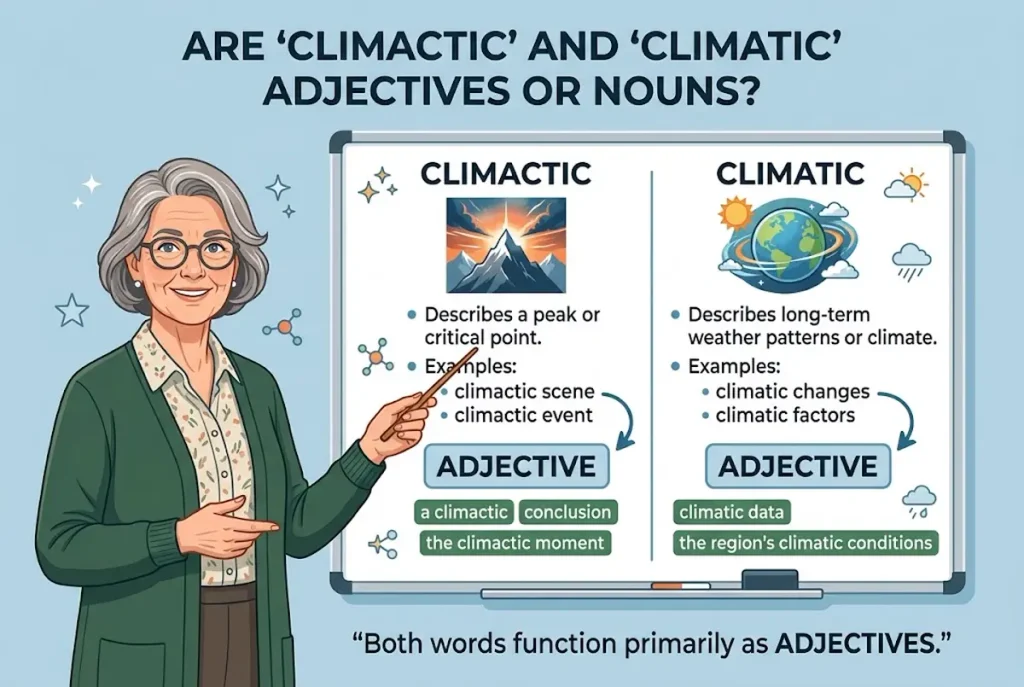
Are Climactic and Climatic Adjectives or Nouns?
Both climactic and climatic are adjectives.
An adjective describes or gives more information about a noun.
These words commonly appear before nouns, although they can also appear after linking verbs in suitable sentences.
The Word Family of Climactic
| Part of Speech | Word | Example |
|---|---|---|
| Noun | Climax | The story reached its climax. |
| Adjective | Climactic | The climactic scene shocked the audience. |
| Adverb | Climactically | The film builds climactically toward its final confrontation. |
The Word Family of Climatic
| Part of Speech | Word | Example |
|---|---|---|
| Noun | Climate | The region has a dry climate. |
| Adjective | Climatic | Climatic conditions affect agriculture. |
| Adverb | Climatically | The two regions are climatically similar. |
| Noun | Climatology | Climatology examines long-term climate patterns. |
| Adjective | Climatological | The study used climatological data. |
Is There a Difference Between American and British English?
The meanings of climactic and climatic are the same in American and British English.
Neither word has a special regional spelling, and both are accepted in formal and informal writing.
| Feature | American English | British English |
|---|---|---|
| Climactic spelling | Climactic | Climactic |
| Climatic spelling | Climatic | Climatic |
| Meaning of climactic | Related to a climax | Related to a climax |
| Meaning of climatic | Related to climate | Related to climate |
| Grammatical use | Adjective | Adjective |
Which Word Should You Use in Different Writing Situations?
Context is one of the easiest ways to choose the correct word.
Before writing, ask yourself what you are describing.
Is it an important high point, or is it something connected to climate?
The answer usually makes the choice clear.
Which Word Is Better for a Resume?
Climactic is rarely needed in a professional resume. It can sound overly dramatic unless you are describing a genuine high point in a career or project.
For most resumes, words such as key, major, successful, and significant are more natural.
Example:
Led the project through its climactic final presentation, securing approval from senior management.
A simpler resume version would be:
Led the final project presentation and secured senior management approval.
Climatic may be appropriate when applying for positions related to environmental science, geography, agriculture, or climate research.
Example:
Analyzed climatic data to identify long-term changes in regional rainfall.
The best choice depends on the actual work you performed.
Which Word Is Better for an Essay?
Both words are useful in essays, but they belong to different subjects.
Use climactic when writing about literature, movies, history, or an important sequence of events.
Example:
The novel’s climactic confrontation reveals the main character’s true intentions.
Use climatic when discussing geography, environmental science, agriculture, or long-term weather patterns.
Example:
The essay examines how climatic conditions influence agricultural production.
In academic writing, choosing the correct word is especially important because the wrong one can change your intended meaning.
Which Word Sounds Natural in Text Messages?
Climactic can work in casual messages, especially when discussing movies, television shows, sports, or exciting experiences.
Example:
That climactic ending was completely unexpected!
However, dramatic, intense, and exciting are often more natural in everyday texting.
Climatic is less common in casual messages, but it is still correct when discussing climate.
Example:
Our geography teacher asked us to compare the climatic conditions of two regions.
If you are simply talking about today’s weather, you probably do not need climatic.
What Are Some Real-Life Examples of Climactic and Climatic?
Reading complete sentences is one of the best ways to understand the difference.
The following examples show how both adjectives work in everyday situations, professional writing, education, entertainment, and science.
Examples of Climactic in Sentences
- The climactic scene revealed that the detective had known the truth all along.
- The championship reached its climactic moment during the final seconds.
- Everyone applauded after the play’s climactic performance.
Notice that each example involves an important moment or high point.
Examples of Climatic in Sentences
- Climatic conditions influence the types of crops farmers can grow.
- Scientists are studying climatic changes in the Arctic.
- The country’s climatic diversity supports many different ecosystems.
Every sentence connects directly to climate or long-term environmental conditions.
Climactic vs Dramatic: What’s the Difference?
Climactic and dramatic are closely related, but they do not mean exactly the same thing.
Dramatic describes something striking, emotional, exciting, or full of strong contrasts.
Climactic describes the high point of a developing event or sequence.
A scene can be dramatic without being climactic.
For example, an argument near the beginning of a movie may be dramatic, but it might not represent the story’s main climax.
| Climactic | Dramatic |
|---|---|
| Refers to a high point | Refers to strong emotion or striking action |
| Often involves a buildup | Does not require a buildup |
| Common in story structure | Common in many situations |
| Emphasizes position in a sequence | Emphasizes emotional or visual impact |
Climactic vs Pivotal: Are They Interchangeable?
Pivotal means extremely important because something depends on it or changes because of it.
Climactic refers to the highest or most important point in a developing series of events.
These meanings can overlap, but they emphasize different things.
| Climactic | Pivotal |
|---|---|
| Focuses on the high point | Focuses on importance or influence |
| Often occurs after a buildup | Can occur at any stage |
| Common in storytelling | Common in business, history, and general writing |
| Suggests a peak | Suggests a turning point or central influence |
What Are the Most Common Mistakes With These Words?
Most errors happen because people recognize the words visually but forget their different meanings.
Here are some mistakes worth avoiding.
Mistake 1: Using Climatic for an Exciting Ending
Incorrect: The book had a climatic ending.
Correct: The book had a climactic ending.
A book’s exciting high point is its climax, not its climate.
Mistake 2: Using Climactic for Climate Conditions
Incorrect: The climactic conditions make farming difficult.
Correct: The climatic conditions make farming difficult.
Farming is affected by temperature, rainfall, and other climate-related factors.
Mistake 3: Assuming Both Words Mean Dramatic
Climatic does not mean exciting, emotional, or dramatic.
A climatic study might be important, but the word itself does not describe excitement.
If you want to describe a powerful moment in a story, climactic is usually the appropriate choice.
When Should You Avoid Using Climactic or Climatic?
Sometimes neither word is the best choice.
Even when a word is grammatically correct, a simpler alternative may communicate your meaning more clearly.
Avoid climactic when you only mean:
- Final
- Last
- Important
For example:
Less natural: We completed the climactic stage of our routine paperwork.
Better: We completed the final stage of our routine paperwork.
The first sentence adds unnecessary drama to an ordinary administrative task.
Avoid climatic when discussing:
- Today’s temperature
- Tomorrow’s forecast
- A short rainstorm
What Are the Antonyms of Climactic and Climatic?
Antonyms are words with opposite meanings.
Climactic has several possible opposites, depending on the sentence.
Climatic is different because it describes a relationship to climate rather than a quality with a simple opposite.
Opposite Words for Climactic
| Word | Meaning | Example |
|---|---|---|
| Anticlimactic | Disappointing after an exciting buildup | The ending felt anticlimactic. |
| Uneventful | Without anything especially important happening | The meeting was uneventful. |
| Ordinary | Not unusual or special | It was an ordinary afternoon. |
| Minor | Relatively unimportant | The scene involved a minor disagreement. |
| Inconsequential | Having little importance or effect | The change was inconsequential. |
| Routine | Normal or regularly repeated | The team held a routine discussion. |
How Can You Remember the Difference Easily?
You do not need to memorize complicated grammar rules to choose correctly.
A few simple memory tricks can make the distinction stick.
Trick 1: Connect Climactic With Climax
Both words contain the same basic idea.
Climax = The highest or most important point.
Climactic = Related to that point.
Imagine a movie reaching its biggest moment. The hero faces the villain, the music becomes intense, and the audience waits for the outcome.
That moment is climactic.
Trick 2: Connect Climatic With Climate
Climatic is directly connected to climate.
Think about temperature, rainfall, seasons, and long-term weather patterns.
If your sentence concerns these topics, climatic is probably the word you need.
Trick 3: Remember the Extra C
Climactic contains an extra c.
Connect that extra letter with climax.
Climatic has no extra c after the a and belongs to the climate word family.
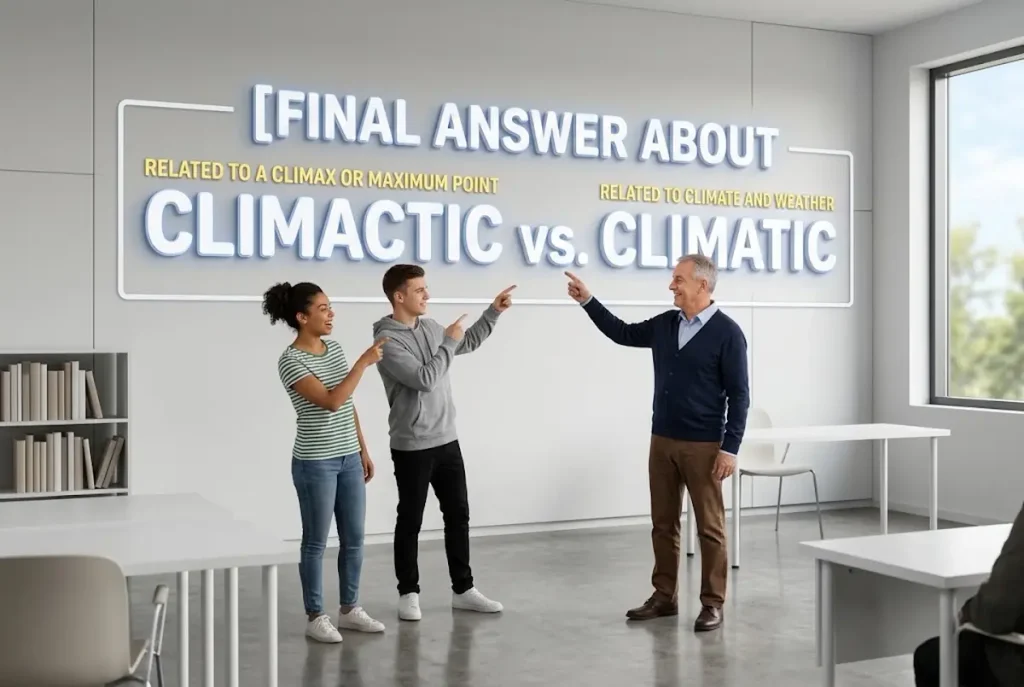
Final Answer About Climactic vs Climatic
The difference between climactic vs climatic comes down to two simple ideas: climax and climate. Climactic describes the most important or intense point in a developing event, such as a movie’s final confrontation or the decisive moment of a competition. Climatic describes something related to climate, including long-term temperature, rainfall, and other environmental patterns.
Neither word is incorrect on its own. The right choice depends entirely on the meaning of your sentence.
When proofreading, look at the noun being described. Words such as ending, scene, battle, and confrontation often need climactic. Words such as conditions, patterns, variation, and factors often need climatic when the subject is climate.
Remember the connection to their original nouns, and you will find it much easier to choose confidently in essays, emails, reports, and everyday conversations.
Conclusion
Understanding the difference between climactic vs climatic is simple once you connect each word to its original meaning. Climactic describes the most important, exciting, or intense point of an event, such as a movie’s final battle or a story’s turning point.
Climatic refers to climate and long-term weather conditions, including temperature, rainfall, and seasonal patterns. Although these words look similar, they serve completely different purposes in English. Remember that climactic comes from climax, while climatic comes from climate.
This small spelling connection can help you avoid common mistakes in essays, emails, reports, and everyday conversations. Whenever you’re unsure, think about the meaning of your sentence. If you’re describing a high point, choose climactic. If you’re discussing climate, choose climatic.
Frequently Asked Questions
What is the main difference between climactic and climatic?
The main difference is that climactic means related to a climax, while climatic means related to climate. Use climactic for important high points and climatic for long-term weather conditions.
Is it a climactic ending or a climatic ending?
Climactic ending is correct when describing the exciting or important high point of a story. Climatic ending would suggest a connection to climate and is not the normal expression.
Is climatic related to climate change?
Yes. Climatic describes things connected to climate, including long-term temperature changes, rainfall patterns, and other environmental conditions. Climate change is the more familiar expression in everyday English.
What’s another way to say climactic?
Common alternatives include pivotal, decisive, dramatic, crucial, and culminating. The best choice depends on the sentence because these words emphasize slightly different qualities.
Can climactic describe a real-life situation?
Yes. Climactic can describe an important high point in real life, including a decisive competition, major confrontation, or significant announcement. It is not limited to fictional stories.

Daniel Grammarfield — The Language Learner
Age: 28Occupation: ESL Learner & Digital Professional
Bio:Daniel is a non-native English speaker who wants to communicate more confidently at work and online. He uses Synotrench to improve grammar, understand confusing words, learn correct sentence structures, and build everyday English skills. He prefers simple explanations with practical examples.
Goals:
Master English grammar rules
Avoid common language mistakes
Improve professional communication
Learn English through real-life examples
Quote:“Learning English is not about memorizing rules — it’s about expressing ideas clearly.”
1 thought on “Climactic vs Climatic: Simple Guide With Examples (2026)”