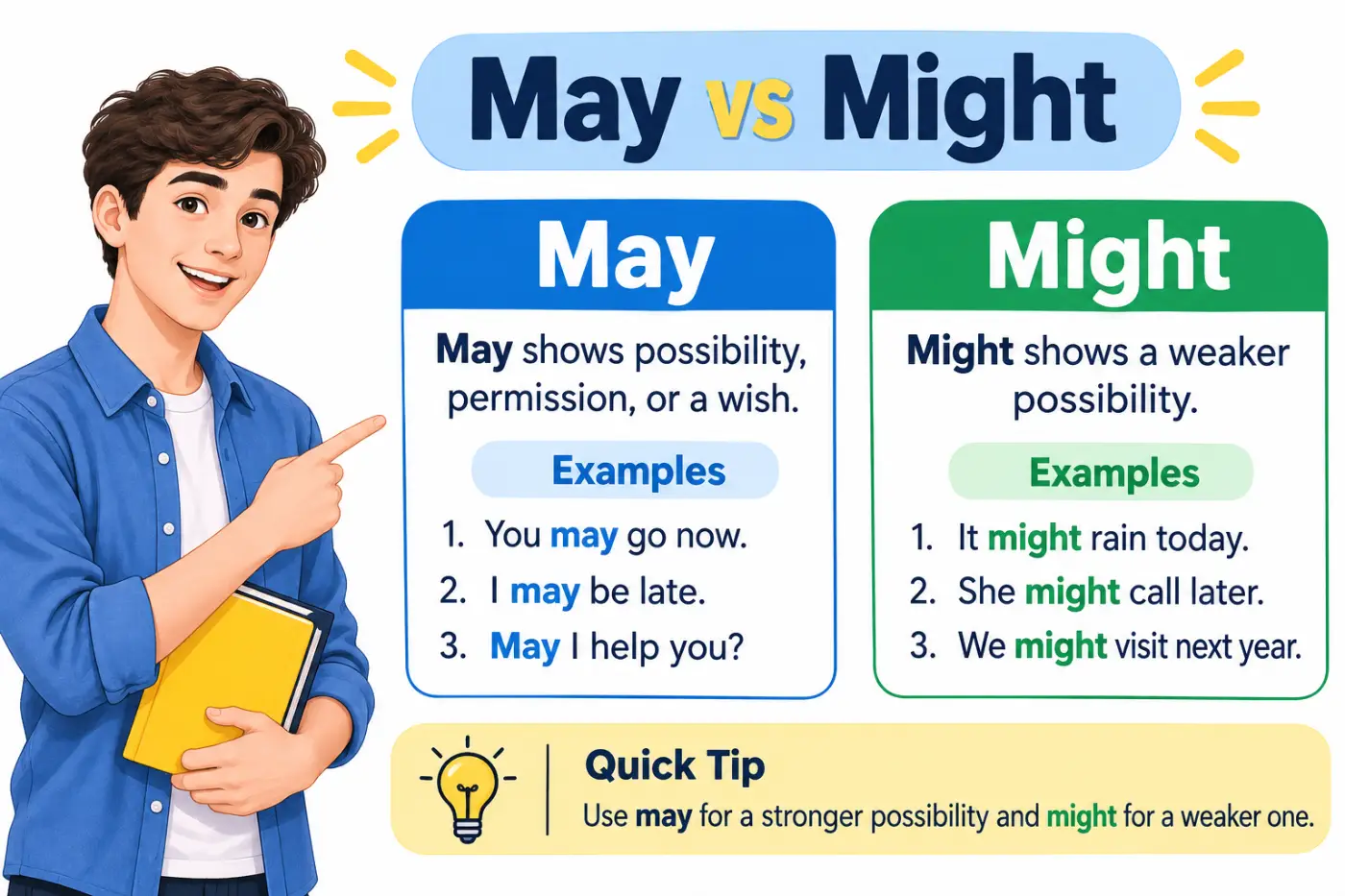
Imagine you’re writing May vs Might an email to your teacher or manager. You want to explain that you could finish a project tomorrow, but you’re not completely sure. Should you write may or might? Both words express possibility, so choosing the right one can feel confusing.
The difference is usually about how strongly you express that possibility. May often suggests that something is possible or allowed. Might often presents a possibility that feels less certain, more tentative, or more hypothetical. However, the two words sometimes overlap.
May and might are modal verbs that express possibility. May can also express permission, while might often makes a statement sound more uncertain or polite.
Learning how these words work can help you write clearer emails, school assignments, business messages, and everyday conversations. You will also understand their history, common synonyms, differences in tone, and the mistakes English learners often make.
What Is the Difference Between May and Might?
May and might are modal auxiliary verbs. They work with the base form of another verb to express possibility, permission, or uncertainty.
The main difference is the strength and tone of the statement.
| Word | Main meaning | Common use | Example |
|---|---|---|---|
| May | Something is possible or permitted | Possibility and permission | It may rain tonight. |
| Might | Something is possible but less certain or more tentative | Uncertain situations and hypothetical ideas | It might rain tonight. |
Both sentences are grammatically correct. However, the second sentence can sound more cautious.
When Should You Use May?
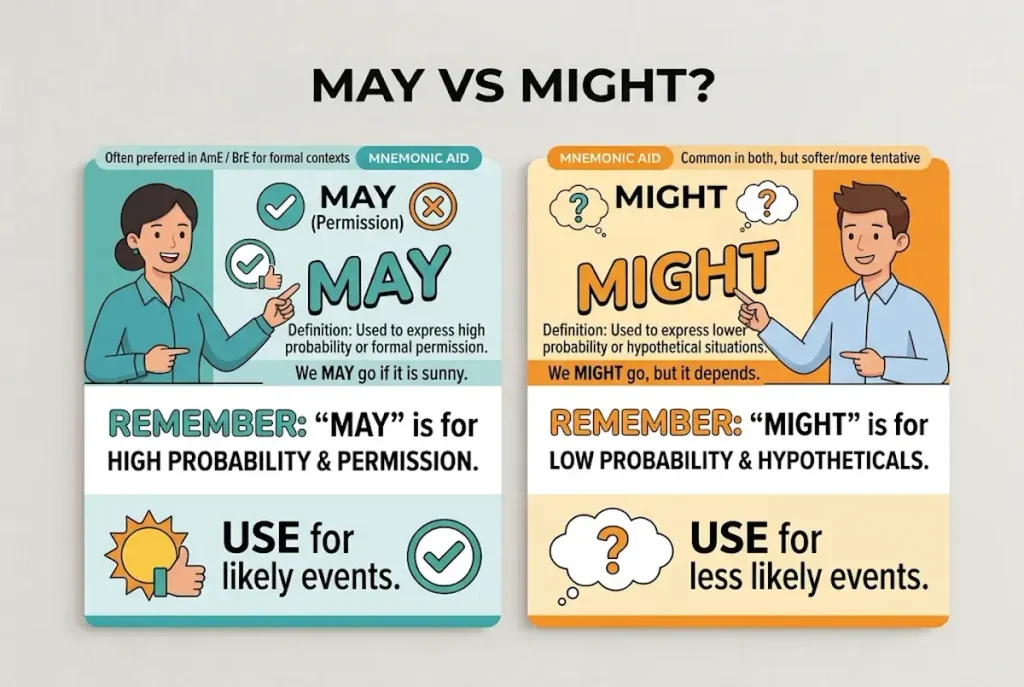
Use may when you want to say that something is possible or when you need to ask for or give permission.
Examples:
- We may visit our grandparents this weekend.
- The package may arrive tomorrow.
- You may leave the classroom after finishing your work.
- This information may help you understand the topic.
- May I use your phone for a moment?
In the first four examples, may expresses possibility or permission. In the last example, it introduces a polite request.
When Should You Use Might?
Use might when you want to express an uncertain possibility, discuss an imagined situation, or make a suggestion sound less direct.
Examples:
- I might visit my grandparents this weekend.
- The package might arrive tomorrow.
- She might need some extra time.
- We might try a different approach.
- You might want to check your spelling.
Might is especially useful when you don’t want to sound completely certain.
Can May and Might Replace Each Other?
Sometimes, yes. Both words can describe something that could happen.
For example:
- It may snow tomorrow.
- It might snow tomorrow.
Both sentences describe a possible event. The second one may sound more uncertain, but the difference is not always strict.
The surrounding context, speaker’s intention, and tone can affect the meaning. English speakers often use these words interchangeably when discussing ordinary possibilities.
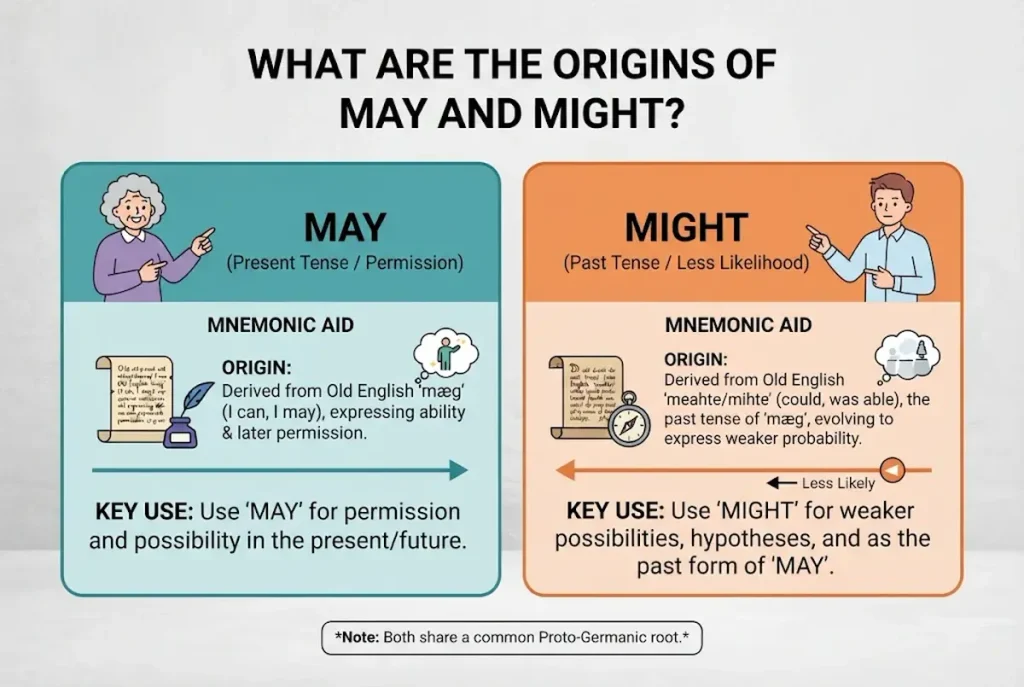
What Are the Origins of May and Might?
Understanding the history of these words makes their relationship easier to remember.
Where Does the Word May Come From?
May comes from Old English mæg, which was related to the verb magan. It expressed ability, power, or having the ability to do something.
Over time, its meaning developed. People began using may to express possibility and permission.
Today, may commonly appears in sentences such as:
- You may enter the building.
- We may need another meeting.
- The answer may be correct.
Its modern meanings include permission and possibility.
Where Does the Word Might Come From?
Might comes from Old English miht or meaht, which referred to power, strength, or ability. It developed alongside the older verb forms related to may.
In modern English, might serves as the past form of may in some reported or indirect statements. It also expresses present and future possibilities.
For example:
- Direct statement: She says she may come.
- Reported statement: She said she might come.
Might also works independently to express uncertainty:
- I might call you later.
- They might change their plans.
Although the words share a historical connection, modern English gives them slightly different uses.
What Are the Best Synonyms for May and Might?
May and might do not have one perfect synonym in every sentence. The best replacement depends on the meaning you want to express.
For example, possible can replace may in some sentences, but it cannot replace may when the word expresses permission.
The following table includes useful alternatives grouped by tone and formality.
Simple Synonyms
These words are easy to understand and work well in everyday English.
| Word | Meaning | Tone | Example |
|---|---|---|---|
| Can | Something is possible or someone has the ability | Simple | We can visit tomorrow. |
| Could | Something is possible | Neutral | It could rain tonight. |
| Possible | Able to happen | Simple | A delay is possible. |
| Perhaps | Maybe something will happen | Neutral | Perhaps she will join us. |
| Maybe | Possibly | Casual | Maybe I’ll call later. |
| Able | Having the ability | Neutral | He may be able to help. |
Everyday Synonyms
These alternatives work in normal conversations, emails, and informal writing.
| Word | Meaning | Tone | Example |
|---|---|---|---|
| Likely | Having a good chance of happening | Neutral | She is likely to arrive soon. |
| Probably | Very possible or expected | Neutral | They will probably agree. |
| Possibly | Something could happen | Neutral | We could possibly meet tomorrow. |
| Conceivably | Something could happen or be imagined | Neutral | He could conceivably win. |
| Chance | An opportunity or possibility | Casual | There is a chance of rain. |
| Seemingly | Appearing to be true | Neutral | She is seemingly ready. |
| Potentially | Having the possibility of happening | Neutral | This could potentially work. |
Formal Synonyms
Use these expressions in reports, academic writing, professional emails, and business communication.
| Word | Meaning | Tone | Example |
|---|---|---|---|
| Presumably | Based on what is known or expected | Formal | The results are presumably accurate. |
| Feasibly | In a way that can realistically happen | Formal | We could feasibly complete the task. |
| Plausibly | In a way that seems reasonable | Formal | This explanation could plausibly be correct. |
| Hypothetically | In an imagined situation | Formal | Hypothetically, the plan might succeed. |
| Arguably | Something that can reasonably be considered true | Formal | This may arguably be the best option. |
| Potential | A possibility that may develop | Formal | The project has potential for growth. |
| Permissible | Allowed under rules or laws | Formal | Entry is permissible with approval. |
Which Synonyms Express Mild and Strong Possibility?
Some words express a weak possibility, while others suggest that something is more likely to happen.
The following guide moves from a very uncertain possibility toward a stronger expectation.
| Level | Word or phrase | Meaning | Example |
|---|---|---|---|
| 1. Very uncertain | Remote possibility | Very unlikely but not impossible | A delay is a remote possibility. |
| 2. Weak | Might | Something could happen | I might attend the event. |
| 3. Weak to moderate | Could | Something is possible | We could finish today. |
| 4. Moderate | May | A possibility exists | She may visit us. |
| 5. Moderate | Possibly | Something can happen | He could possibly win. |
| 6. Fairly strong | Likely | There is a good chance | It is likely to rain. |
| 7. Strong | Probably | Something is expected to happen | They will probably arrive soon. |
| 8. Very strong | Almost certain | Something is expected with very little doubt | She is almost certain to win. |
Are May and Might Different Parts of Speech?
May and might are modal auxiliary verbs. They help the main verb express possibility, permission, or other meanings.
They do not usually change according to the subject.
For example:
- I may leave early.
- She may leave early.
- They may leave early.
- I might leave early.
- She might leave early.
- They might leave early.
How Do Modal Verbs Work With Other Verbs?
A modal verb usually comes before the base form of another verb.
Correct examples:
- She may visit us.
- He might call later.
- They may need help.
- We might finish early.
Incorrect examples:
- She may visits us.
- He might calls later.
- They may needed help.
- We might to finish early.
Can May and Might Be Nouns?
Might can also function as a noun. It means strength, power, or force.
Examples:
- The team fought with all its might.
- The country used its military might to defend itself.
May can also be a proper noun when referring to the fifth month of the year or a person’s name.
Examples:
- May is my favorite month.
- May lives near the school.
Is There a Difference Between May and Might in American and British English?
American and British English use may and might in mostly the same way. Both varieties recognize them as modal verbs for possibility and permission.
There are no major spelling differences between these words.
| Situation | American English | British English |
|---|---|---|
| Expressing possibility | It may rain tomorrow. | It may rain tomorrow. |
| Expressing uncertainty | I might visit later. | I might visit later. |
| Asking permission | May I come in? | May I come in? |
| Making a suggestion | You might try again. | You might try again. |
Which Word Should You Use in Emails?
The right choice depends on the message you want to send. In professional emails, may can communicate a possible action, while might can make a suggestion sound less forceful.
May in Professional Emails
Use may when discussing possible plans, future actions, or permission.
Examples:
- We may need to reschedule the meeting.
- You may contact our support team for assistance.
- The manager may approve the request today.
Might in Professional Emails
Use might when you are unsure about a decision or want to make a suggestion politely.
Examples:
- We might need another day to complete the report.
- You might find the attached document helpful.
- I might be able to attend the meeting.
Which Word Works Best in Essays and Academic Writing?
Both words are useful in academic writing. Your choice depends on how strongly you want to present an idea.
When Should You Use May in an Essay?
Use may when presenting a reasonable possibility or explaining a potential result.
Examples:
- Regular exercise may improve overall health.
- Poor communication may affect team performance.
- This study may provide useful information for future research.
When Should You Use Might in an Essay?
Use might when discussing a more tentative explanation, an uncertain result, or a possible alternative.
Examples:
- Other factors might explain the results.
- The new method might produce different outcomes.
- This approach might not work in every situation.
Which Word Is Better for Texting?
In casual messages, both words are natural. You can choose either based on how certain you feel.
Use May in Text Messages
Examples:
- I may come over tonight.
- We may go shopping later.
- I may call you after dinner.
Use Might in Text Messages
Examples:
- I might be late.
- We might watch a movie.
- I might come over if I finish early.
Which Word Should You Use When Speaking?
In everyday speech, may and might both work well. However, they can create different impressions.
Use may when you want to state a possibility or ask for permission.
Examples:
- It may take a few minutes.
- May I ask you a question?
- We may see them tomorrow.
Use might when you want to sound less certain or make a gentle suggestion.
Examples:
- It might take a few minutes.
- You might enjoy this movie.
- We might see them tomorrow.
For natural conversation, focus on your intended meaning rather than trying to follow a strict rule that always makes one word stronger.
What Are Some Real Examples of May and Might?
Examples make the difference easier to understand. The following sentences show how both words work in school, work, travel, family life, and everyday situations.
| Situation | Sentence with May | Sentence with Might |
|---|---|---|
| Weather | It may rain this afternoon. | It might rain this afternoon. |
| School | The teacher may give us homework. | The teacher might give us homework. |
| Work | The manager may approve my leave. | The manager might approve my leave. |
| Travel | We may visit New York next month. | We might visit New York next month. |
| Family | My brother may come home tonight. | My brother might come home tonight. |
| Shopping | The store may close early. | The store might close early. |
| Health | This medicine may cause side effects. | This medicine might cause side effects. |
| Technology | The update may fix the problem. | The update might fix the problem. |
| Sports | Our team may win the match. | Our team might win the match. |
| Plans | I may attend the party. | I might attend the party. |
| Business | The company may hire new employees. | The company might hire new employees. |
| Daily life | She may need your help. | She might need your help. |
What Is the Difference Between May Have and Might Have?
May have and might have are used to discuss possible past events. They are followed by a past participle.
The basic structure is:
May or might + have + past participle.
Examples:
- She may have forgotten the meeting.
- She might have forgotten the meeting.
- They may have missed the bus.
- They might have missed the bus.
When Should You Use May Have?
Use may have when you believe something possibly happened.
Examples:
- He may have left his keys at home.
- The teacher may have changed the schedule.
- They may have taken the wrong road.
When Should You Use Might Have?
Use might have when you want to present a possible past event more tentatively.
Examples:
- He might have left his keys at home.
- The teacher might have changed the schedule.
- They might have taken the wrong road.
Can May Have and Might Have Express Regret?
Might have can also appear in sentences about missed opportunities or imagined past situations.
Examples:
- I might have won if I had trained harder.
- She might have become a doctor if she had continued studying.
- We might have arrived earlier if we had left on time.
What Is the Difference: May vs Could vs Might?
May, could, and might all express possibility, but each word has other uses.
| Word | Main use | Example |
|---|---|---|
| May | Possibility and permission | She may join us. |
| Could | Possibility, ability, and past ability | She could join us. |
| Might | Uncertain or tentative possibility | She might join us. |
Could vs May
May often presents something as a possible event. Could can describe possibility, ability, or an available option.
Examples:
- We may travel next week.
- We could travel next week.
The first sentence presents a possible plan. The second can suggest that traveling is one available option.
Could vs Might
Could often focuses on what is possible. Might focuses on whether something may happen.
Examples:
- This solution could work.
- This solution might work.
Both are correct. The first can emphasize the solution’s potential, while the second expresses uncertainty about its success.
What Is the Difference: May vs Must ?
May and must express different levels of certainty and obligation.
May expresses possibility or permission. Must often expresses strong necessity, obligation, or a logical conclusion.
| Word | Meaning | Example |
|---|---|---|
| May | Something is possible or allowed | You may leave now. |
| Must | Something is required or strongly expected | You must wear a seat belt. |
What Are the Most Common Mistakes With May and Might?
English learners sometimes confuse these words because their meanings overlap. However, a few simple grammar rules can prevent most mistakes.
Adding To After May or Might
Modal verbs take the base form of the main verb without to.
Incorrect: She may to visit us.
Correct: She may visit us.
Incorrect: He might to call tomorrow.
Correct: He might call tomorrow.
Adding S or ES to the Main Verb
The main verb does not take an s or es after may or might.
Incorrect: He may comes later.
Correct: He may come later.
Incorrect: She might needs help.
Correct: She might need help.
Using May and Might Together
Do not normally place may and might together as two modal verbs in one verb phrase.
Incorrect: I may might attend the meeting.
Correct: I may attend the meeting.
Correct: I might attend the meeting.
Choose one modal verb based on your intended meaning.
Confusing Permission With Possibility
May can express permission, but might does not usually serve the same purpose in standard permission questions.
For example:
– May I enter the room?
This is a polite way to ask for permission.
You might hear might in a very tentative or unusual request, such as Might I ask a question? However, this is formal and less common.
Thinking Might Always Means the Past
Might can be the past form of may in reported speech, but it also expresses present and future possibilities.
Examples:
- I might visit tomorrow.
- She might be sleeping now.
- They said they might arrive late.
The meaning depends on the sentence, not just the verb form.
Using May Not and Might Not Incorrectly
Both forms can make a negative statement, but their meaning depends on the context.
Examples:
- She may not attend the event.
- She might not attend the event.
Both sentences suggest that her attendance is uncertain.
However, may not can sometimes mean that something is not permitted.
For example:
– Students may not use phones during the exam.
Here, may not expresses a rule or prohibition, not uncertainty.
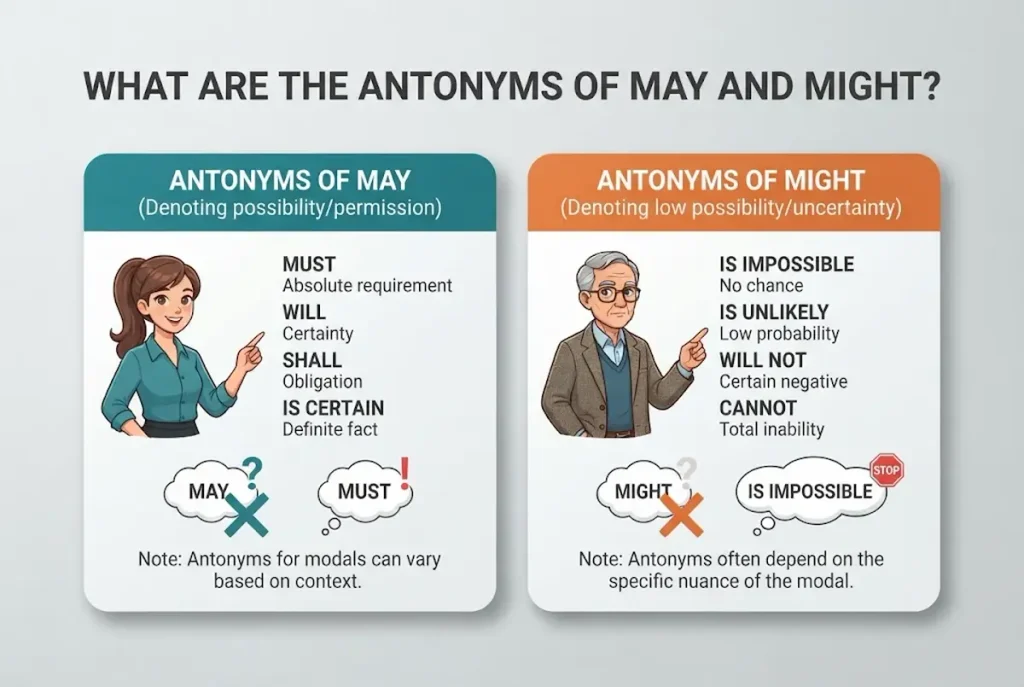
What Are the Antonyms of May and Might?
May and might express possibility, so their opposite ideas often involve impossibility, certainty, or prohibition.
| Word or phrase | Opposite meaning | Example |
|---|---|---|
| Cannot | Something is not possible or allowed | This cannot be correct. |
| Impossible | Unable to happen | It is impossible to finish today. |
| Definitely will not | A certain negative outcome | He definitely will not attend. |
| Must | Strong necessity or conclusion | You must follow the rules. |
| Prohibited | Not allowed | Parking is prohibited here. |
| Certainly | Without doubt | She will certainly arrive. |
How Can You Choose Between May and Might?
Use these simple tips to make the right choice in everyday writing and speaking.
- Use may when you want to express a possibility or give permission.
- Use might when you want to sound more tentative or discuss an uncertain situation.
- Use may have or might have when discussing a possible past event.
- Use might for polite suggestions, such as You might want to check your work.
- Use may not carefully because it can express either uncertainty or prohibition.
Conclusion
Choosing the right modal verb depends on the meaning and tone you want to communicate. May expresses possibility and permission, while might often presents an uncertain or more tentative possibility.
Both words can describe the same event, so you don’t need to treat their difference as an unbreakable rule. In formal writing, use may when you want to present a reasonable possibility and might when you want to sound more cautious.
In everyday conversations, either word may sound natural. Remember to follow both words with the base form of a verb. With regular practice, you’ll find it easier to choose the right expression in emails, essays, and daily conversations.
Frequently Asked Questions
Is may stronger than might?
May can sound slightly more confident than might when expressing possibility. However, the difference depends on the context and the speaker’s intention.
Can I use may and might in the same sentence?
Yes, you can use both in one sentence when each belongs to a different clause. For example, I may leave early if I might miss the last train is grammatically possible, although a more natural version would be I may leave early because I might miss the last train.
Is might the past tense of may?
Might is traditionally the past form of may. It appears in reported speech, but it also expresses present and future possibilities.
Should I use may or might in formal writing?
Both are suitable for formal writing. Use may to express a reasonable possibility or permission, and might when you want to present an idea more cautiously.
Can might be used for permission?
Yes, but it is uncommon and very formal. For example, Might I ask a question? is a polite request. May I ask a question? is more common.
What’s another way to say may or might?
You can use words such as could, possibly, perhaps, maybe, or potentially. The best alternative depends on the sentence because these words do not all express permission.
What is the difference between may not and might not?
May not can express uncertainty or a lack of permission. Might not usually expresses uncertainty about something happening.
Which is correct: It may happen or it might happen?
Both sentences are correct. It may happen can sound slightly more direct, while it might happen often sounds more tentative.

Daniel Grammarfield — The Language Learner
Age: 28Occupation: ESL Learner & Digital Professional
Bio:Daniel is a non-native English speaker who wants to communicate more confidently at work and online. He uses Synotrench to improve grammar, understand confusing words, learn correct sentence structures, and build everyday English skills. He prefers simple explanations with practical examples.
Goals:
Master English grammar rules
Avoid common language mistakes
Improve professional communication
Learn English through real-life examples
Quote:“Learning English is not about memorizing rules — it’s about expressing ideas clearly.”
2 thoughts on “May vs Might: The Ultimate Guide to the Difference”