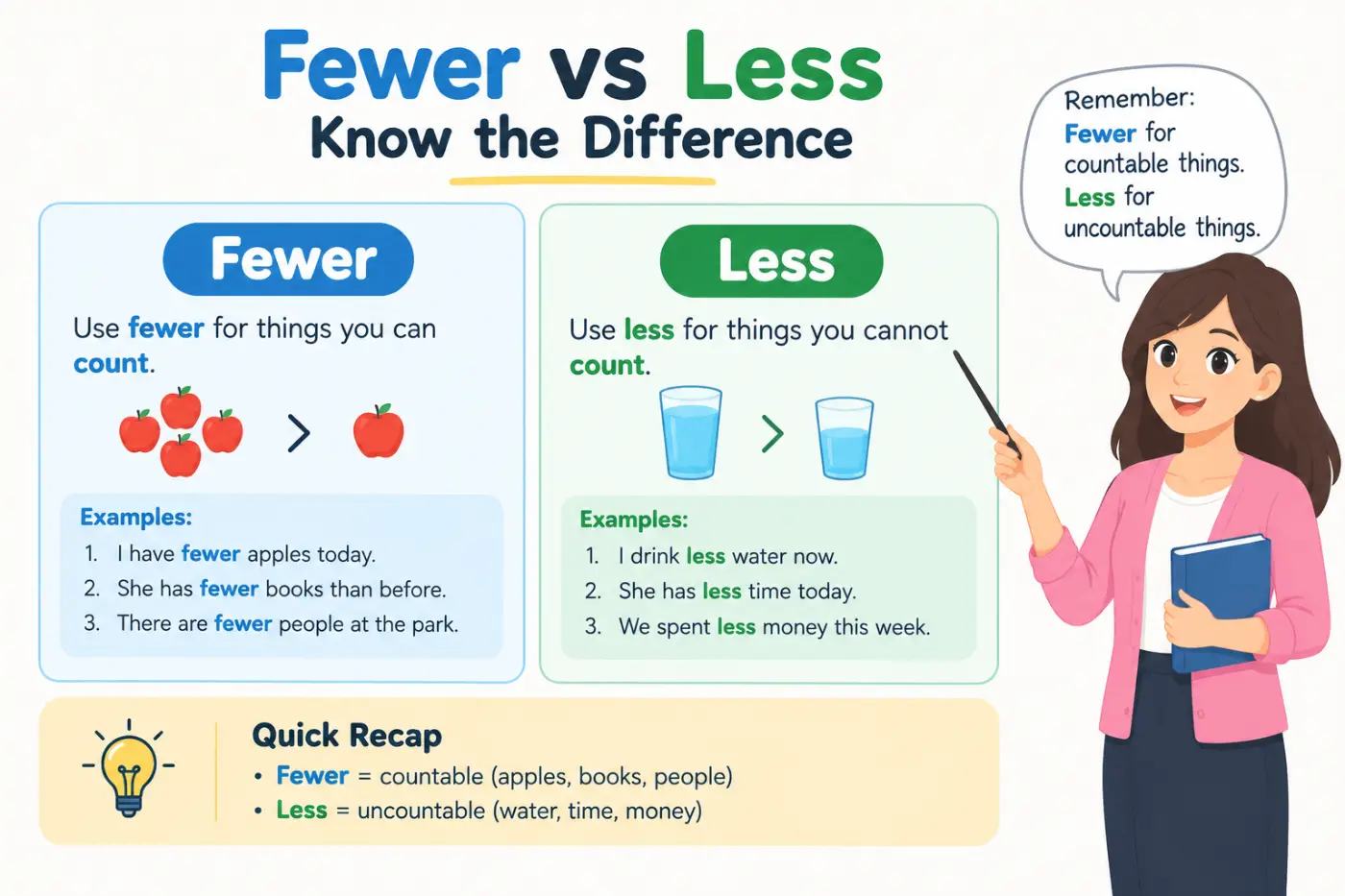
The confusion between Fewer vs Less is common because both words describe a smaller amount. However, they don’t always work with the same types of nouns. Understanding this difference helps you write clearer sentences without second-guessing yourself.
Fewer is generally used with things you can count individually, such as books, people, and mistakes. Less is generally used with things measured as an amount, such as water, money, and time.
In this guide, you’ll learn the meaning and origin of both words, their grammar rules, useful alternatives, common mistakes, and practical examples. You’ll also discover why some familiar expressions don’t follow the basic rule.
What Is the Difference Between Fewer and Less?
The main difference comes down to countable and uncountable nouns.
Fewer refers to a smaller number of individual things. Less refers to a smaller amount, quantity, or degree.
Consider these examples:
- There are fewer students in class today.
- I need less sugar in my coffee.
- She made fewer mistakes on her second attempt.
Students and mistakes can be counted individually. Sugar and time are usually treated as measurable amounts.
Fewer vs Less at a Glance
| Feature | Fewer | Less |
|---|---|---|
| Main meaning | A smaller number | A smaller amount |
| Used with | Countable nouns | Uncountable nouns |
| Main question | How many? | How much? |
| Example with food | Fewer apples | Less rice |
| Example with work | Fewer tasks | Less work |
| Example with people | Fewer visitors | Less traffic |
| Comparative form of | Few | Little |
| Common opposite | More | More |
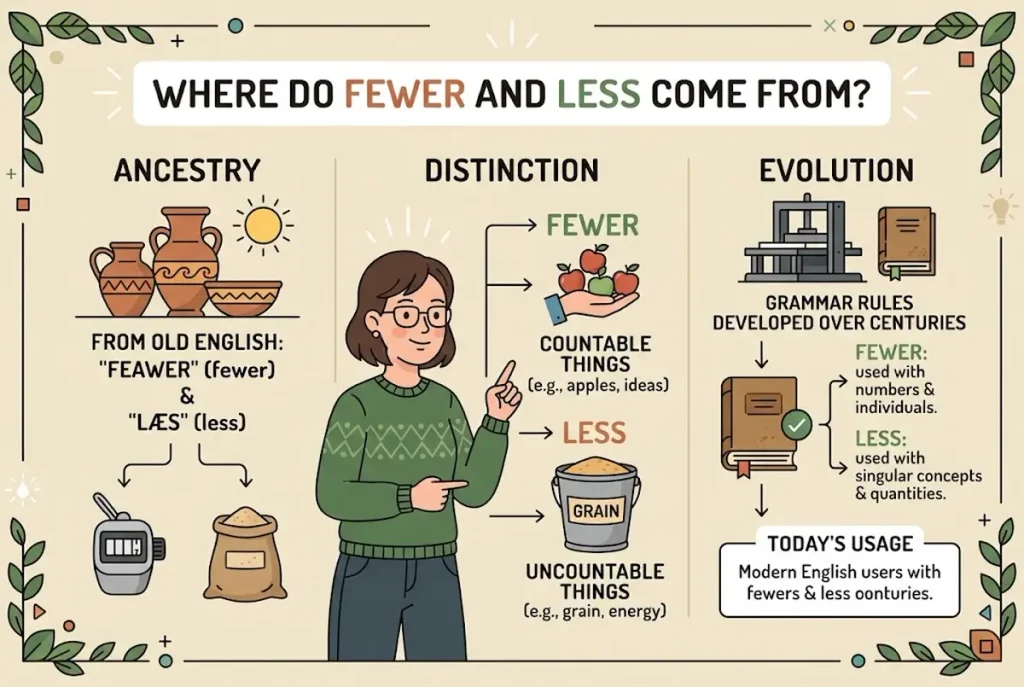
Where Do Fewer and Less Come From?
Understanding their origins makes the grammar rule easier to remember.
Origin of Fewer
Fewer comes from the Old English word fēawa, meaning few or a small number.
Over time, English developed fewer as the comparative form of few.
Today, it describes a smaller number of countable people, objects, or events.
For example:
- Few people attended the meeting.
- Fewer people attended the second meeting.
The second sentence compares two numbers of attendees.
Origin of Less
Less comes from the Old English word lǣssa, which expressed a smaller amount or degree.
It became the comparative form associated with little.
For example:
- There is little hope of rain.
- There is less hope of rain today than yesterday.
Less can describe physical quantities, abstract ideas, and degrees of something.
Why Do People Confuse These Words?
English speakers have used less with both countable and uncountable nouns for centuries.
The familiar distinction became especially influential through an eighteenth-century grammar recommendation associated with Robert Baker.
Modern formal writing generally follows the distinction, but everyday English still allows less in several situations involving numbers, measurements, and fixed expressions.
This explains why some sentences sound natural even when they don’t follow the simplest classroom rule.
When Should You Use Fewer?
Use fewer when discussing individual items that can be counted separately.
These nouns are called countable nouns.
Examples include:
- Students
- Books
- Cars
- Mistakes
- Questions
Each item can be counted using numbers.
You can say one book, two books, or ten books. Therefore, fewer books is the standard choice.
Examples of Fewer in Sentences
- Fewer customers visited the store on Monday.
- Our teacher assigned fewer questions this week.
- She received fewer emails during her vacation.
- The new system produces fewer errors.
- We need fewer chairs for tomorrow’s meeting.
Notice that every example involves separate items that could be counted.
Can Fewer Be Used Without a Noun?
Yes. You can use fewer without repeating a noun when its meaning is already clear.
Example:
Last year, 50 students joined the club. This year, fewer joined.
The reader understands that fewer refers to students.
You can also write:
I ordered twelve notebooks, but she ordered fewer.
Repeating notebooks isn’t necessary.
When Should You Use Less?
Use less when discussing something treated as an amount rather than individual units.
These are generally called uncountable or mass nouns.
Common examples include:
- Water
- Milk
- Sugar
- Money
- Information
You can measure these things, but you don’t normally count them directly as separate units.
For example, you can count bottles of water, but you don’t usually say three waters when referring to the liquid itself. In a restaurant, however, three waters can informally mean three servings.
Examples of Less in Sentences
- I need less salt in my soup.
- She spends less money on unnecessary purchases.
- We have less information about the second candidate.
- The new refrigerator uses less electricity.
- He showed less patience during the discussion.
In each sentence, the noun represents a quantity or general amount.
Can Less Be Used Without a Noun?
Yes. Like fewer, less can stand alone when the meaning is understood.
Example:
I used to drink three cups of coffee daily. Now I drink less.
Here, less refers to the amount of coffee consumed.
Another example:
The first project required considerable effort, but the second required less.
The noun effort doesn’t need to appear twice.
What Are the Best Synonyms for Fewer and Less?
Both words have useful alternatives, but their synonyms aren’t always interchangeable.
Some alternatives refer to numbers, others describe amounts, and some express a decrease in intensity.
The following tables include more than 30 related words and expressions grouped by tone and usage.
Simple Alternatives
| Word or Phrase | Meaning | Tone | Example |
|---|---|---|---|
| Smaller number | A reduced count | Simple | A smaller number of students enrolled. |
| Smaller amount | A reduced quantity | Simple | Add a smaller amount of sugar. |
| Not as many | A lower number | Casual | Not as many people attended. |
| Not as much | A lower amount | Casual | I don’t need as much water. |
| A little less | A slightly reduced amount | Simple | Use a little less oil. |
| A few less | A slightly lower count | Casual | We have a few less than before. |
| Reduced | Made smaller | Neutral | The reduced workload helped everyone. |
| Lower | Below a previous level | Neutral | Sales were lower this month. |
Everyday Alternatives
| Word or Phrase | Meaning | Tone | Example |
|---|---|---|---|
| Cut down | Reduce something | Conversational | We should cut down on waste. |
| Cut back | Use or spend less | Conversational | She cut back on spending. |
| Scaled down | Made smaller | Neutral | They planned a scaled-down event. |
| Limited | Kept within a boundary | Neutral | The store has limited stock. |
| Decreased | Became smaller | Neutral | Attendance decreased this week. |
| Reduced quantity | A smaller amount | Neutral | Choose a reduced quantity of rice. |
| Reduced number | A smaller count | Neutral | A reduced number of workers attended. |
| Shorter | Smaller in length or duration | Everyday | We had a shorter meeting. |
Formal Alternatives
| Word or Phrase | Meaning | Tone | Example |
|---|---|---|---|
| Diminished | Reduced in size or strength | Formal | The project received diminished support. |
| Declining | Gradually becoming smaller | Formal | Declining enrollment concerned the school. |
| Decreased | Reduced from an earlier level | Formal | The report showed decreased demand. |
| Lower volume | A smaller overall quantity | Professional | The factory reported a lower volume of waste. |
| Lower proportion | A smaller share of a total | Academic | A lower proportion of students passed. |
| Reduced frequency | Something happening less often | Formal | The treatment required reduced frequency of use. |
| Minimal | Very small in amount | Formal | The changes caused minimal disruption. |
| Limited availability | A restricted supply | Professional | Limited availability affected deliveries. |
| Lesser | Smaller in degree or importance | Formal | The decision carried lesser financial risk. |
How Do You Choose Synonyms by Intensity?
Not every reduction is equal.
Sometimes you want to describe a tiny change. Other times, you need to show a major decrease.
The following scale helps communicate the size of a reduction.
| Intensity | Useful Expression | Example |
|---|---|---|
| Very mild | Slightly fewer | Slightly fewer people registered. |
| Mild | A little less | We need a little less water. |
| Moderate | Somewhat fewer | Somewhat fewer employees attended. |
| Moderate | Noticeably less | The machine produces noticeably less noise. |
| Strong | Significantly fewer | Significantly fewer errors appeared. |
| Strong | Considerably less | The project required considerably less funding. |
| Very strong | Far fewer | Far fewer students failed the test. |
| Very strong | Much less | We experienced much less traffic. |
| Extreme | Drastically reduced | Production was drastically reduced. |
| Extreme | Almost none | Almost no supplies remained. |
How Do Fewer and Less Work With Different Parts of Speech?
Both words can function as comparative determiners and pronouns. Less can also function as an adverb.
Understanding these roles helps explain why the words sometimes appear without nouns.
Fewer as a Determiner
A determiner appears before a noun and helps describe its quantity.
Example:
Fewer employees requested leave this month.
Fewer as a Pronoun
A pronoun can replace a noun that is already understood.
Example:
Twenty people applied last year, but fewer applied this year.
Fewer stands for a smaller number of people.
Less as a Determiner
Less can describe the amount of an uncountable noun.
Example:
The new design requires less space.
It describes the amount of space.
Less as a Pronoun
Less can also stand alone.
Example:
I expected more, but received less.
The word refers to a smaller amount than expected.
Are Fewer and Less Used Differently in American and British English?
The basic grammar distinction is the same in American and British English.
Both generally recommend fewer for countable nouns and less for uncountable nouns in edited writing.
However, everyday usage isn’t always identical to formal grammar recommendations.
American English Usage
American English commonly uses expressions such as:
- Less than $100.
- Less than five miles.
- Less than two hours.
The last expression is especially familiar on supermarket signs, although ten items or fewer follows the traditional countable-noun rule.
British English Usage
British English follows the same general distinction.
Expressions involving money, time, distance, and measurements also commonly use less.
For example:
The journey takes less than thirty minutes.
This sentence is natural in both varieties.
Does the Supermarket Sign Break the Rule?
Supermarket signs often say “10 items or less.”
Traditional grammar guidance prefers “10 items or fewer” because items are countable.
However, the version using less is common and widely understood.
For academic writing, professional reports, and grammar exercises, fewer is the safer choice with countable items.
Which Word Should You Use in Different Writing Situations?
The best choice depends on the noun, not simply on how formal your sentence sounds.
Here are practical examples for common situations.
Which Word Is Better for a Resume?
Use fewer when describing a reduction in countable errors, complaints, or tasks.
Use less when describing reduced spending, waste, or workload.
Examples:
- Reduced processing errors, resulting in fewer customer complaints.
- Introduced a new workflow that required less manual effort.
- Helped the department complete projects with fewer delays.
For resumes, measurable results are especially useful.
Instead of writing “Made fewer mistakes,” consider a specific achievement such as “Reduced reporting errors from 15 per month to 4.”
Which Word Should You Use in an Essay?
Follow the standard countable and uncountable distinction.
Academic writing benefits from precise grammar and clear comparisons.
Examples:
- Fewer students selected online courses during the second semester.
- The experiment required less water than originally expected.
- Fewer participants completed the final survey.
Avoid using less with ordinary plural count nouns when fewer is expected.
Which Word Is Better for Texting?
Casual messages allow more flexibility, but using the standard form is still easy.
Examples:
- Fewer people are coming tonight.
- I have less homework today.
- We need fewer snacks this time.
Informal alternatives also work:
I have way less energy today.
There is no need to make casual messages sound overly formal.
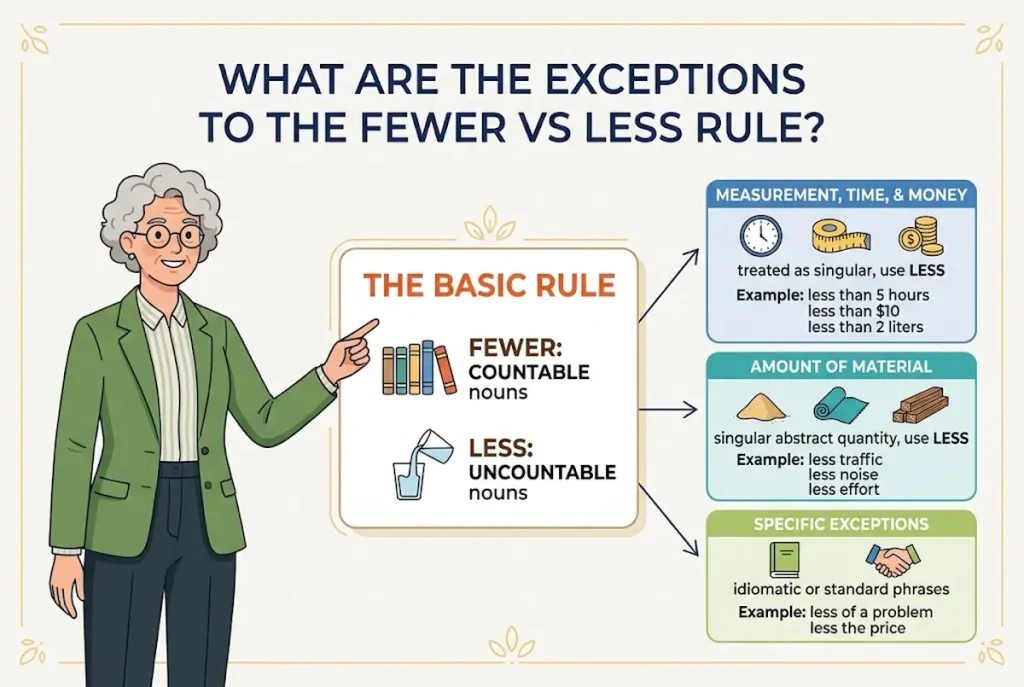
What Are the Exceptions to the Fewer vs Less Rule?
The simple countable and uncountable rule is useful, but English has several common exceptions.
These exceptions usually involve treating a number as one overall measurement.
Less With Money
Money can be counted in dollars, cents, and other units. However, we often treat a monetary value as a single amount.
Correct:
The jacket costs less than $50.
This is more natural than fewer than $50.
However, when referring to individual coins or bills, fewer is appropriate.
Example:
I have fewer dollar bills than you.
Less With Time
Time is commonly treated as a continuous measurement.
Correct:
The meeting lasted less than two hours.
Even though hours can be counted, the sentence refers to an overall duration.
Compare:
- I worked fewer hours this week.
- The journey took less than three hours.
The first counts working hours as units. The second treats three hours as a measured duration.
Less With Distance
Distance expressions commonly use less.
Example:
The school is less than five miles away.
The sentence describes one measurement rather than counting separate miles as individual objects.
Real Life Examples
The following table shows how the rule works across familiar situations.
| Situation | Correct Sentence | Reason |
|---|---|---|
| Shopping | We bought fewer oranges. | Oranges are countable. |
| Cooking | Add less butter. | Butter is treated as an amount. |
| School | Fewer students missed class. | Students are countable. |
| Work | We need less paperwork. | Paperwork is uncountable. |
| Travel | Fewer passengers boarded the bus. | Passengers are countable. |
| Health | Try eating less sugar. | Sugar is treated as an amount. |
| Technology | The update caused fewer errors. | Errors are countable. |
| Environment | The factory produces less pollution. | Pollution is uncountable. |
| Entertainment | Fewer people watched the sequel. | People are countable. |
| Finance | She spends less money on clothing. | Money represents an amount. |
| Education | The teacher assigned fewer exercises. | Exercises are countable. |
| Household | We have less storage space. | Space is treated as an amount. |
Fewer vs Less and Fewer vs Lower
These expressions are closely related, but they communicate slightly different ideas.
Fewer vs Less
| Fewer | Less |
|---|---|
| Describes a smaller number | Describes a smaller amount or degree |
| Fewer employees attended. | Less work was completed. |
| Fewer mistakes appeared. | Less confusion occurred. |
| Fewer packages arrived. | Less mail arrived. |
Fewer and Lower
It describes the number of individual things. Lower often describes a level, rate, value, or measurement.
Compare:
Fewer employees reported problems.
The company reported a lower employee turnover rate.
The first describes a count. The second describes a rate.
Another comparison:
- Fewer products were sold.
- Product prices were lower.
You wouldn’t normally say lower products when describing a smaller number of products.
Less or Little
Little describes a small amount. Less compares that amount with another amount.
| Little | Less |
|---|---|
| Describes a small quantity | Describes a smaller quantity |
| We have little time. | We have less time than yesterday. |
| She showed little interest. | She showed less interest this week. |
| The project received little support. | The project received less support than expected. |
What Are the Most Common Mistakes With Fewer and Less?
Several mistakes appear regularly in essays, emails, reports, and everyday writing.
Mistake 1 Using Less With Ordinary Countable Nouns
Incorrect: There are less students in the classroom.
Correct: There are fewer students in the classroom.
Students are individual people who can be counted.
Mistake 2 Using Fewer With Uncountable Nouns
Incorrect: I need fewer water.
Correct: I need less water.
Water is treated as an uncountable quantity.
However, you can write:
I need fewer bottles of water.
Bottles are countable.
Mistake 3 Thinking Every Number Requires Fewer
A number doesn’t automatically make fewer the correct choice.
Correct examples:
- Less than $200.
- Less than four hours.
- Less than ten miles.
These expressions refer to measurements or total amounts.
Mistake 4 Confusing Fewer With Fewest
Fewer is comparative. Fewest is superlative.
Compare:
Sarah made fewer mistakes than James.
Sarah made the fewest mistakes in the class.
The first compares two quantities. The second identifies the smallest number within a group.
Mistake 5 Using Fewer to Describe Intensity
Incorrect: I feel fewer tired today.
Correct: I feel less tired today.
Less modifies the adjective tired.
Fewer cannot replace less in this construction.
When Should You Avoid Using Fewer or Less?
Sometimes neither word is the most natural choice.
Use Lower for Prices and Rates
Instead of:
The store offers less prices.
Write:
The store offers lower prices.
Prices are numerical values, so lower is the natural adjective.
Use Shorter for Length and Duration
Instead of:
We had a less meeting.
Write:
We had a shorter meeting.
You can also say:
The meeting lasted less time than expected.
Use Smaller for Physical Size
Instead of:
I need a less box.
Write:
I need a smaller box.
Less doesn’t normally replace smaller when directly describing the physical size of a countable object.
Use Reduced for General Changes
Sometimes reduced sounds clearer in professional writing.
Example:
The company introduced a reduced work schedule.
This describes a general change without focusing on individual countable items or an uncountable amount.
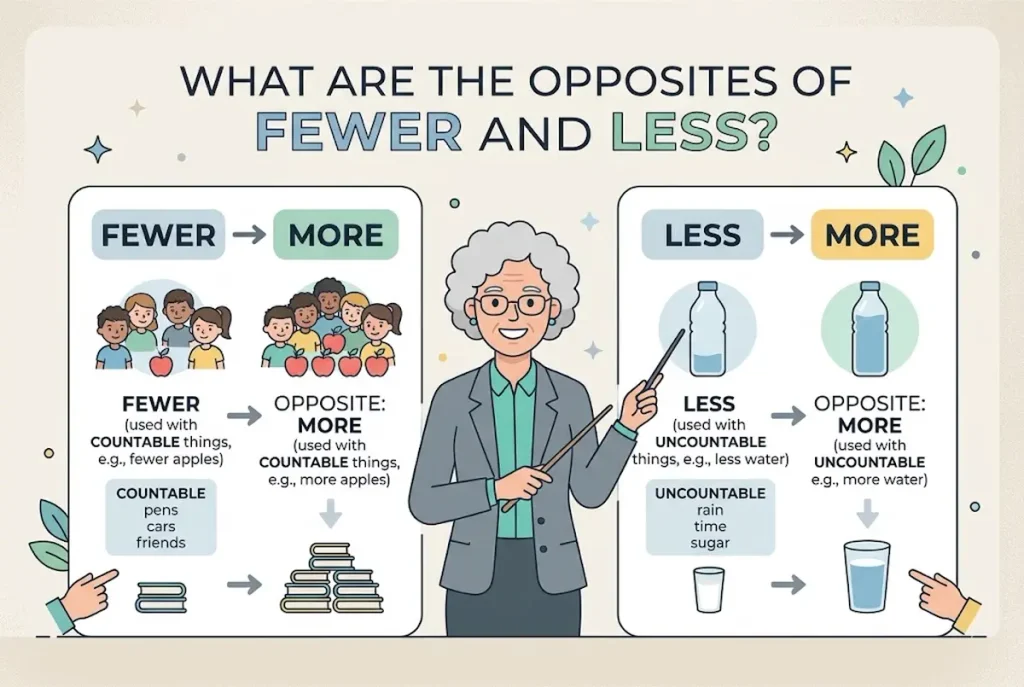
What Are the Opposites of Fewer and Less?
The most common opposite of both fewer and less is more.
However, other alternatives may fit particular contexts.
| Word | Opposite | Example |
|---|---|---|
| Fewer | More | More students joined the class. |
| Less | More | We need more information. |
| Fewest | Most | This group received the most votes. |
| Least | Most | This option requires the most effort. |
| Reduced | Increased | Production increased this month. |
| Lower | Higher | The company reported higher sales. |
| Declining | Growing | The school has a growing enrollment. |
| Limited | Abundant | The region has abundant natural resources. |
How Can You Remember the Difference Easily?
You don’t need to memorize every grammar exception to make the right choice in everyday writing.
Start with these practical tips.
Tip 1 Ask How Many or How Much
If how many sounds natural, fewer is usually correct.
If how much sounds natural, less is usually correct.
Examples:
How many chairs? Fewer chairs.
How much milk? Less milk.
Tip 2 Check If You Can Count Individual Items
Try placing a number directly before the noun.
You can say three books, so fewer books works.
You cannot normally say three furniture, so less furniture is correct.
However, you can say three pieces of furniture. In that case, fewer pieces of furniture works.
Tip 3 Watch for Measurements
Money, time, weight, and distance often use less when expressing a total measurement.
Examples:
- Less than $20.
- Less than an hour.
- Less than five pounds.
Conclusion
Understanding both words becomes much easier once you recognize the difference between individual items and general amounts. Use fewer for things you can count separately, such as books, employees, mistakes, and questions. Use less for quantities such as water, money, energy, and information.
Remember that measurements involving time, distance, weight, and monetary values often use less, even when a number appears in the sentence. These familiar expressions are part of natural English usage.
For school assignments, business emails, and professional documents, following the standard distinction will help you communicate more precisely. When you’re unsure, identify the noun and ask yourself if you’re describing a number or an amount. With regular practice, choosing the right word will become a natural part of your writing.
Frequently Asked Questions
What is the main difference between fewer and less?
Fewer describes a smaller number of countable things, while less describes a smaller amount or degree. For example, fewer apples and less juice are both correct.
Is it fewer people or less people?
Fewer people is the standard grammatical choice because people are countable. You can count one person, two people, or several people.
Is it less than 10 or fewer than 10?
Both can be correct depending on what you’re describing. Use fewer than 10 students for individual people, but less than 10 miles for a distance measurement.
Why do supermarkets say 10 items or less?
The expression is a familiar convention in everyday English. Traditional grammar recommends 10 items or fewer because items are countable.
Should I say less money or fewer money?
Less money is correct because money is generally treated as an uncountable amount. However, fewer coins and fewer dollar bills are correct because those objects can be counted individually.
Can less be used with plural nouns?
Yes, particularly in established expressions involving measurements and certain numerical comparisons. However, fewer is generally preferred with ordinary countable plural nouns in formal writing.

Daniel Grammarfield — The Language Learner
Age: 28Occupation: ESL Learner & Digital Professional
Bio:Daniel is a non-native English speaker who wants to communicate more confidently at work and online. He uses Synotrench to improve grammar, understand confusing words, learn correct sentence structures, and build everyday English skills. He prefers simple explanations with practical examples.
Goals:
Master English grammar rules
Avoid common language mistakes
Improve professional communication
Learn English through real-life examples
Quote:“Learning English is not about memorizing rules — it’s about expressing ideas clearly.”
1 thought on “Fewer vs Less Simple Guide With Examples (2026)”