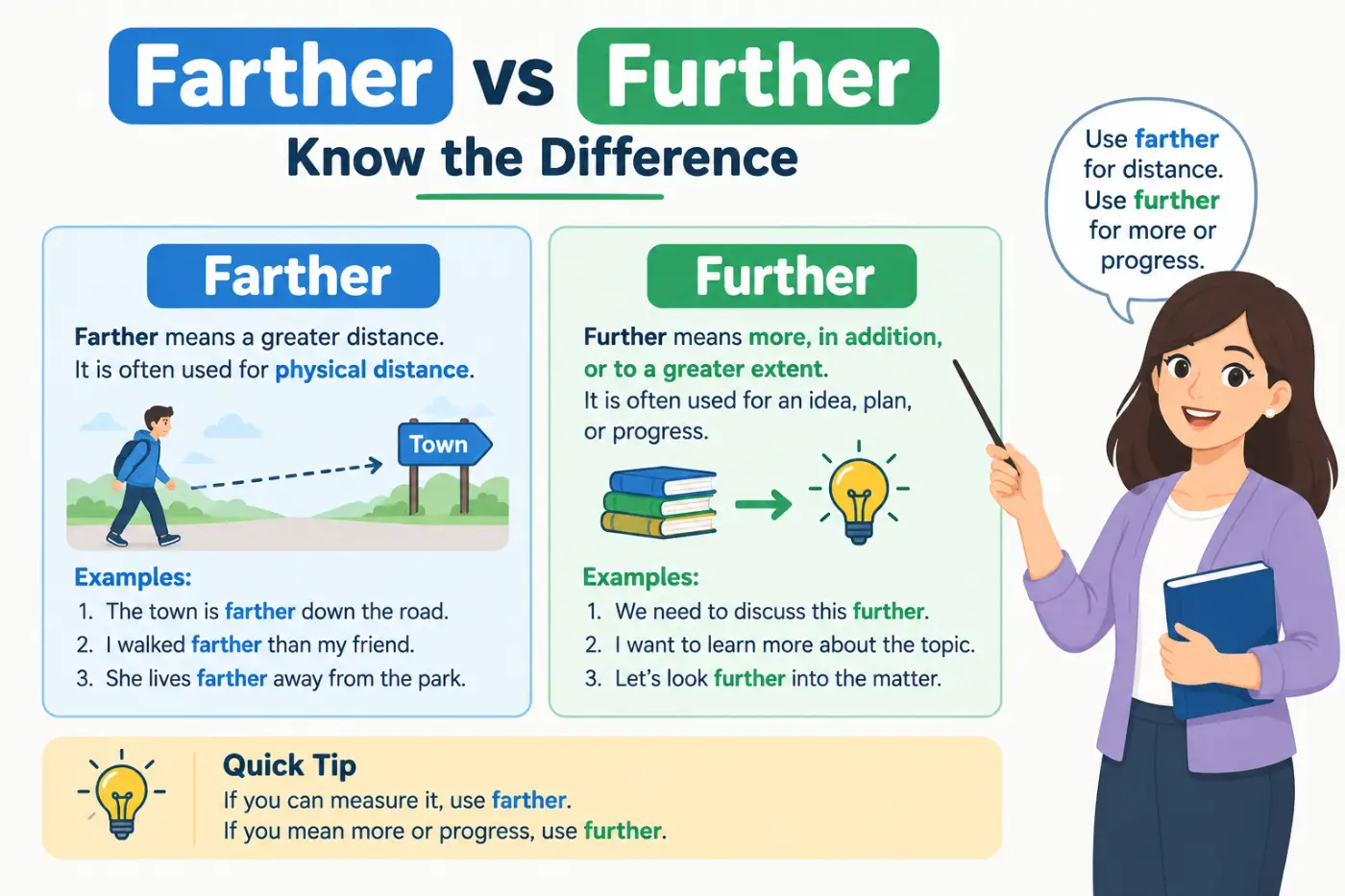
The confusion between Farther vs Further is common, even among native English speakers. These two words look similar, sound similar, and sometimes share the same meaning. However, knowing their differences can make your writing clearer and more accurate.
Farther usually refers to physical distance, while further can describe physical distance, additional information, or progress. Both words are correct when discussing distance, but further has more uses.
This guide explains their meanings, origins, grammar rules, and everyday uses. You’ll also find 30 useful alternatives, comparison tables, practical examples, common mistakes, and simple tips to help you choose the right word confidently.
What Is the Difference Between Farther and Further?
The easiest way to understand these words is to look at what you’re describing.
Farther mainly describes a greater physical distance. You use it when talking about something that can be measured in miles, feet, kilometers, or other units of distance.
Further has a broader meaning. It can describe physical distance, additional information, more progress, or something happening to a greater degree.
Here’s a quick comparison.
| Feature | Farther | Further |
|---|---|---|
| Main meaning | Greater physical distance | Greater distance, degree, or amount |
| Physical distance | Yes | Yes |
| Additional information | No | Yes |
| Abstract progress | Less common | Yes |
| Used as a verb | No in standard modern usage | Yes |
| Common example | Walk farther down the road. | We need further information. |
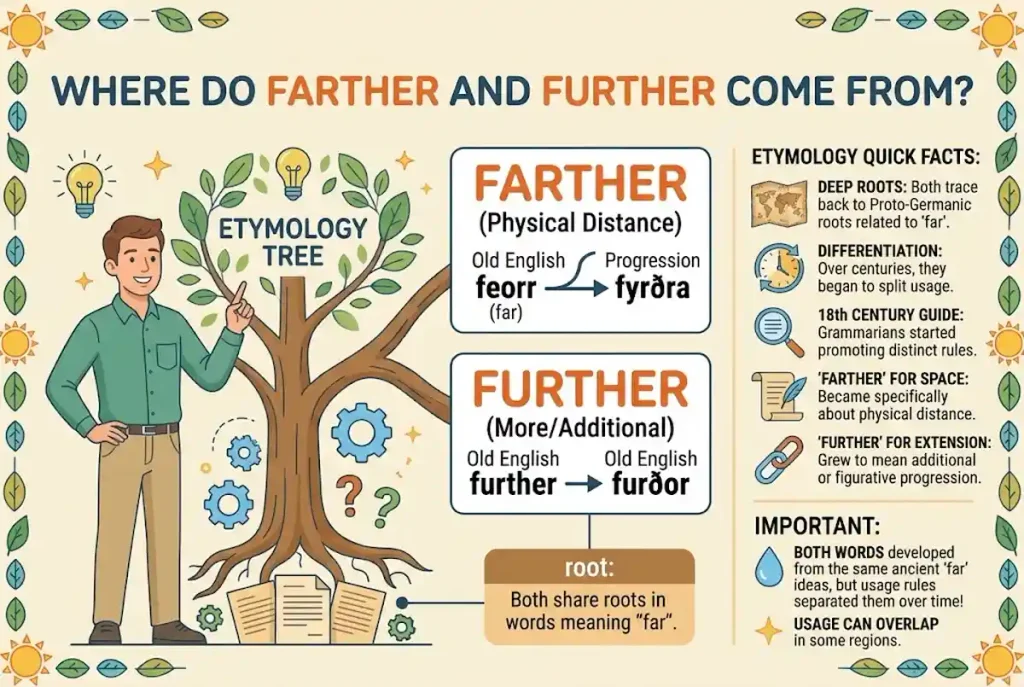
Where Do Farther and Further Come From?
Understanding the history of these words makes their modern meanings easier to remember.
Both words have roots in Old English. Further developed from the Old English word furþor, which expressed the idea of being more distant, more advanced, or beyond something.
Farther developed later as a variation influenced by the word far. Over time, English speakers began associating farther more strongly with measurable distance.
The distinction became especially useful in modern edited English.
Today, many writing guides recommend using farther for physical distance and further for additional amounts, degrees, and abstract ideas.
However, their meanings still overlap because they share a closely related history.
What Does Farther Mean in Simple English?
Farther means at, to, or over a greater physical distance.
It helps readers understand the location of something or how much additional distance someone travels.
Examples:
- The airport is farther than I expected.
- We drove farther into the countryside.
- Her office is farther from downtown.
- Can you throw the ball farther?
You can often connect farther with a measurable distance.
What Does Further Mean in Simple English?
Further means more, additional, or to a greater extent. It can also describe greater physical distance.
Examples:
- We need further details before making a decision.
- She wants to further her education.
- The investigation continued further.
- They traveled further north.
Further can also function as a verb meaning to help something develop or progress.
Example:
The organization hopes to further scientific research.
You cannot normally replace further with farther in that sentence.
When Should You Use Farther or Further?
The simplest method is to identify the meaning of your sentence before choosing a word.
Use Farther for Physical Distance
Choose farther when comparing locations or describing measurable movement.
Examples:
- Chicago is farther from here than Milwaukee.
- The second parking lot is farther away.
- He ran farther than his teammates.
- Our new apartment is farther from the office.
- The children walked farther along the beach.
These sentences focus on actual distance.
Use Further for Additional Information
Choose further when you mean more information, extra details, or additional discussion.
Examples:
- Please contact us for further information.
- We need further evidence.
- The teacher provided further instructions.
- No further explanation is necessary.
- Further research could help answer this question.
Farther would sound unnatural in these situations because the sentences aren’t about physical distance.
Use Further for Progress and Development
Further is also useful when describing improvement, advancement, or continued action.
Examples:
- She enrolled in college to further her education.
- The new policy could further economic growth.
- We need to investigate the issue further.
- His experience helped further his career.
- The discussion moved further into the topic.
Here, further expresses advancement rather than measurable movement.
What Are the Best Synonyms for Farther and Further?
Sometimes, replacing either word with a clearer alternative can make your sentence more natural.
The best synonym depends on your intended meaning. A word describing distance won’t always work when you’re discussing additional information or progress.
The following list includes 32 useful alternatives grouped by tone and everyday use.
Simple Synonyms
These alternatives work well in clear, everyday English.
| Word | Meaning | Tone | Example |
|---|---|---|---|
| More distant | At a greater distance | Simple | The village is more distant than the town. |
| Beyond | Past a particular point | Simple | The school is beyond the bridge. |
| More | An additional amount | Simple | We need more time. |
| Extra | Added to what already exists | Simple | Please bring an extra notebook. |
| Additional | Something added | Neutral | We need additional details. |
| Longer | Greater in length or duration | Simple | We took a longer route. |
| Ahead | Farther forward | Simple | The station is just ahead. |
| Away | At a distance | Simple | The nearest hospital is miles away. |
Everyday Synonyms
These expressions are common in conversations, emails, and casual writing.
| Word | Meaning | Tone | Example |
|---|---|---|---|
| Farther away | At a greater distance | Everyday | The next store is farther away. |
| Further along | At a later point or stage | Everyday | We’re further along in the project. |
| Farther down | At a greater distance along a route | Everyday | The café is farther down the street. |
| Onward | Continuing forward | Everyday | We traveled onward after lunch. |
| More advanced | At a higher stage | Everyday | Her skills are more advanced now. |
| Extended | Made longer or greater | Neutral | The deadline was extended. |
| Continued | Kept going | Everyday | Continued practice improved his writing. |
| Another | One more | Everyday | Let’s discuss another example. |
Formal Synonyms
These words are useful in academic writing, professional emails, business reports, and research papers.
| Word | Meaning | Tone | Example |
|---|---|---|---|
| Supplementary | Added to support something | Formal | Supplementary materials are available. |
| Subsequent | Happening afterward | Formal | Subsequent research confirmed the findings. |
| Extensive | Covering a large area or amount | Formal | The report requires extensive analysis. |
| Expanded | Increased in size or scope | Formal | The company introduced expanded services. |
| Advanced | Developed to a higher level | Formal | The course covers advanced concepts. |
| Additional | Added to an existing amount | Formal | Additional documentation is required. |
| Greater | Larger in amount or degree | Formal | The project requires greater attention. |
| Continued | Ongoing without stopping | Formal | Continued investment is necessary. |
How Do Synonyms Change From Mild to Strong?
Some alternatives express a small increase, while others suggest a much greater distance, amount, or level of progress.
Choosing the right intensity helps readers understand exactly what you mean.
Words for Physical Distance
| Intensity | Expression | Example |
|---|---|---|
| Mild | A little farther | Walk a little farther. |
| Mild | Slightly more distant | The second building is slightly more distant. |
| Moderate | Farther away | The supermarket is farther away. |
| Moderate | Beyond | The village lies beyond the hills. |
| Strong | Much farther | The airport is much farther than expected. |
| Strong | Considerably more distant | The second location is considerably more distant. |
| Very strong | Miles away | The nearest hospital is miles away. |
Words for Additional Information or Progress
| Intensity | Expression | Example |
|---|---|---|
| Mild | A little more | We need a little more information. |
| Mild | Extra | Please include extra details. |
| Moderate | Additional | Additional research is necessary. |
| Moderate | Further | Further investigation is required. |
| Strong | Extensive | Extensive research supports the findings. |
| Strong | In-depth | We need an in-depth analysis. |
| Very strong | Comprehensive | The team completed a comprehensive review. |
These aren’t fixed dictionary intensity rankings. They show how different expressions can change the strength of your message.
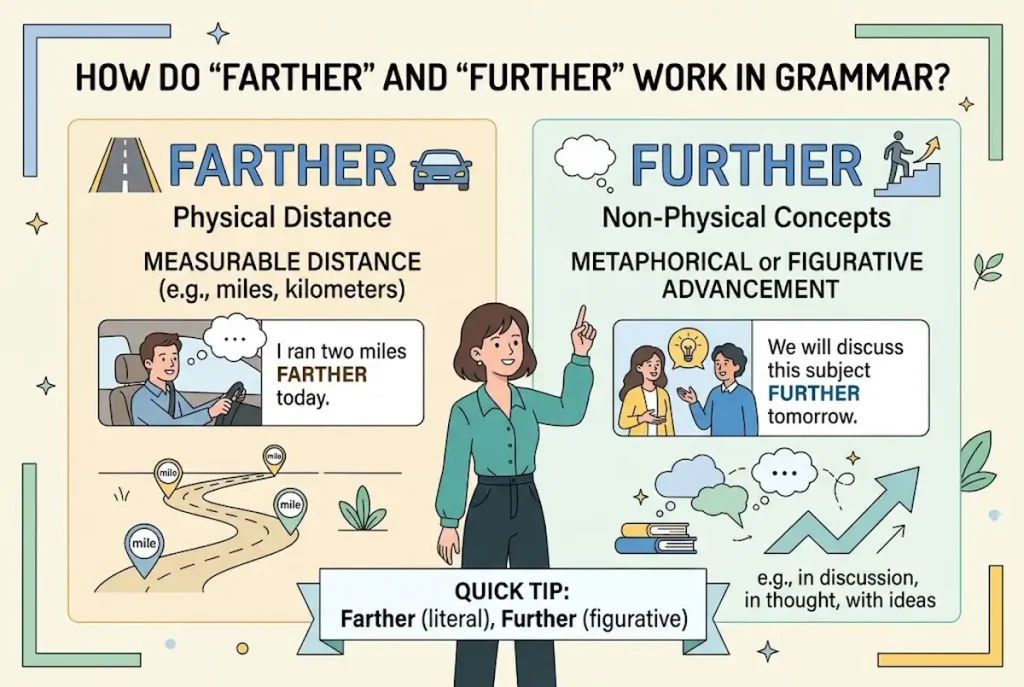
How Do Farther and Further Work in Grammar?
Both words can function as comparative adverbs and comparative adjectives.
However, further has an additional grammatical use that farther doesn’t normally share.
Farther as an Adverb
An adverb can describe an action.
Farther tells readers that an action covers a greater physical distance.
Examples:
- She walked farther than her brother.
- The airplane flew farther than expected.
- We couldn’t drive any farther.
In these sentences, farther describes how far someone or something moves.
Farther as an Adjective
An adjective describes a noun.
Examples:
- We chose the farther entrance.
- The farther shore was difficult to see.
- They visited the farther side of the island.
Here, farther identifies something located at a greater distance.
Further as an Adverb
Further can describe additional action, progress, or distance.
Examples:
- We discussed the problem further.
- The company expanded further into international markets.
- She traveled further along the river.
Further as an Adjective
Further can mean additional or more.
Examples:
- Further instructions will arrive tomorrow.
- We need further clarification.
- Further delays could affect the project.
Further as a Verb
Further can also mean to promote, advance, or help something develop.
Examples:
- Education can further your career.
- The program aims to further scientific understanding.
- Their support helped further the organization’s mission.
This is one of the clearest grammatical differences between the two words.
Which Synonyms Work With Each Part of Speech?
| Part of Speech | Useful Alternatives | Example |
|---|---|---|
| Adjective | Additional, extra, more distant | We need additional evidence. |
| Adverb | Beyond, onward, farther away | They continued onward. |
| Verb | Advance, promote, develop | The program will advance research. |
| Noun alternatives | Progress, advancement, distance | The team made significant progress. |
Is Farther or Further More Common in American English?
Both words are correct in American English, but US writing guides often recommend a practical distinction.
Use farther for physical distance and further for additional amounts, abstract ideas, and progress.
Examples:
American English:
- The restaurant is farther from my house.
- We need further information.
British English also accepts both words. However, further is commonly used for physical distance as well as abstract meanings.
For example:
- We traveled further north.
- Further investigation is needed.
Both sentences sound natural in British English.
The distinction is not a strict US versus UK rule. American speakers also use further for physical distance, and British speakers use farther.
For professional writing, consistency matters more than forcing a difference that doesn’t exist in every situation.
Which Word Should You Use in Different Situations?
Your choice depends on the purpose of your sentence.
The following examples show how to use these words naturally in resumes, essays, text messages, emails, and everyday speech.
Should You Use Farther or Further on a Resume?
Further is usually more useful on a resume because professional writing often discusses development, responsibilities, training, and career progress.
Examples:
- Completed additional training to further my professional skills.
- Helped further the company’s customer service goals.
- Pursued further education in business management.
However, farther is appropriate when describing measurable distance.
Example:
Managed delivery operations across locations farther than 100 miles from headquarters.
For stronger resume writing, use direct action verbs when possible.
Instead of writing, “Worked to further sales performance,” you could write, “Increased quarterly sales by 18%.”
The second sentence communicates a measurable achievement.
Which Word Is Better in an Essay?
Academic essays frequently use further because they discuss evidence, analysis, research, and development.
Examples:
- Further research is needed to understand the results.
- The findings provide further evidence for the argument.
- This discovery could further our understanding of climate change.
Use farther when your essay discusses physical geography or measurable movement.
Example:
The researchers traveled farther inland to collect additional samples.
Which Word Sounds Natural in Texting?
Both words work in text messages.
Use the one that matches your meaning.
Examples:
- Is your house farther than Jake’s?
- Can we talk about this further tomorrow?
- I can’t walk any farther!
- Send me further details when you can.
In casual texting, more often sounds simpler than further.
For example:
“Send me more details” sounds natural and direct.
Should You Use Farther or Further in an Email?
Professional emails often use further when requesting information or explaining the next steps.
Examples:
- Please contact me if you need further assistance.
- We can discuss the proposal further during tomorrow’s meeting.
- Further details will be shared by Friday.
Farther is appropriate when discussing location.
Example:
Our new office is farther from the city center than our previous location.
A useful email-writing tip is to choose the clearest expression, not necessarily the most formal one.
“Please send more information” is often just as professional as “Please provide further information.”
Which Word Should You Use When Speaking?
Everyday conversation is flexible.
People commonly use both words when describing distance, and listeners generally understand the intended meaning.
Examples:
- How much farther do we have to walk?
- Let’s discuss that further.
- The beach is farther away than I thought.
- I don’t want to take this argument any further.
If you’re unsure, remember that farther is a helpful choice for measurable distance, while further works across a wider range of meanings.
Farther vs Further Examples in Everyday English
The following examples show how the distinction works in real situations.
| Situation | Example Sentence | Why It Works |
|---|---|---|
| Travel | The hotel is farther from the airport than expected. | Physical distance |
| Education | She plans to further her studies next year. | Academic progress |
| Business | Further discussion is necessary before signing. | Additional discussion |
| Fitness | He ran farther than he did yesterday. | Measurable distance |
| Research | Scientists requested further evidence. | Additional evidence |
| Shopping | The next supermarket is farther down the road. | Physical location |
| Career | The course could further his professional development. | Career advancement |
| Customer service | Contact our team for further assistance. | Additional help |
| Hiking | We walked farther into the mountains. | Physical movement |
| Technology | Further testing revealed several problems. | Additional testing |
| Relationships | They decided not to take the relationship any further. | Abstract progress |
| Transportation | The bus stop is farther away than the train station. | Physical distance |
| Communication | Could you explain your suggestion further? | More explanation |
| Personal goals | She wants to further her knowledge of photography. | Personal development |
Farther vs Further in Similar Sentences
Sometimes, changing just one word changes the meaning of the entire sentence.
Compare these examples.
| Using Farther | Using Further |
|---|---|
| We walked farther into the forest. | We investigated the problem further. |
| The shop is farther away. | We need further information about the shop. |
| He threw the ball farther. | He wants to further his athletic career. |
| They drove farther south. | They discussed the southern expansion further. |
| The farther entrance is closed. | Further instructions will be provided. |
The farther examples focus on measurable locations or movement.
The further examples focus on extra information, continued action, or development.
Further vs Additional
Further and additional are close synonyms, especially in professional and academic writing.
However, their meanings aren’t always identical.
Further can suggest something that continues or develops beyond an existing point.
Additional simply means something extra has been added.
| Further | Additional |
|---|---|
| Can suggest continuation or progress | Emphasizes an extra amount |
| Works as an adjective, adverb, and verb | Mainly works as an adjective |
| Can describe distance | Doesn’t normally describe distance |
| Further investigation is required. | Additional documents are required. |
Farther vs More Distant
Farther and more distant can both describe physical distance.
However, farther is usually shorter and more natural in everyday conversation.
More distant can sound slightly formal or descriptive.
| Farther | More Distant |
|---|---|
| Common in everyday speech | Common in descriptive writing |
| Often describes movement or location | Often emphasizes relative location |
| Usually sounds direct | Can sound more formal |
| The station is farther away. | The second station is more distant. |
Example:
“She became more distant after their disagreement.”
What Are the Most Common Farther vs Further Mistakes?
Understanding the basic rule is helpful, but avoiding common mistakes makes your writing more accurate.
Mistake 1 Using Farther for Additional Information
Incorrect:
Please send me farther information.
Correct:
Please send me further information.
Further means additional in this sentence. Farther doesn’t naturally express that meaning.
Mistake 2 Using Farther as a Verb
Incorrect:
The program will farther your education.
Correct:
The program will further your education.
Further can function as a verb meaning advance or promote.
Mistake 3 Thinking Further Cannot Describe Distance
Some learners believe further is always incorrect when discussing physical distance.
That’s not true.
Both of these sentences are acceptable:
- We walked farther down the road.
- We walked further down the road.
Farther is often preferred in American edited English when emphasizing measurable distance, but further is also grammatically correct.
Mistake 4 Using Farther With Abstract Progress
Awkward:
We need to take this discussion farther.
More natural:
We need to take this discussion further.
Farther can sometimes appear in figurative expressions, but further is the safer and more conventional choice for abstract progress.
Mistake 5 Confusing Further With Furthermore
Further and furthermore aren’t interchangeable in every sentence.
Further can describe additional information or continued action.
Furthermore is a linking adverb meaning in addition.
Correct:
Further research is required.
Correct:
Furthermore, the results support our earlier findings.
Incorrect:
Furthermore research is required.
Use furthermore when connecting an additional point to something already stated.
When Should You Avoid Using Farther or Further?
Sometimes, neither word is the clearest choice.
For example, further can sound unnecessarily formal when a simple word like more communicates the same idea.
Compare:
- Please provide further information.
- Please send more information.
Both are correct, but the second may sound friendlier in an everyday email.
You should also avoid farther when discussing extra time, additional documents, or abstract development.
Examples:
| Avoid | Better Choice |
|---|---|
| Farther instructions | Further instructions |
| Farther education | Further education |
| Farther clarification | Further clarification |
| Farther assistance | Further assistance |
| Farther progress | Further progress |
Another useful tip is to avoid using further repeatedly in the same paragraph.
Instead of writing “further research,” “further investigation,” and “further analysis” in consecutive sentences, consider alternatives such as additional research, continued investigation, or detailed analysis.
Use the expression that best communicates your intended meaning.
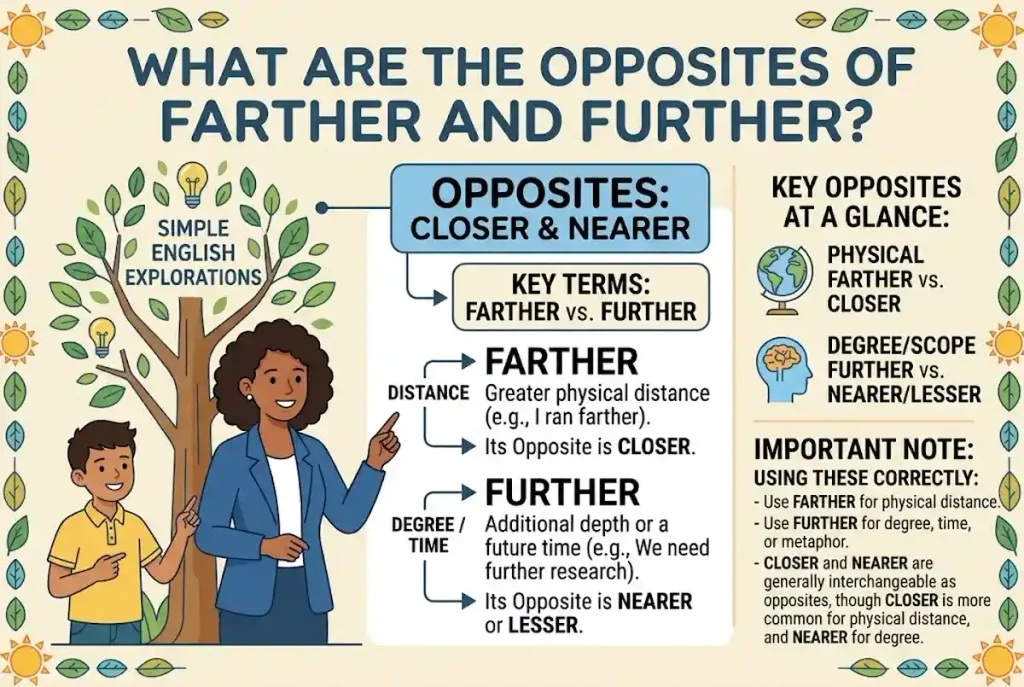
What Are the Opposites of Farther and Further?
Antonyms help explain the meaning of both words by showing the opposite idea.
Opposites of Farther
| Antonym | Meaning | Example |
|---|---|---|
| Nearer | At a smaller distance | The library is nearer than the museum. |
| Closer | Less distant | Move closer to the window. |
| Nearby | Located close to something | There’s a nearby restaurant. |
| Adjacent | Directly next to something | The adjacent building is empty. |
Opposites of Further
The opposite depends on how further is being used.
| Antonym or Opposite Expression | Meaning | Example |
|---|---|---|
| Less | A smaller amount | We need less information. |
| Fewer | A smaller number | Fewer documents are required. |
| Limited | Restricted in amount or scope | The project received limited support. |
| Reduced | Made smaller | The team worked with a reduced budget. |
| No additional | Nothing extra | No additional explanation is necessary. |
| Hinder | Prevent or slow progress | Poor planning can hinder development. |
Hinder is an opposite of further when further functions as a verb meaning to advance or promote.
For physical distance, nearer and closer are the most useful opposites.
Conclusion
The difference between Farther vs Further becomes easier once you focus on the meaning of your sentence rather than memorizing complicated grammar rules.
Farther is a useful choice when discussing physical distance, especially in American English. Further has a wider range of uses. It can describe additional information, continued progress, greater degree, and physical distance.
Remember that both words are acceptable in many distance-related sentences. The distinction is a helpful writing convention, not an absolute rule that applies to every situation.
When writing an essay, email, resume, or everyday message, choose the word that makes your meaning clearest. With a little practice, you’ll recognize the difference naturally and spend less time second-guessing your writing.
Frequently Asked Questions
What is the main difference between farther and further?
Farther usually describes physical distance, while further can describe distance, additional information, or progress. Both words can be correct when discussing physical distance.
Is it farther or further down the road?
Both expressions are grammatically correct. Farther down the road is often preferred in American English because it clearly describes physical distance.
Can I use further instead of farther?
Yes, further can replace farther in many sentences about physical distance. However, farther cannot replace further in expressions such as further information or further education.
Is farther or further correct in American English?
Both are correct in American English. A common writing recommendation is to use farther for measurable distance and further for abstract ideas, additional amounts, and progress.
What’s another way to say further information?
You can say additional information, more details, extra information, or supplementary material. Additional information is particularly useful in professional writing.
Is it further your education or farther your education?
Further your education is correct because further functions as a verb meaning to advance or develop something. Farther isn’t normally used as a verb in modern English.
How can I remember Farther vs Further easily?
Remember that farther contains far, which helps connect it with physical distance. Use further for additional information, continued progress, and other abstract meanings.
Is it further away or farther away?
Both are correct. Farther away is a common choice when emphasizing physical distance, while further away is also widely accepted in American and British English.

Daniel Grammarfield — The Language Learner
Age: 28Occupation: ESL Learner & Digital Professional
Bio:Daniel is a non-native English speaker who wants to communicate more confidently at work and online. He uses Synotrench to improve grammar, understand confusing words, learn correct sentence structures, and build everyday English skills. He prefers simple explanations with practical examples.
Goals:
Master English grammar rules
Avoid common language mistakes
Improve professional communication
Learn English through real-life examples
Quote:“Learning English is not about memorizing rules — it’s about expressing ideas clearly.”