
The difference between might vs could mainly depends on what you want to express. Might usually shows that something is possible or uncertain. Could can express possibility, ability, permission, or a possible result under certain conditions.
When writing an email, completing a school assignment, or sending a text, you may pause and wonder which word sounds right: might or could. Both words express possibility, but they don’t always communicate the same idea. Choosing the wrong one can make your sentence sound unclear or change its meaning.
Might expresses possibility or uncertainty, while could expresses possibility, ability, permission, or a potential result. Although they sometimes work in the same sentence, they can create slightly different meanings.
For example, you might say, I might visit my friend tomorrow, when you’re unsure about your plans. However, you could say, I could visit my friend tomorrow, when you’re considering it as one possible option.
In this guide, you’ll learn the meanings, origins, differences, synonyms, grammar rules, and everyday uses of both words. You’ll also find practical examples, common mistakes, and simple tips to help you choose the right word.
What Do Might and Could Mean in Simple English?
Both words are modal verbs. Modal verbs are helping verbs that change the meaning of the main verb. They can express possibility, ability, permission, advice, and other ideas.
However, might and could focus on different parts of a situation.
What Does Might Mean?
Might means that something is possible, but you’re not completely sure it will happen.
It often expresses uncertainty, a guess, or a possibility.
For example:
- It might rain this evening.
- Sarah might attend the meeting tomorrow.
- We might travel to California next summer.
What Does Could Mean?
Could is the past form of can, but people also use it to discuss present and future possibilities.
It can express:
- A possible action.
- Someone’s ability in the past.
- Permission.
For example:
- We could visit the museum tomorrow.
- My grandfather could speak three languages.
- Could I borrow your notebook?
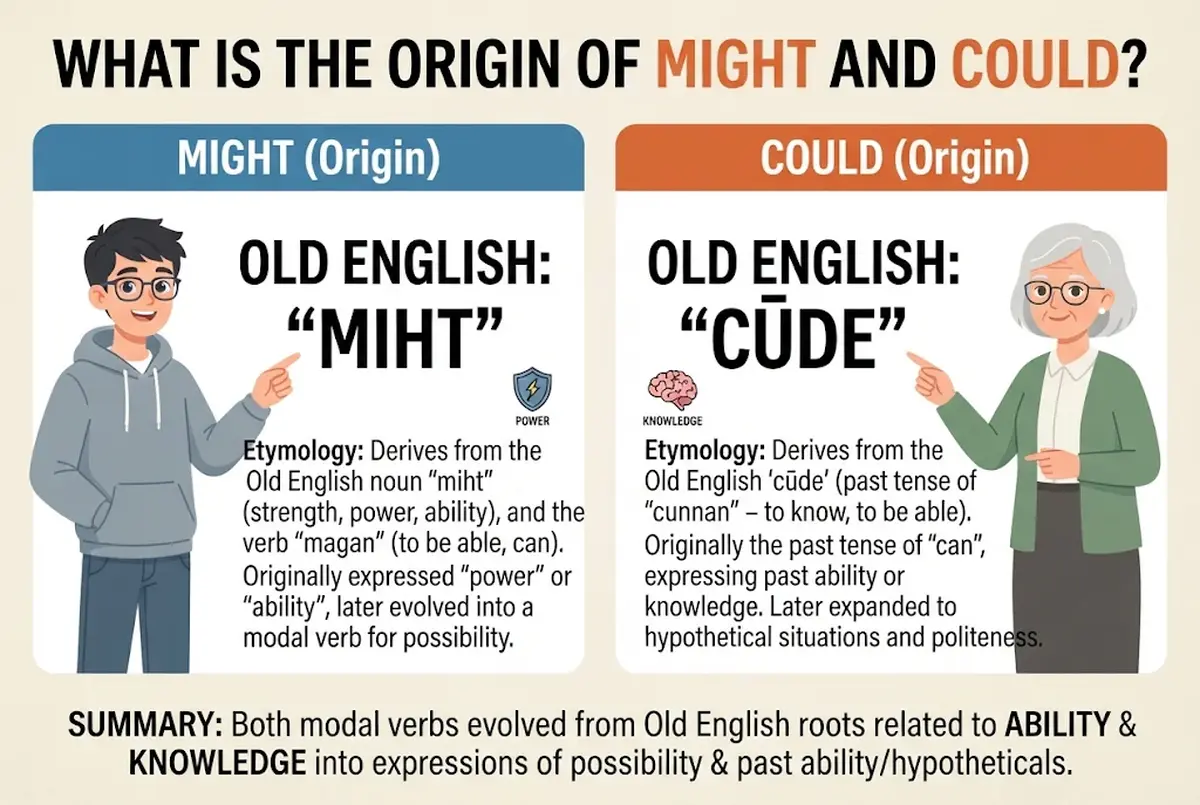
What Is the Origin of Might and Could?
Understanding the history of these words can help explain why they have different uses today.
Both words come from older forms of English and developed through the language’s modal verb system.
Where Did the Word Might Come From?
Might comes from the Old English word mihte, which was the past tense of mæg, meaning may or can.
Over time, might developed into a modal verb that expresses possibility, uncertainty, and hypothetical situations.
Today, people commonly use it when they want to suggest that something may happen without saying it will definitely happen.
For example:
The package might arrive before noon.
This sentence expresses a possibility rather than a confirmed delivery time.
Where Did the Word Could Come From?
Could developed from the Middle English form coude, which came from the Old English word cūþe.
It was historically connected to the verb can, which expresses ability or knowledge.
The letter L appeared in the spelling because of the influence of could’s relationship with should and would. The L was not originally pronounced.
Today, could serves several grammatical purposes.
For example:
My sister could swim when she was five.
This sentence describes an ability in the past.
Another example:
We could order pizza tonight.
Here, could introduces a possible choice.
The word also appears in polite questions.
Could you help me with this project?
In this example, it makes the request sound more respectful.
What Is the Main Difference Between These Two Words?
The main difference is the idea each word emphasizes.
Might usually focuses on uncertainty. Could often focuses on an available possibility, ability, or potential action.
Consider these sentences:
- I might visit London next year.
- I could visit London next year.
Comparison Table
| Feature | Might | Could |
|---|---|---|
| Main purpose | Shows possibility | Shows possibility and ability |
| Uncertainty | Commonly expresses uncertainty | Can express uncertainty |
| Ability | Not normally used for ability | Commonly expresses ability |
| Permission | Possible in limited contexts | Commonly used in polite requests |
| Suggestions | Offers gentle suggestions | Presents possible options |
| Past meaning | Often expresses past possibility with a perfect infinitive | Can describe past ability |
| Future situations | Shows uncertain future events | Presents possible future actions |
| Formal writing | Appropriate | Appropriate |
| Everyday speech | Very common | Very common |
When Should You Use Might Instead of Could?
Choose might when your main purpose is to communicate uncertainty or suggest that something may happen.
It works well when you don’t have enough information to make a definite statement.
Use Might for Uncertain Future Events
Might is useful when you’re talking about something that could happen in the future, but you aren’t sure.
Examples:
- Our teacher might give us a surprise test.
- My parents might visit us this weekend.
- The weather might become colder tonight.
Use Might for Possibilities
You can use might when you want to explain that something is possible.
Examples:
- This answer might be correct.
- The missing keys might be in the kitchen.
- That noise might come from the garage.
Use Might for Gentle Suggestions
Might can make advice sound less direct and more polite.
Examples:
- You might try reading the instructions again.
- You might consider taking a short break.
- You might want to contact the manager.
When Should You Use Could Instead of Might?
Choose could when you’re discussing an available option, an ability, permission, or a possible result.
The surrounding words usually make its meaning clear.
Use Could for Past Ability
Could commonly describes something a person was able to do in the past.
Examples:
- I could ride a bicycle when I was six.
- My mother could cook delicious meals.
- He could run very fast in school.
Use Could for Possible Options
Could is helpful when you’re considering different choices.
Examples:
- We could watch a movie tonight.
- You could take the bus instead of driving.
- I could finish the assignment after dinner.
Use Could for Polite Requests
Could makes questions and requests sound respectful.
Examples:
- Could you open the window?
- Could you send me the report?
- Could I use your phone?
What Are the Best Synonyms for Might and Could?
Might and could have several related words, but not every alternative works in every situation.
Some words express uncertainty, while others suggest ability, permission, or opportunity.
The following table groups useful alternatives by tone and purpose.
Simple Synonyms
These words are easy to understand and work well in everyday English.
| Word | Meaning | Tone | Example |
|---|---|---|---|
| May | Something is possible | Neutral | It may rain today. |
| Can | Someone has the ability | Everyday | I can help you. |
| Maybe | Possibly | Casual | Maybe we’ll go tomorrow. |
| Perhaps | Possibly | Neutral | Perhaps she is busy. |
| Able | Having the ability | Neutral | He is able to swim. |
| Possible | Something can happen | Neutral | A delay is possible. |
| Likely | Having a good chance | Neutral | It is likely to snow. |
Everyday Synonyms
These alternatives work well in conversations, emails, and general writing.
| Word | Meaning | Tone | Example |
|---|---|---|---|
| Possibly | Something may happen | Neutral | We could possibly finish today. |
| Probably | Something is expected to happen | Everyday | She will probably call. |
| Seemingly | Appearing to be true | Neutral | He seemingly forgot. |
| Conceivably | Something can be imagined | Neutral | We could conceivably win. |
| Potentially | Having the possibility | Neutral | This could potentially help. |
| Chance | An opportunity or possibility | Everyday | There is a chance of rain. |
| Option | One available choice | Everyday | We have another option. |
Formal Synonyms
These alternatives are useful in academic assignments, reports, business documents, and professional communication.
| Word | Meaning | Tone | Example |
|---|---|---|---|
| Potentially | Having the ability to happen | Formal | The change could potentially improve efficiency. |
| Presumably | Based on reasonable belief | Formal | The results presumably indicate progress. |
| Feasibly | In a way that is practical | Formal | We could feasibly complete the work. |
| Plausibly | In a way that seems reasonable | Formal | This explanation could plausibly be correct. |
| Hypothetically | In an imagined situation | Formal | We could hypothetically test another method. |
| Arguably | Open to reasonable discussion | Formal | This might arguably be the best approach. |
| Prospectively | With attention to the future | Formal | The policy could prospectively affect operations. |
| Tentatively | Without a final decision | Formal | We might tentatively schedule the meeting. |
Which Synonyms Express Different Levels of Possibility?
Not every word communicates the same level of confidence.
Some alternatives suggest a small chance, while others indicate that something is more likely to happen.
Understanding these differences helps you communicate more accurately.
Mild Possibility
Use these words when something is possible but uncertain.
- Possibly.
- Conceivably.
- Perhaps.
- Maybe.
- Might.
Moderate Possibility
Use these words when something seems reasonably possible.
- Could.
- May.
- Potentially.
- Plausibly.
- There is a chance.
Strong Possibility
Use these words when you believe something is more likely to happen.
- Probably.
- Likely.
- Almost certainly.
- Very possibly.
- Expected to.
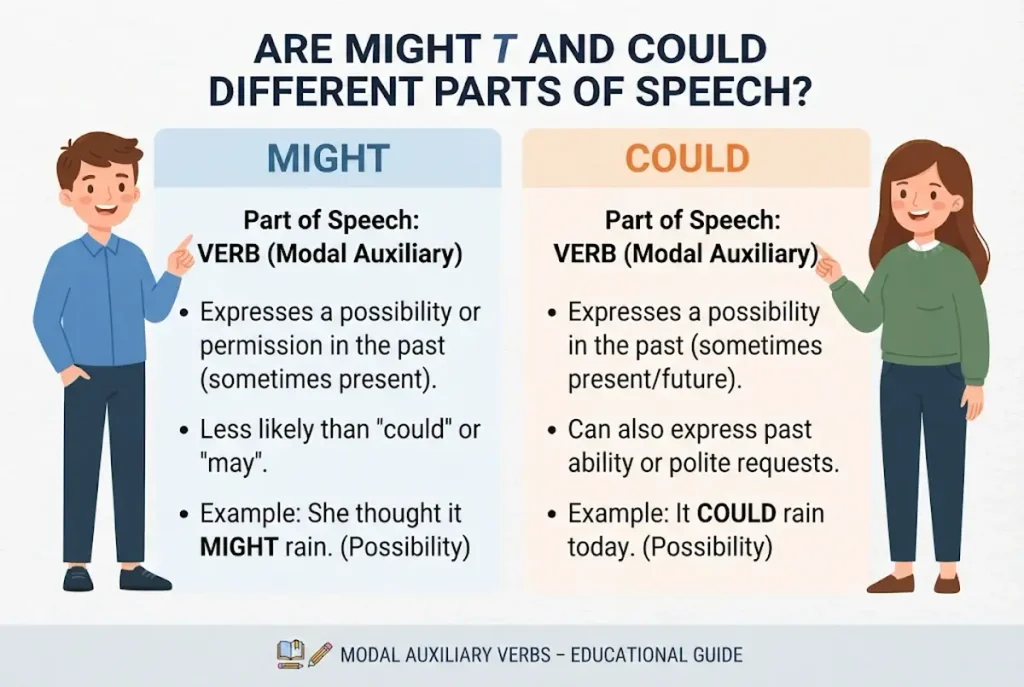
Are Might and Could Different Parts of Speech?
Might and could are both modal auxiliary verbs. They do not function as ordinary nouns, adjectives, or adverbs in these grammatical uses.
However, their meanings can connect to different types of expressions.
Modal Verbs
A modal verb helps another verb express an idea such as possibility, ability, or permission.
Examples:
- I might call you later.
- We could visit the park.
- She might understand the problem.
Expressions of Possibility
You can replace a modal construction with an expression that communicates a similar idea.
Examples:
1. It might happen.
It is possible that it will happen.
2. We could win.
We have a chance of winning.
3. She might arrive late.
There is a possibility that she will arrive late.
Is There a Difference Between American and British English?
American and British English use might and could in largely the same ways.
There is no major regional grammar rule that changes their basic meanings.
Both varieties use might for possibility and uncertainty. Both also use could for past ability, possible actions, and polite requests.
American English Examples
- I might go to the store later.
- We could meet after work.
- It might snow tomorrow.
British English Examples
- I might pop into the shops later.
- We could meet after work.
- It might rain tomorrow.
Which Word Is Best for a Resume?
When writing a resume, choose language that clearly communicates your skills and achievements.
Neither might nor could is usually the strongest choice when describing completed work or proven abilities.
When to Use Could in a Resume
Could may work when describing an ability or potential contribution, but direct action verbs are usually more convincing.
Weak:
I could manage a team of five employees.
Better:
Managed a team of five employees.
The second sentence communicates an actual achievement instead of a possible ability.
When to Use Might in a Resume
Might is rarely useful when describing your professional qualifications because it can make your statements sound uncertain.
Weak:
I might improve the company’s customer service.
Better:
Improved customer service by responding to customer concerns.
Use confident, accurate statements that reflect your real experience.
Which Word Is Better for an Essay?
Both words work well in essays, but your choice should depend on the meaning you want to communicate.
Use Might for Academic Possibilities
Might is useful when discussing an explanation or outcome that isn’t certain.
Example:
Climate changes might affect agricultural production in some regions.
This sentence presents a possible outcome without claiming that it is guaranteed.
Use Could for Potential Effects
Could works well when describing possible causes, results, or solutions.
Example:
Better educational resources could improve student performance.
This sentence explains a potential effect.
In academic writing, avoid making uncertain claims sound like established facts. Choose the modal verb that accurately represents the evidence.
Which Word Sounds Better in Text Messages?
In text messages, both words are natural.
Your choice depends on what you want to communicate.
Use Might for Uncertain Plans
Examples:
- I might come over tonight.
- We might watch a movie later.
- I might call you after dinner.
Use Could for Suggestions
Examples:
- We could grab some coffee.
- We could meet at your place.
- I could help you with that.
Which Word Should You Use in Professional Emails?
Professional emails should communicate your ideas clearly and respectfully.
Both modal verbs are useful, but they serve different purposes.
Use Might for Cautious Statements
Might can help you communicate uncertainty without sounding too direct.
Example:
We might need additional time to complete the report.
This sentence tells the reader that more time may be necessary.
Use Could for Polite Requests
Could is particularly useful when asking someone to do something.
Example:
Could you please review the attached document before Friday?
This request sounds respectful and professional.
You can also use could to suggest an option.
Example:
We could arrange another meeting next week if that works for everyone.
Which Word Should You Use When Speaking?
In everyday conversations, both words are common.
The best choice depends on your message.
Use might when discussing something uncertain.
Example:
I might visit my cousin this weekend.
Use could when suggesting an action or describing an ability.
Example:
We could take a different route to avoid traffic.
If someone asks for your opinion about a possible plan, you can use either word.
For example:
That might be a good idea.
That could be a good idea.
What Are 10 Practical Examples of Might and Could?
The following examples show how these words work in everyday situations.
| Situation | Sentence | Explanation |
|---|---|---|
| Weather | It might rain tomorrow. | Expresses an uncertain prediction. |
| Travel | We could visit New York next summer. | Presents a possible travel plan. |
| Education | She might pass the examination. | Shows an uncertain result. |
| Work | We could finish the report today. | Suggests an available option. |
| Family | My brother might visit us tonight. | Describes an uncertain plan. |
| Technology | This update could fix the problem. | Shows a possible result. |
| Shopping | I might buy a new phone. | Expresses an undecided intention. |
| Cooking | You could add more salt. | Offers a suggestion. |
| Health | Rest might help you feel better. | Suggests a possible benefit. |
| Sports | Our team could win the final. | Describes a possible outcome. |
More Examples in Complete Sentences
Here are additional examples that show how meaning changes with context.
- The teacher might cancel the class because of the storm.
- You could save money by preparing meals at home.
- My friend might know someone who can help us.
- We could use the conference room for the presentation.
- The train might arrive later than expected.
- She could play the piano beautifully when she was young.
- This new method might reduce unnecessary expenses.
- Could you explain the instructions one more time?
- The company might announce its decision next week.
- We could invite our neighbors to the party.
Might vs May: What Is the Difference?
Might and may both express possibility, but they can create slightly different impressions.
May often sounds more direct when expressing a possible event. Might can sound more tentative or less certain.
| Feature | May | Might |
|---|---|---|
| Possibility | Yes | Yes |
| Uncertainty | Yes | Yes |
| General tone | Sometimes more direct | Often more tentative |
| Formal writing | Common | Common |
| Permission | Common | Less common |
Examples:
- She may attend the conference.
- She might attend the conference.
Could vs Can: What Is the Difference?
Can and could are closely related, but they often refer to different time frames or levels of politeness.
Can usually describes present ability, permission, or possibility. Could can describe past ability, hypothetical situations, and polite requests.
| Can | Could |
|---|---|
| I can swim. | I could swim when I was young. |
| Can you help me? | Could you help me? |
| We can leave now. | We could leave earlier. |
| This can happen. | This could happen. |
What Common Mistakes Should You Avoid?
Even though these words are easy to understand, some grammar mistakes can change their meaning or make sentences incorrect.
Mistake 1: Adding To After a Modal Verb
Modal verbs are followed by the base form of the main verb.
Incorrect:
I might to visit my uncle.
Correct:
I might visit my uncle.
Incorrect:
She could to finish the project.
Correct:
She could finish the project.
Do not place to between these modal verbs and the main verb.
Mistake 2: Adding S to the Main Verb
The main verb does not take an S after might or could.
Incorrect:
He might goes to school.
Correct:
He might go to school.
Incorrect:
She could speaks English.
Correct:
She could speak English.
Always use the base form of the main verb.
Mistake 3: Using Do With Might or Could
You don’t need do or does to form ordinary questions with modal verbs.
Incorrect:
Do you could help me?
Correct:
Could you help me?
Incorrect:
Does she might come today?
Correct:
Might she come today?
The modal verb moves before the subject when forming a question.
Mistake 4: Confusing Possibility With Ability
Might generally expresses possibility, not someone’s skill or ability.
Incorrect:
I might swim very well when I was a child.
Correct:
I could swim very well when I was a child.
The second sentence describes an ability that existed in the past.
Mistake 5: Treating Both Words as Completely Interchangeable
Sometimes both words work, but their meanings can differ.
Compare:
I might take the train.
I could take the train.
The first sentence expresses uncertainty about your decision. The second presents taking the train as an available option.
Always consider what you want the reader to understand.
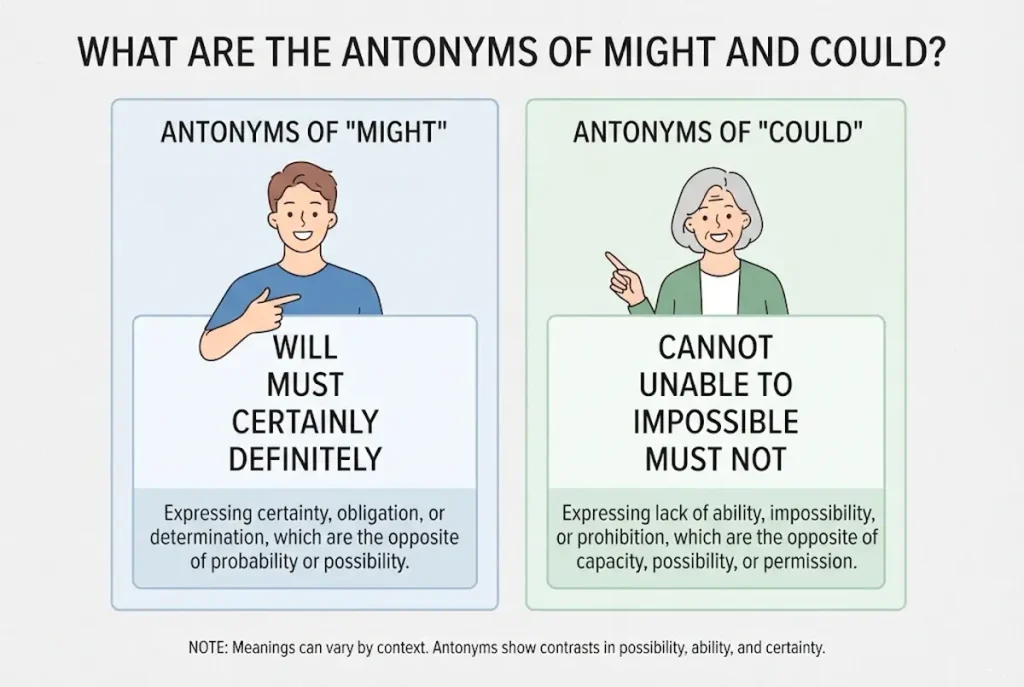
What Are the Antonyms of Might and Could?
An antonym is a word with an opposite or contrasting meaning.
Because might and could express several ideas, they don’t have one perfect opposite in every situation.
However, the following expressions can communicate contrasting meanings.
| Word or Expression | Opposite Idea | Example |
|---|---|---|
| Impossible | Not possible | It is impossible to finish today. |
| Cannot | Lack of ability or permission | I cannot attend the meeting. |
| Unable | Not having the ability | She is unable to drive. |
| Certain | Without doubt | I am certain he will arrive. |
| Definitely | Without uncertainty | We will definitely attend. |
| Must | Strong necessity or obligation | You must submit the form. |
| Will | Expresses a definite future intention or prediction | She will visit tomorrow. |
What Are the Quick Tips for Choosing the Right Word?
You don’t need to memorize every grammar rule to use these words correctly.
A few simple questions can help you make the right choice.
1. Are you expressing uncertainty? Use might when you want to say something is possible but not certain.
2. Are you discussing an available option? Use could when presenting something you can choose to do.
3. Are you describing past ability? Use could to explain what someone was able to do in the past.
4. Are you making a polite request? Use could to make your question sound more respectful.
5. Are you suggesting a possible result? Both words may work, but consider the meaning you want to emphasize.
Conclusion
Understanding the difference between might and could helps you communicate your thoughts more clearly in everyday conversations, academic assignments, and professional writing. Might generally expresses uncertainty or a possibility that hasn’t been confirmed.
Could has a wider range of uses, including past ability, polite requests, suggestions, and possible outcomes. However, both words can express similar possibilities, so the surrounding sentence matters.
When choosing between them, think about the message you want to deliver rather than simply replacing one word with the other. With regular practice and attention to context, you’ll become more confident using both modal verbs. Start by noticing how people use them in conversations and try creating your own sentences.
Frequently Asked Questions
Is might stronger than could?
Not necessarily. Both words express possibility, but might often sounds more tentative, while could frequently presents an available option or potential outcome. Their strength depends on context.
Can I use might and could in the same sentence?
Yes, you can use both in one sentence when they serve different purposes. For example, You might discover that changing your schedule could improve your productivity.
Is could the past tense of can?
Yes, could is traditionally the past form of can. It describes general past abilities, but it also expresses present and future possibilities, hypothetical situations, and polite requests.
Which word is more polite in a request?
Could is generally more natural and polite in everyday requests. For example, Could you help me with this assignment? sounds respectful without being overly formal.
Can might and could have the same meaning?
Yes, both can express possibility. For example, It might rain tomorrow and It could rain tomorrow are both correct, although the speaker may emphasize slightly different levels or types of possibility.
What’s another way to say might or could?
You can use may, perhaps, possibly, maybe, potentially, or conceivably, depending on the sentence. For example, It might happen can become It may happen.
Should I use might or could for future plans?
Use might when you’re unsure about a future plan. Use could when you’re presenting an available option. For example, I might travel next month expresses uncertainty, while I could travel next month presents a possible choice.
Is might vs could the same in American and British English?
Yes, both American and British English follow nearly the same grammar rules for these words. Their basic meanings and uses remain consistent across both varieties.

Daniel Grammarfield — The Language Learner
Age: 28Occupation: ESL Learner & Digital Professional
Bio:Daniel is a non-native English speaker who wants to communicate more confidently at work and online. He uses Synotrench to improve grammar, understand confusing words, learn correct sentence structures, and build everyday English skills. He prefers simple explanations with practical examples.
Goals:
Master English grammar rules
Avoid common language mistakes
Improve professional communication
Learn English through real-life examples
Quote:“Learning English is not about memorizing rules — it’s about expressing ideas clearly.”