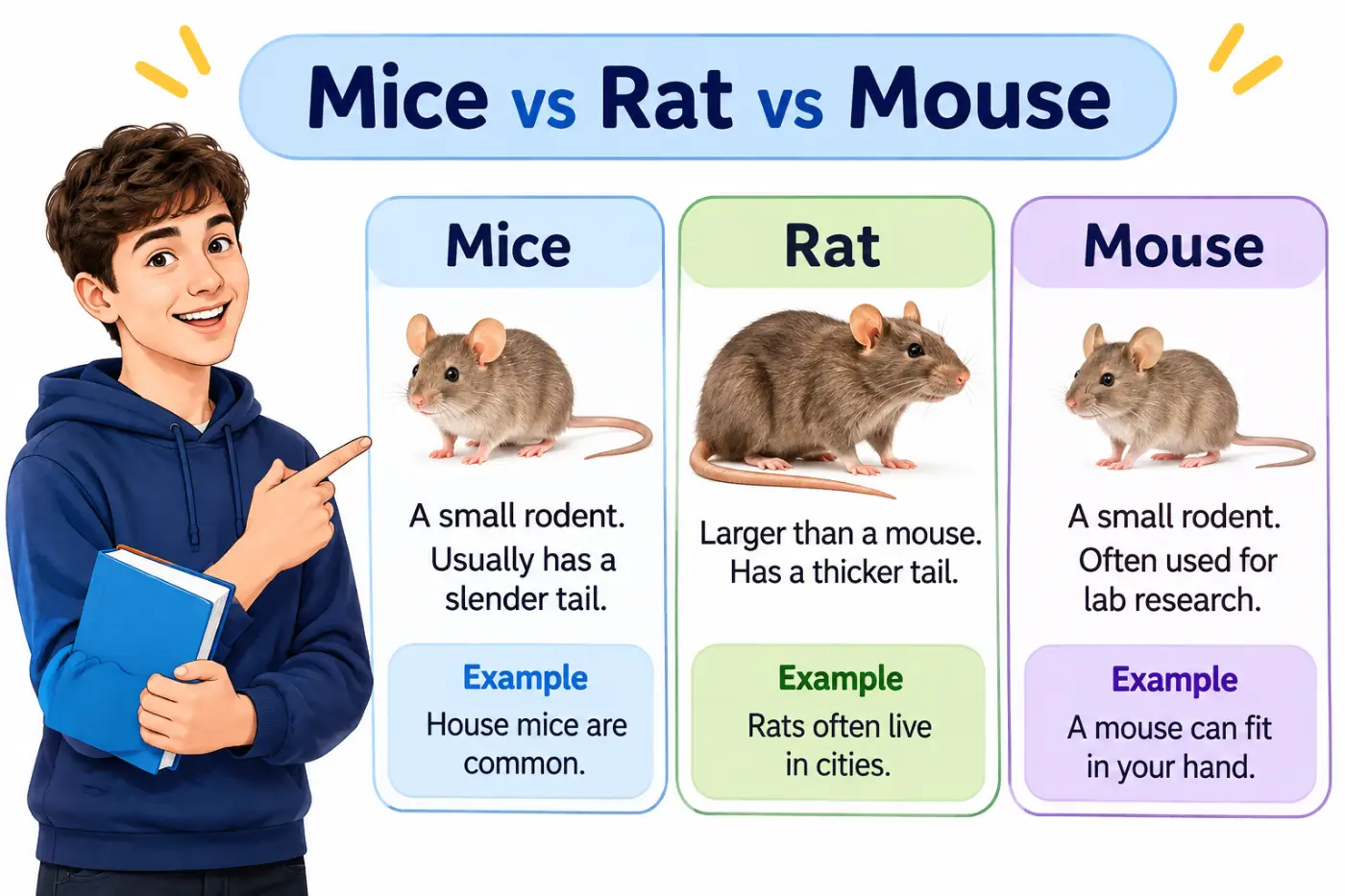
Have you ever written Mice vs Rat vs Mouse an email, school assignment, or story and stopped to wonder if you should write mouse, mice, or rat? These three words are closely related, but they don’t mean exactly the same thing. Choosing the wrong one can make a sentence confusing or change its meaning.
The main difference between these words comes down to number and animal type. Mouse refers to one small rodent, mice refers to more than one mouse, and rat refers to a different type of rodent. Although mice and rats share several physical features, they aren’t the same animal.
A mouse is a small rodent, mice is the plural form of mouse, and a rat is a separate rodent that is generally larger and has different physical features.
Understanding these differences will help you use the correct word in everyday conversations, schoolwork, emails, and professional writing. This guide explains their meanings, origins, physical differences, examples, common mistakes, and the best ways to remember each word.
What Is the Difference Between Mouse Mice and Rat?
The easiest way to understand these words is to look at their meanings and grammatical roles.
| Word | Meaning | Grammar | Example |
|---|---|---|---|
| Mouse | One small rodent | Singular noun | A mouse entered the kitchen. |
| Mice | More than one mouse | Plural noun | Three mice entered the kitchen. |
| Rat | A different type of rodent | Singular noun | A rat ran across the street. |
| Rats | More than one rat | Plural noun | Several rats live near the building. |
Is Mouse Singular or Plural?
Mouse is the singular form of the word. Use it when you are talking about one animal.
For example:
- A mouse is hiding behind the refrigerator.
- The mouse ate a piece of cheese.
- I saw a mouse near the garden.
- That little mouse has a long tail.
- The cat is watching a mouse.
Is Mice Singular or Plural?
Mice is the plural form of mouse. Use it when you are talking about two or more mice.
For example:
- Two mice are running across the floor.
- The farmer found mice inside the barn.
- Several mice live near the storage room.
- The children saw three mice in the garden.
- Mice can enter houses through small openings.
Is a Rat the Same as a Mouse?
No. A rat is a different kind of rodent, not another word for mouse.
Rats are generally larger than common house mice. They often have thicker bodies, larger feet, and heavier tails. However, size alone doesn’t always identify a rodent correctly because some mouse species can be larger than certain rat species.
Both animals have continuously growing front teeth, long tails, and strong abilities to adapt to different environments.
What Are the Origins of the Words Mouse Mice and Rat?
The history of these words explains why mouse and mice have such different spellings.
Where Does the Word Mouse Come From?
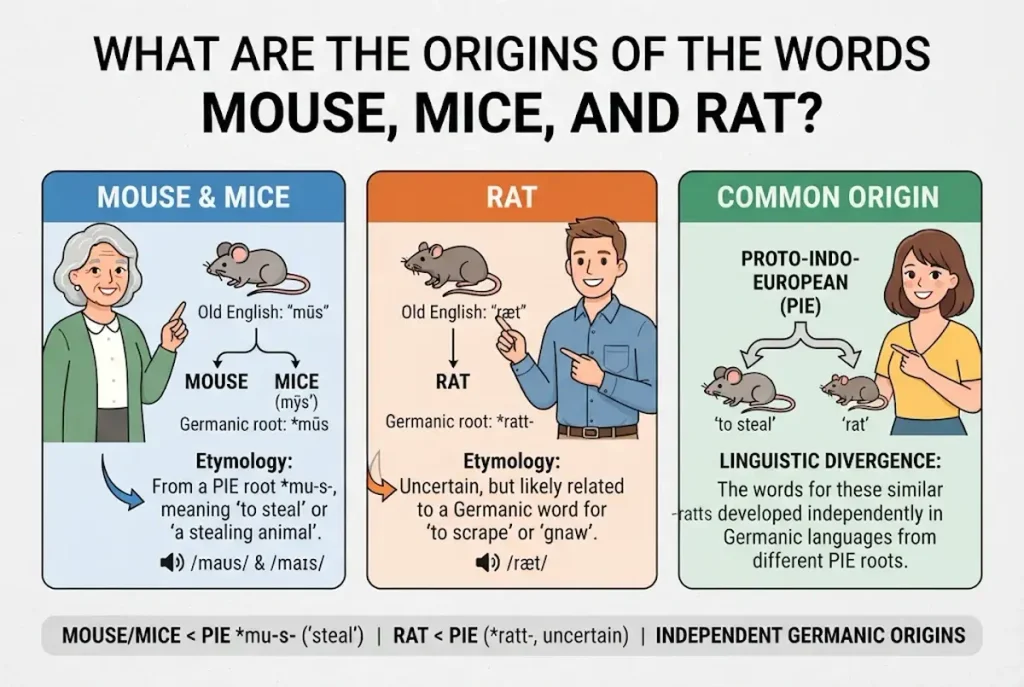
The word mouse comes from the Old English word mūs, which referred to a small rodent. It entered Middle English as mous before developing into the modern spelling mouse.
The word has much older Germanic roots. Related forms appear in languages such as German, Dutch, Swedish, and Danish.
Interestingly, mouse also developed another meaning. Today, it can refer to a small computer device used to move a pointer across a screen.
Examples:
- A mouse ran under the kitchen table.
- I bought a wireless computer mouse.
- The farmer noticed a mouse near the grain.
Why Is the Plural of Mouse Mice?
Mice comes from the Old English plural form mȳs. Its unusual spelling developed through an older English sound change called i-mutation.
This historical change affected the vowel in the plural form. Over time, the older spelling developed into the modern word mice.
That’s why English uses mice instead of the more regular form mouses when talking about the animals.
However, mouses can appear in some technical contexts when people refer to multiple computer pointing devices. For ordinary animal references, mice is the standard plural.
Where Does the Word Rat Come From?
Rat entered English through Middle English, where forms such as ratte appeared. Its deeper origin isn’t completely certain, although dictionaries connect it with older European word forms.
Unlike mouse, rat doesn’t have an irregular plural form. English speakers simply add an s to make rats.
Examples:
- One rat entered the garage.
- Two rats were hiding behind the boxes.
- The farmer noticed rats near the grain.
How Can You Tell the Difference Between a Rat and a Mouse?
The easiest way to distinguish an adult rat from an adult mouse is to examine its overall size, body shape, ears, feet, nose, and tail.
However, remember that young rats can look similar to adult mice. Size alone isn’t always enough to identify an animal correctly. Cornell IPM+2
What Does a Mouse Look Like?
A common house mouse has a small, slender body and a pointed nose. Its ears and eyes look relatively large compared with its head.
Typical features include:
- Small and lightweight body.
- Pointed muzzle.
- Relatively large ears.
What Does a Rat Look Like?
A common Norway rat has a heavier body and a broader head than a house mouse. Its nose is generally blunter, and its ears and eyes look smaller compared with its overall head size.
Typical features include:
- Larger and heavier body.
- Broad head.
- Blunt muzzle.
What Is the Difference Between a Baby Rat and an Adult Mouse?
A baby rat isn’t a mouse. It is simply a young rat that hasn’t reached adulthood.
This difference matters because people sometimes mistake young rats for adult mice.
Look for these features:
- Head: Young rats often have a relatively large head.
- Feet: Their feet may look larger compared with their bodies.
- Muzzle: A young rat generally has a broader, blunter face.
Rat vs Mouse Comparison Table
| Feature | Mouse | Norway Rat |
|---|---|---|
| Body size | Small | Much larger |
| Body shape | Slender | Thick and heavy |
| Head | Small | Broad |
| Nose | Pointed | Blunt |
| Ears | Relatively large | Relatively small |
| Eyes | Relatively large | Relatively small |
| Feet | Small | Larger |
| Tail | Thin | Thick |
| Fur | Usually fine | Usually coarse |
| Movement | Quick and agile | Strong and agile |
| Common habitat | Homes, fields, and buildings | Buildings, sewers, fields, and burrows |
Are Mice and Rats the Same Type of Animal?
Mice and rats belong to the order Rodentia, which includes many mammals with continuously growing front teeth.
However, the names mouse and rat cover different groups of rodents. The common house mouse belongs to the genus Mus, while the Norway rat belongs to the genus Rattus.
This means that mice and rats are related, but they aren’t simply two sizes of the same animal.
What Is the Scientific Name for a Mouse?
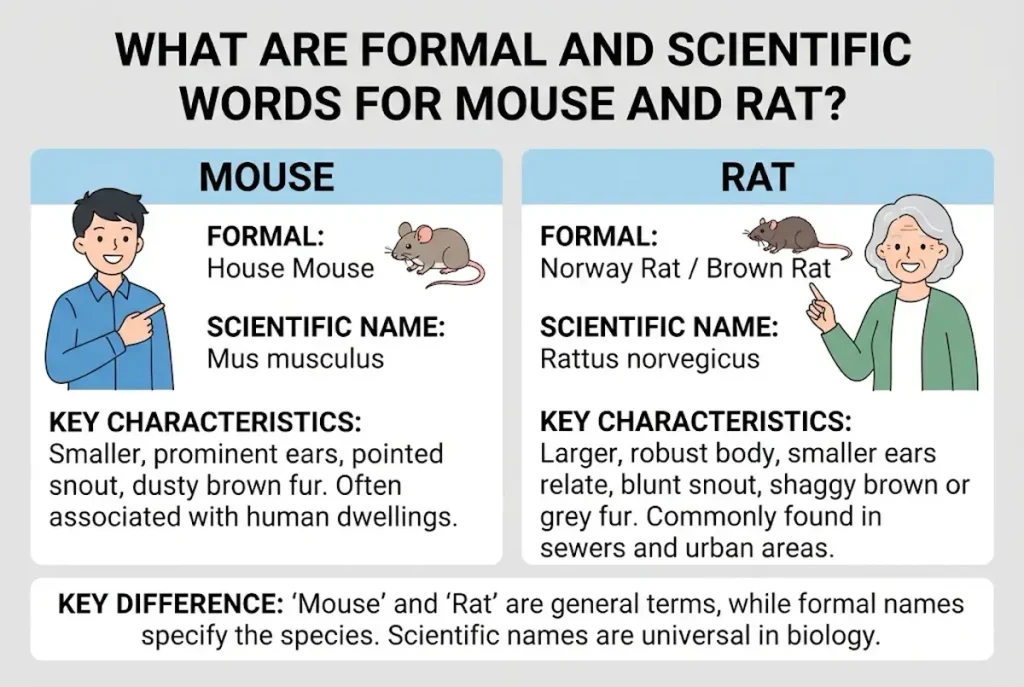
The scientific name of the common house mouse is Mus musculus.
It belongs to the family Muridae, which includes many mice and rats.
Other mouse species have different scientific names. For example, deer mice belong to the genus Peromyscus.
What Is the Scientific Name for a Rat?
Two familiar rat species are:
- Norway rat: Rattus norvegicus.
- Roof rat: Rattus rattus.
Both belong to the genus Rattus.
These scientific names help researchers identify specific species without relying on common names that can vary between regions.
Are Mice and Rats Related?
Yes. Both are rodents and share several biological characteristics.
For example, they have strong front incisors that continue growing throughout their lives. They also have flexible bodies, sensitive senses, and the ability to adapt to different environments.
However, being related doesn’t make them the same species or interchangeable names.
What Are the Different Words for Mouse and Rat?
There aren’t many true synonyms for mouse and rat because each word identifies a particular type of animal. However, several everyday, scientific, descriptive, and informal words can help you discuss these rodents more naturally.
The following table groups related terms by tone and use. Some are broader animal names rather than exact replacements.
What Are Simple Words for Mouse and Rat?
These are easy words that work well in everyday conversations and beginner-level writing.
| Word | Meaning | Tone | Example |
|---|---|---|---|
| Rodent | An animal with continuously growing front teeth | Simple | A mouse is a rodent. |
| Animal | A living creature | Simple | The small animal ran away. |
| Creature | A living being | Simple | A tiny creature entered the shed. |
| Mouse | One small mouse | Simple | A mouse crossed the floor. |
| Mice | More than one mouse | Simple | Mice entered the storage room. |
| Rat | One rat | Simple | A rat appeared near the bin. |
| Rats | More than one rat | Simple | Rats were seen outside. |
What Are Everyday Words for Mouse and Rat?
These expressions help describe rodents in ordinary speech.
| Word | Meaning | Tone | Example |
|---|---|---|---|
| House mouse | A mouse commonly found in buildings | Everyday | A house mouse entered the pantry. |
| Field mouse | A mouse that lives in fields or outdoor areas | Everyday | A field mouse crossed the path. |
| Deer mouse | A North American mouse species | Everyday | A deer mouse was spotted outdoors. |
| Brown rat | A common name for the Norway rat | Everyday | A brown rat entered the shed. |
| Black rat | A common name for the roof rat | Everyday | A black rat climbed the tree. |
| Roof rat | A slender rat species known for climbing | Everyday | A roof rat reached the attic. |
| Norway rat | A large rat species | Everyday | A Norway rat was found near the drain. |
What Are Formal and Scientific Words for Mouse and Rat?
These terms are useful in biology, research, education, and professional writing.
| Word | Meaning | Tone | Example |
|---|---|---|---|
| Rodentia | The scientific order containing rodents | Formal | Mice belong to Rodentia. |
| Muridae | A family containing many mice and rats | Formal | The house mouse belongs to Muridae. |
| Mus musculus | Scientific name for the house mouse | Scientific | Mus musculus is widely studied. |
| Rattus norvegicus | Scientific name for the Norway rat | Scientific | Rattus norvegicus is a common research animal. |
| Rattus rattus | Scientific name for the roof rat | Scientific | Rattus rattus is an agile climber. |
| Murine | Relating to mice or mouse-like rodents | Formal | Researchers used a murine model. |
| Rodent species | A particular kind of rodent | Formal | The study examined several rodent species. |
| Small mammal | A general term for a small mammal | Formal | The animal is a small mammal. |
Which Word Should You Use in Different Writing Situations?
The best word depends on your audience, purpose, and sentence. You don’t always need a scientific term. In most situations, mouse, mice, and rat are clear enough.
Which Word Is Best for a Resume?
A resume rarely needs words such as mouse or rat unless you’re applying for a job involving animal care, laboratory research, wildlife, or pest management.
In those situations, choose a specific term that describes your experience.
Example:
- I have experience caring for laboratory mice and rats.
- I assisted with research involving small rodent species.
- I maintained clean and safe environments for laboratory animals.
Which Word Is Best for an Essay?
Use mouse when discussing one mouse and mice when discussing several. Use rat when referring to a rat species.
Examples:
- The mouse is a common subject in scientific research.
- Mice have helped researchers study genetics and disease.
- Rats are intelligent rodents that can learn different tasks.
Which Word Is Best for Texting?
In text messages, simple and familiar words are usually best.
Examples:
- I just saw a mouse in the kitchen!
- There are mice in the garage.
- That rat was much bigger than I expected.
What Are 15 Example Sentences Using Mouse Mice and Rat?
Examples make it easier to understand how these words work in real situations. Notice how the singular and plural forms change depending on the sentence.
What Are Examples of Mouse in Sentences?
Use mouse when you’re talking about one animal.
- A small mouse entered our kitchen while everyone was sleeping.
- The mouse disappeared behind the refrigerator before I could see it clearly.
- My cat spent several minutes watching a mouse near the garden wall.
- A mouse made a tiny nest inside the old storage box.
- The scientist observed a mouse during the laboratory experiment.
What Are Examples of Mice in Sentences?
Use mice when referring to more than one mouse.
- Several mice were hiding behind the wooden shelves.
- The farmer found mice eating grains in the storage room.
- Two mice ran across the floor when someone opened the door.
- Mice can enter buildings through surprisingly small openings.
What Are Examples of Rat in Sentences?
Use rat when referring to one rat.
- A large rat appeared near the garbage container.
- The rat quickly disappeared into a hole beside the wall.
- A young rat can sometimes look like an adult mouse.
What Are Examples of Rats in Sentences?
The plural form rats describes two or more rats.
- Rats often search for food in places where waste collects.
- The workers noticed rats near the old warehouse.
- Several rats were seen moving around the drainage area.
Mouse vs Mice vs Rat: What Is the Difference?
The words mouse, mice, and rat can be confusing because they describe related animals. However, their meanings and grammatical uses are different.
| Comparison | Mouse | Mice | Rat |
|---|---|---|---|
| Number | One | Two or more | One |
| Animal | Mouse | Mouse | Rat |
| Grammar | Singular | Plural | Singular |
| Plural form | Mice | Already plural | Rats |
| Common appearance | Small and slender | Small and slender | Generally larger and heavier |
| Example | A mouse is here. | Mice are here. | A rat is here. |
Mouse vs Mice: What’s the Difference?
Mouse is singular, while mice is plural. Both words refer to the same animal.
Examples:
- Correct: I found a mouse in the room.
- Correct: I found three mice in the room.
- Incorrect: I found three mouse in the room.
- Incorrect: I found one mice in the room.
What’s the Difference: Mice vs Rats?
Mice and rats are different rodents. Mice are generally smaller and have more delicate bodies, while common adult rats are usually larger and heavier.
Examples:
- Mice entered the kitchen through a small opening.
- Rats were searching for food near the garbage bins.
Mouse vs Rat: What’s the Difference?
Mouse refers to a mouse, while rat refers to a different rodent. Both words are singular nouns.
Examples:
- A mouse was hiding behind the cupboard.
- A rat was running beside the wall.
What Are the Most Common Mistakes When Using These Words?
Even native English speakers sometimes make mistakes with irregular plurals and animal names. These are the errors worth avoiding.
Using Mouses Instead of Mice
One common mistake is adding s to mouse to form its plural.
Incorrect: There are five mouses in the garage.
Correct: There are five mice in the garage.
For ordinary animal references, mice is the correct plural form.
Using Mice for One Animal
Mice is plural, so it shouldn’t describe just one mouse.
Incorrect: A mice is eating the food.
Correct: A mouse is eating the food.
Use mouse when the sentence refers to one animal.
Calling Every Small Rat a Mouse
A young rat doesn’t become a mouse just because it’s small.
Incorrect: That baby rat is a mouse.
Correct: That animal is a young rat.
Remember that rats and mice are different rodents with different life cycles.
Using Rat and Mouse as Interchangeable Words
Although both animals belong to the rodent group, their names aren’t interchangeable.
Incorrect: A mouse is a large type of Norway rat.
Correct: A mouse and a Norway rat are different rodents.
Use the correct animal name whenever you know which one you’re describing.
Confusing the Animal Mouse With a Computer Mouse
The word mouse has two common meanings. It can refer to an animal or a computer device.
Examples:
- The mouse ran under the table.
- My computer mouse stopped working.
The surrounding words usually make the meaning clear.
Using Mice With a Singular Verb
Because mice is plural, it normally takes a plural verb.
Incorrect: The mice is hiding behind the box.
Correct: The mice are hiding behind the box.
Compare:
- The mouse is hiding.
- The mice are hiding.
Are There American and British English Differences?
The words mouse, mice, rat, and rats have the same basic meanings in American and British English.
There isn’t a major spelling difference between these forms.
| Word | American English | British English |
|---|---|---|
| Mouse | Mouse | Mouse |
| Mice | Mice | Mice |
| Rat | Rat | Rat |
| Rats | Rats | Rats |
| House mouse | House mouse | House mouse |
| Norway rat | Norway rat | Norway rat |
However, regional names for rodents can vary.
For example, people may use different everyday descriptions for field mice, house mice, and rats depending on the species found in their area.
Some British speakers may also use informal expressions such as ratty in casual conversation. In American English, rat can have several figurative meanings, including an untrustworthy person or someone who informs on another person.
What Are the Antonyms of Mouse Mice and Rat?
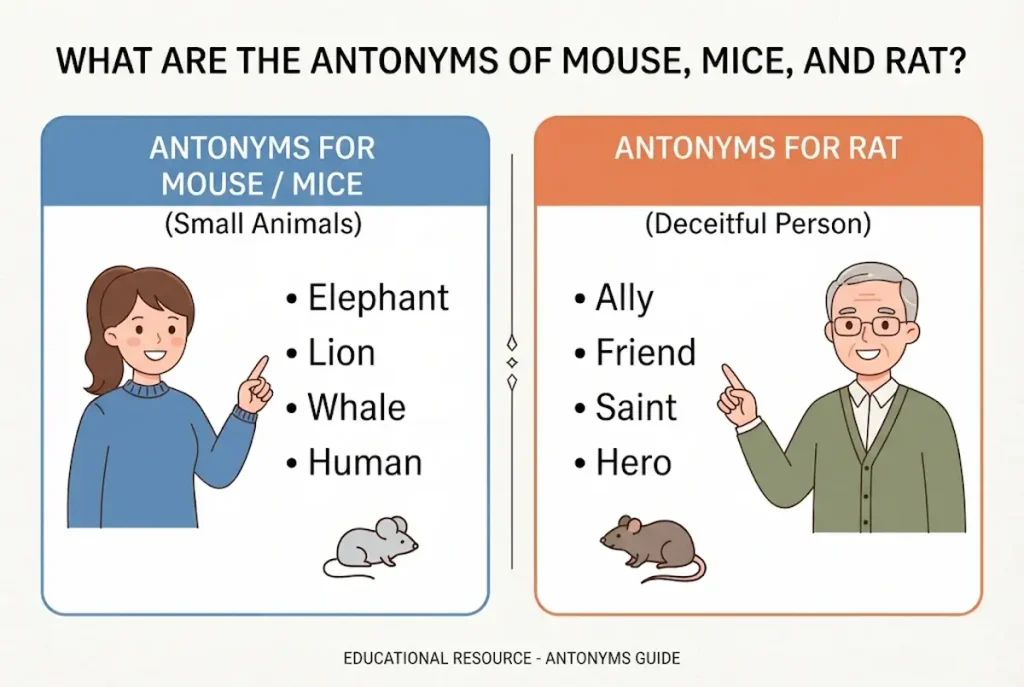
Mouse, mice, and rat are animal names, so they don’t have direct antonyms in the same way that words such as hot and cold do.
However, you can use contrasting animal terms when a sentence needs a comparison.
| Word | Possible Contrast | Explanation |
|---|---|---|
| Mouse | Large animal | Contrasts with its generally small size |
| Mice | Large mammals | Contrasts with the usual size of mice |
| Rat | Small mouse | Contrasts with the typical size difference |
| Rodent | Non-rodent mammal | Describes an animal outside the rodent group |
How Can You Remember the Difference Between Mouse Mice and Rat?
You don’t need to memorize complicated grammar rules to use these words correctly. A few simple tricks can help.
Remember That One Mouse Becomes Many Mice
Think of mouse and mice as an irregular singular and plural pair.
- One mouse.
- Two mice.
- Three mice.
Remember That Rats Are Different Animals
A rat isn’t the plural of mouse or a grown-up version of a mouse.
Think of rat as a separate animal name.
- One mouse.
- One rat.
- Several mice.
Check the Number Before Choosing a Word
Before writing your sentence, ask yourself how many animals you’re describing.
If you’re describing one mouse, write mouse. You’re describing more than one, write mice. If you’re describing a rat, write rat.
Learn the Irregular Plural
Many English nouns form their plurals by adding s or es.
For example:
- Cat becomes cats.
- Dog becomes dogs.
- Box becomes boxes.
Conclusion
Understanding the difference between mouse, mice, and rat makes English writing much easier. Mouse refers to one small rodent, while mice is the irregular plural form used for two or more.
Rat identifies a separate animal that generally has a larger, heavier body than a common house mouse. The easiest way to remember these words is to connect mouse with one animal, mice with several, and rat with a different rodent.
Also, remember that a baby rat doesn’t become a mouse just because it’s small. With these simple distinctions, you can choose the correct word in conversations, school assignments, emails, and professional writing. Keep practicing with real sentences, and these words will soon feel natural.
Frequently Asked Questions
Is Mouse Singular or Plural?
Mouse is singular because it refers to one animal. Its plural form is mice, which refers to two or more animals.
Why Is the Plural of Mouse Mice Instead of Mouses?
Mice comes from an older English plural form that developed through a historical vowel change called i-mutation. That’s why it doesn’t follow the regular rule of adding s.
Is a Baby Rat Called a Mouse?
No. A baby rat is called a pup or a rat pup. It remains a rat as it grows into adulthood.
Are Mice and Rats the Same Species?
No. They are different rodents that belong to the same broader animal order. The common house mouse is Mus musculus, while the Norway rat is Rattus norvegicus.
What’s Another Way to Say Mouse?
You can use terms such as small rodent, house mouse, or field mouse when they accurately describe the animal. However, rodent is a broader category and doesn’t mean exactly the same thing as mouse.
Can I Use Mouses Instead of Mice?
For ordinary animal references, use mice as the plural of mouse. Mouses may appear in some technical contexts when discussing computer pointing devices, but mice is the standard choice for the animals.
What Is the Difference Between Mice vs Rat vs Mouse?
Mice vs Rat vs Mouse describes three related terms with different meanings. Mouse is the singular form, mice is its plural form, and rat refers to a separate type of rodent.
Are Rats Bigger Than Mice?
Common adult rats, such as Norway rats, are generally much larger and heavier than house mice. However, physical size varies across rodent species, and young rats can sometimes resemble adult mice.

Daniel Grammarfield — The Language Learner
Age: 28Occupation: ESL Learner & Digital Professional
Bio:Daniel is a non-native English speaker who wants to communicate more confidently at work and online. He uses Synotrench to improve grammar, understand confusing words, learn correct sentence structures, and build everyday English skills. He prefers simple explanations with practical examples.
Goals:
Master English grammar rules
Avoid common language mistakes
Improve professional communication
Learn English through real-life examples
Quote:“Learning English is not about memorizing rules — it’s about expressing ideas clearly.”
1 thought on “Mice vs Rat vs Mouse: The Ultimate Guide (2026)”