
Mental Health Similes make difficult feelings easier to describe by comparing emotions and experiences with familiar things. For example, someone might say that anxiety feels like a storm gathering in the sky or that emotional exhaustion feels like carrying a heavy backpack all day. These comparisons help readers picture feelings that they cannot see.
Have you ever tried to explain how you feel but struggled to find the right words? Perhaps you’re writing a school essay, sharing your thoughts in a journal, or sending a message to someone you trust. Sometimes, ordinary words cannot fully express sadness, anxiety, hope, or emotional exhaustion. That’s when a good simile can help.
In this guide, you’ll find more than 30 original comparisons, their meanings, examples, and different ways to describe emotional experiences. You’ll also learn how to choose the right expression for essays, conversations, emails, and everyday writing.
What Are Mental Health Similes?
A mental health simile is a comparison that describes an emotion, thought, or psychological experience by connecting it to something familiar. It uses the words “like” or “as” to make an invisible feeling easier to imagine.
For example:
- Anxiety feels like a storm that never seems to pass.
- Depression can feel like walking through thick fog.
- Inner peace is like a quiet lake on a calm morning.
Each sentence connects an internal experience with something people can picture. This makes emotional descriptions more meaningful and easier to understand.
These expressions can describe positive and difficult experiences. Some communicate hope, confidence, and healing, while others help explain fear, loneliness, stress, and sadness.
What Is the Origin of Similes and Their Meaning?
The word “simile” comes from the Latin word “similis,” which means similar or like. English adopted the term through French and Latin influences.
Writers have used comparisons for centuries to make descriptions more vivid. Ancient poets, storytellers, and philosophers often compared human emotions with nature, animals, weather, and everyday objects.
For example, comparing a worried mind to a storm helps readers imagine confusion and emotional pressure. Comparing hope to sunlight suggests warmth, comfort, and a fresh beginning.
The basic structure of a simile is simple:
- Subject: The feeling or experience being described.
- Connecting word: Like or as.
- Comparison: Something familiar that represents the feeling.
Example: Her anxiety felt like a ticking clock.
Here, anxiety is the subject, like is the connecting word, and a ticking clock represents constant worry and anticipation.
The comparison doesn’t mean anxiety is literally a clock. It gives readers a familiar picture of an unfamiliar experience.
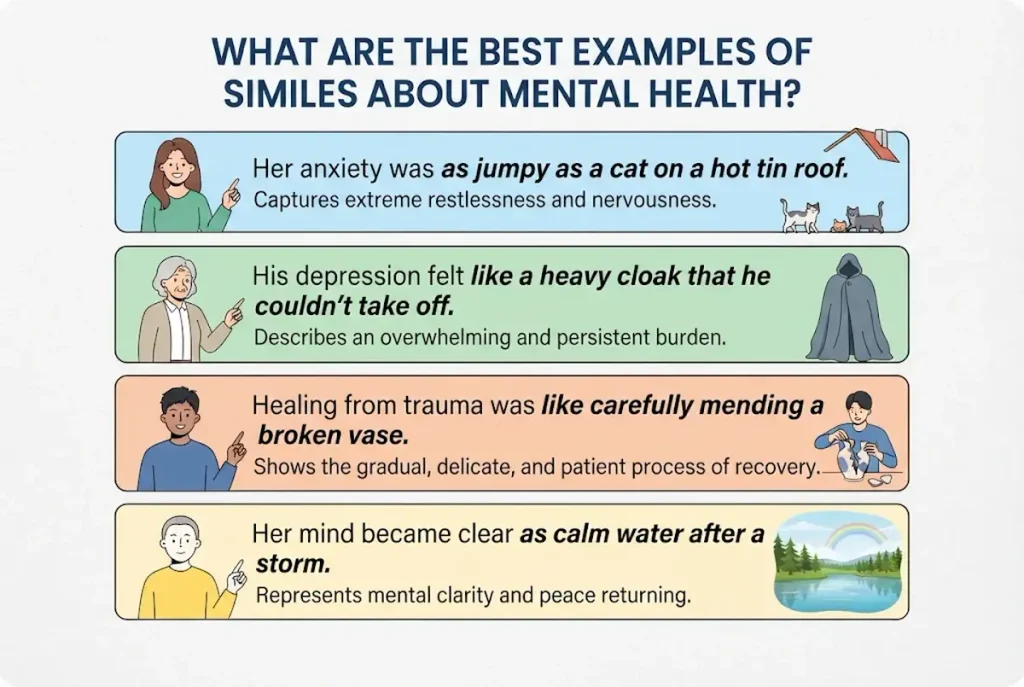
What Are the Best Examples of Similes About Mental Health?
Here are original comparisons for different emotions and psychological experiences. Each example includes a simple meaning and an explanation of its tone.
| Simile | Meaning | Tone | Example |
|---|---|---|---|
| Like a storm inside a quiet house | Hidden emotional struggles | Serious | She felt like a storm inside a quiet house. |
| Like walking through thick fog | Confusion or uncertainty | Reflective | His thoughts were like walking through thick fog. |
| Like carrying a mountain on your shoulders | Feeling overwhelmed | Strong | Her responsibilities felt like carrying a mountain on her shoulders. |
| Like a candle fighting the wind | Trying to remain hopeful | Hopeful | His hope was like a candle fighting the wind. |
| Like a heavy cloud over the heart | Deep sadness | Emotional | The news felt like a heavy cloud over her heart. |
| Like a tangled ball of string | Confused thoughts | Descriptive | My thoughts were like a tangled ball of string. |
| Like an alarm that never stops ringing | Constant anxiety | Intense | His worries were like an alarm that never stopped ringing. |
| Like a room without windows | Feeling trapped | Serious | Her loneliness felt like a room without windows. |
| Like a battery running low | Mental exhaustion | Everyday | By evening, my mind felt like a battery running low. |
| Like waves crashing against a shore | Repeated emotional difficulties | Reflective | His emotions came like waves crashing against a shore. |
| Like a garden waiting for rain | Needing care and support | Hopeful | Her tired spirit was like a garden waiting for rain. |
What Are the Different Types of Similes?
Different emotions need different descriptions. A comparison about anxiety may not work for loneliness, and a hopeful expression may not communicate emotional exhaustion.
The following groups make it easier to find an appropriate comparison.
What Similes Describe Anxiety?
Anxiety can involve persistent worry, nervousness, fear, or a feeling that something might go wrong. Comparisons can help explain the pressure without making the experience sound humorous or unimportant.
- Like a storm that refuses to move away.
- Like a thousand thoughts racing through one small room.
- Like waiting for a phone to ring with bad news.
- Like standing on a bridge during strong winds.
- Like an alarm that keeps ringing in an empty building.
What Similes Describe Depression and Sadness?
Sadness and depression are not the same thing. Sadness is a common human emotion, while depression is a mental health condition that can affect mood, energy, thinking, and daily life.
These comparisons can describe feelings without suggesting that everyone experiences depression in the same way.
- Like living under a gray sky.
- Like walking through a field covered in heavy mist.
- Like a song playing without its melody.
- Like a garden waiting for spring.
- Like watching the world through a dusty window.
What Similes Describe Stress and Overthinking?
Stress can make ordinary responsibilities feel difficult. Overthinking can also create a sense of mental pressure when someone repeatedly examines the same problem.
Consider these examples:
- Like having twenty browser tabs open at once.
- Like carrying five heavy shopping bags in one hand.
- Like trying to read while a television plays loudly.
- Like running on a treadmill without reaching the finish line.
- Like a computer with too many programs running.
What Similes Describe Loneliness?
Loneliness is not simply being physically alone. Someone can feel lonely even when surrounded by friends, family, or coworkers.
These comparisons communicate emotional distance and the desire for connection.
- Like sitting in a crowded room where nobody knows your name.
- Like a house with every light switched off.
- Like sending a letter into an empty ocean.
- Like standing on an island surrounded by people you cannot reach.
- Like listening to an echo in an empty hallway.
What Similes Describe Emotional Exhaustion?
Emotional exhaustion can develop after long periods of stress, difficult experiences, or caring for others without enough time to rest.
Try these comparisons:
- Like a phone that needs charging but has no power source.
- Like a candle burning at both ends.
- Like an empty bottle after a long journey.
- Like a runner who has reached the finish line with no energy left.
- Like a clock that keeps moving even when its batteries are dying.
What Similes Describe Healing and Recovery?
Healing does not always happen quickly. It can involve small improvements, setbacks, patience, and support.
These comparisons focus on progress rather than expecting someone to recover overnight.
- Like a flower growing after a long winter.
- Like learning to walk on a new path.
- Like sunlight slowly entering a dark room.
- Like rebuilding a house one brick at a time.
- Like a river finding its way around a mountain.
Which Similes Are Mild and Which Are Strong?
The intensity of a comparison changes the way readers understand an emotion. A mild expression may describe ordinary nervousness, while a stronger one may communicate serious emotional pressure.
Use the following guide to choose the right level.
| Intensity | Simile | What It Communicates |
|---|---|---|
| Mild | Like a cloudy afternoon | A slightly low mood |
| Mild | Like a quiet room | A need for space |
| Mild | Like a slow-moving river | Gradual progress |
| Mild | Like a phone with low battery | Feeling tired |
| Moderate | Like carrying a heavy backpack | Emotional pressure |
| Moderate | Like walking through thick fog | Confusion |
| Moderate | Like a crowded train station | Mental overload |
| Moderate | Like a boat in rough water | Emotional challenges |
| Strong | Like a storm trapped inside a house | Intense inner conflict |
| Strong | Like carrying a mountain | Feeling overwhelmed |
| Strong | Like an alarm that never stops | Persistent worry |
| Strong | Like a road blocked by fallen trees | Feeling unable to move forward |
What Are the Best Similes by Part of Speech?
Similes are complete expressions rather than individual synonyms. However, they can work in different grammatical positions.
Understanding these patterns helps you place them naturally in sentences.
Similes Used as Adjective Descriptions
These expressions describe a person, mood, or situation.
Examples:
- Her mind was as cloudy as a winter morning.
- His thoughts were like a tangled fishing net.
- The atmosphere felt as heavy as a rainy sky.
Similes Used as Adverbial Comparisons
These expressions explain how someone acts or how something happens.
Examples:
- He moved through the day like someone walking through deep snow.
- She held on to hope like a sailor holding a rope.
- His thoughts raced like cars on a busy highway.
Similes Used as Complete Clauses
These comparisons can stand as part of a larger sentence.
Examples:
- It felt like the whole world had become quieter.
- Her worries came like waves after a storm.
- His confidence grew like a tree developing new branches.
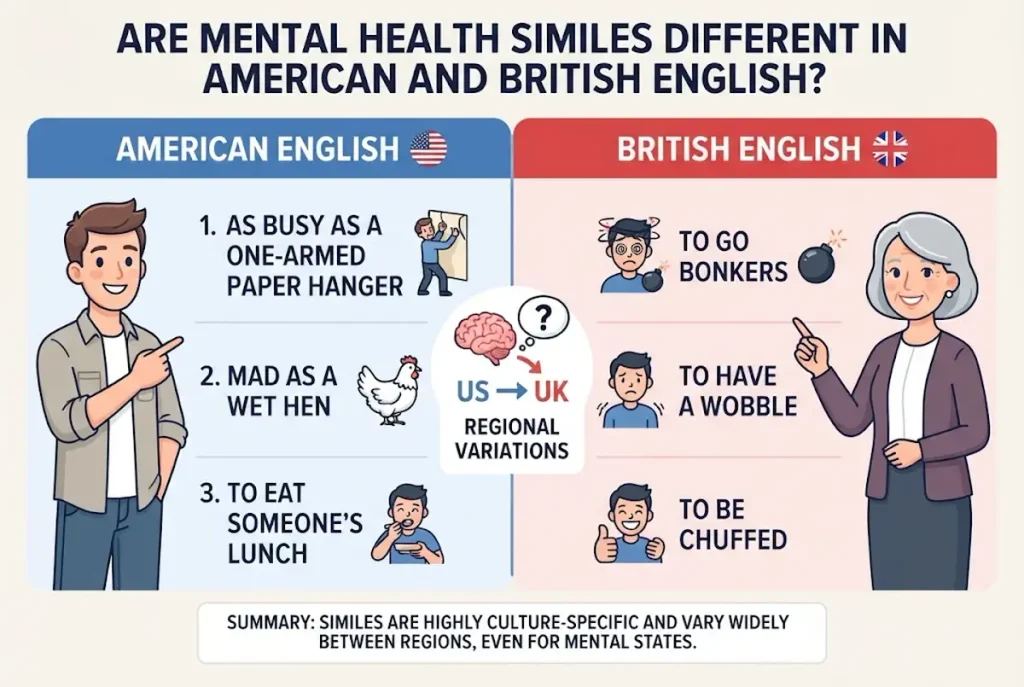
Are Mental Health Similes Different in American and British English?
Most English similes work in both American and British English. The connecting words “like” and “as” have the same basic function in both varieties.
However, everyday vocabulary and cultural references can change the way readers understand a comparison.
Here are a few examples:
| American English | British English | Explanation |
|---|---|---|
| Like a packed subway | Like a packed underground train | Both suggest overcrowding. |
| Like a crowded parking lot | Like a crowded car park | Both communicate limited space. |
| Like a fall afternoon | Like an autumn afternoon | Both can describe a seasonal mood. |
| Like a busy sidewalk | Like a busy pavement | Both suggest a crowded walking area. |
Which Similes Should You Use in Different Writing Situations?
The right comparison depends on your audience and purpose. A school essay needs clear language, while a personal message may sound more natural with an everyday expression.
Which Similes Work Best in a Resume?
A resume should focus on professional strengths, responsibilities, and achievements. Emotional comparisons usually do not belong in formal resume descriptions.
However, they may help when writing a personal statement, professional biography, or reflective career profile.
Example:
My approach to professional development is like building a strong foundation, with each new experience adding another layer of knowledge.
This comparison communicates patience and steady improvement without making the resume sound overly emotional.
Another example:
I approach workplace challenges like a navigator studying a changing map, adjusting my direction while keeping the final goal in sight.
Use these expressions sparingly. Direct evidence of your skills is more valuable than decorative language in a resume.
Which Similes Work Best in an Essay?
Essays often benefit from comparisons because they help explain complicated emotions and experiences.
Choose clear expressions that support your main point.
Example:
For students facing academic pressure, a busy mind can feel like a computer running too many programs at once.
Another example:
Recovering from emotional difficulties can be like learning to walk along an unfamiliar road, with each small step building confidence.
These comparisons work well in descriptive, personal, and reflective essays.
For academic research papers, however, use factual language when discussing clinical conditions. A simile can support an explanation, but it should not replace reliable evidence.
Which Similes Work Best in Text Messages?
Text messages usually sound better with short, familiar comparisons. You don’t need complicated language to explain how you feel.
Examples:
- My brain feels like twenty tabs are open.
- Today feels like walking through thick fog.
- I’m running on an almost empty battery.
Which Similes Work Best in Emails?
Emails require a balance between clarity and personality. When writing to a teacher, colleague, manager, or friend, choose comparisons that fit your relationship.
Examples:
The current workload feels like trying to manage several moving projects at once.
The recent changes have made this process feel like navigating an unfamiliar road.
I’ve been feeling mentally exhausted, almost like a phone that needs time to recharge.
In professional emails, keep the language respectful and straightforward. Avoid dramatic comparisons that could make a simple situation sound more serious than it is.
Which Similes Work Best When Speaking?
Spoken English usually sounds natural with familiar objects, situations, and experiences.
Try these examples:
- My head feels like a crowded room today.
- That week was like running a marathon without a finish line.
- I feel as light as a feather after talking about it.
What Are 10 Original Examples of Mental Health in Everyday Situations?
The following sentences show how comparisons can work in real situations. They include school, relationships, work, family life, and personal development.
- Before the final examination, my thoughts were like a crowded highway during rush hour.
- Her sadness was like a rainy afternoon that seemed to stretch into the evening.
- Although he smiled at everyone, his mind felt like a room filled with unopened boxes.
- Starting therapy was like opening a window in a room that had been closed for years.
- His confidence returned like sunlight slowly spreading across a quiet garden.
- During the difficult family discussion, her emotions moved like waves crashing against a rocky shore.
- Trying to finish three assignments at once felt like juggling glass balls while walking on a narrow bridge.
- After taking a break from work, my mind felt like a clear sky after a thunderstorm.
- Learning to accept mistakes was like planting a seed and allowing it time to grow.
- Even though the future seemed uncertain, she continued forward like a traveler following a small light through the forest.
What Is the Difference Between Similar Health Similes?
Some comparisons appear similar but communicate different ideas. Choosing carefully can make your writing more accurate.
Anxiety Like a Storm vs. Anxiety Like a Ticking Clock
Both comparisons describe anxiety, but they focus on different experiences.
| Anxiety Like a Storm | Anxiety Like a Ticking Clock |
|---|---|
| Suggests intense emotional pressure. | Suggests constant worry and anticipation. |
| Communicates a feeling that may rise suddenly. | Communicates a feeling that continues over time. |
| Creates an image of powerful weather. | Creates an image of time passing with tension. |
| Best for emotional intensity. | Best for persistent nervousness. |
Depression Like Thick Fog vs. Depression Like a Heavy Cloud
These comparisons both suggest difficult emotions, but they create different pictures.
| Depression Like Thick Fog | Depression Like a Heavy Cloud |
|---|---|
| Suggests confusion and difficulty seeing a way forward. | Suggests sadness and emotional heaviness. |
| Focuses on uncertainty. | Focuses on mood. |
| Creates an image of reduced visibility. | Creates an image of darkness or limited sunlight. |
Emotional Exhaustion Like a Dead Battery vs. Emotional Exhaustion Like a Heavy Backpack
These expressions describe tiredness from different angles.
| Like a Dead Battery | Like a Heavy Backpack |
|---|---|
| Focuses on having little energy left. | Focuses on carrying emotional responsibilities. |
| Suggests needing rest. | Suggests feeling burdened. |
| Works well in casual writing. | Works well in reflective writing. |
What Are Common Mistakes When Using Similes About Mental Health?
Similes can make emotional writing stronger, but careless comparisons may create confusion or hurt readers. Avoid these common mistakes.
Confusing Similes With Metaphors
A simile uses like or as to compare two things. A metaphor describes one thing as another without using those connecting words.
Simile: My mind feels like a storm.
Metaphor: My mind is a storm.
Both are figurative expressions, but their grammatical structures are different.
Using Comparisons That Sound Too Dramatic
Not every difficult day needs a powerful comparison.
For example, describing ordinary nervousness as a complete emotional disaster may exaggerate the situation.
Instead of:
My homework is destroying my entire existence.
Try:
My workload feels like a heavy backpack that I need to organize.
The second sentence communicates pressure without unnecessary drama.
Treating Every Mental Health Experience as the Same
Anxiety, sadness, depression, grief, and stress are different experiences. Don’t assume one comparison explains them all.
For instance, describing depression as simply feeling tired may leave out many other symptoms and challenges.
Choose language that reflects the particular experience being discussed.
Using Hurtful or Judgmental Comparisons
Avoid expressions that portray people with mental health conditions as dangerous, weak, lazy, or broken.
For example, saying someone is like a damaged machine can make a personal struggle sound like a character flaw.
A more respectful alternative is:
He felt like a machine that had been running without enough rest.
This describes exhaustion rather than judging the person.
Using Too Many Similes in One Paragraph
One strong comparison is usually better than several unrelated ones.
Consider this sentence:
Her mind was like a storm, a crowded train, a broken clock, and a dark forest.
The reader has to imagine too many different things.
A clearer version is:
Her mind felt like a crowded train station, with too many thoughts arriving at once.
Keep your comparisons focused and easy to picture.
Forgetting the Actual Meaning
A beautiful comparison is not useful if readers cannot understand what it represents.
For example, an unfamiliar cultural reference may confuse readers instead of helping them understand an emotion.
Use familiar images such as weather, nature, everyday objects, and common experiences.
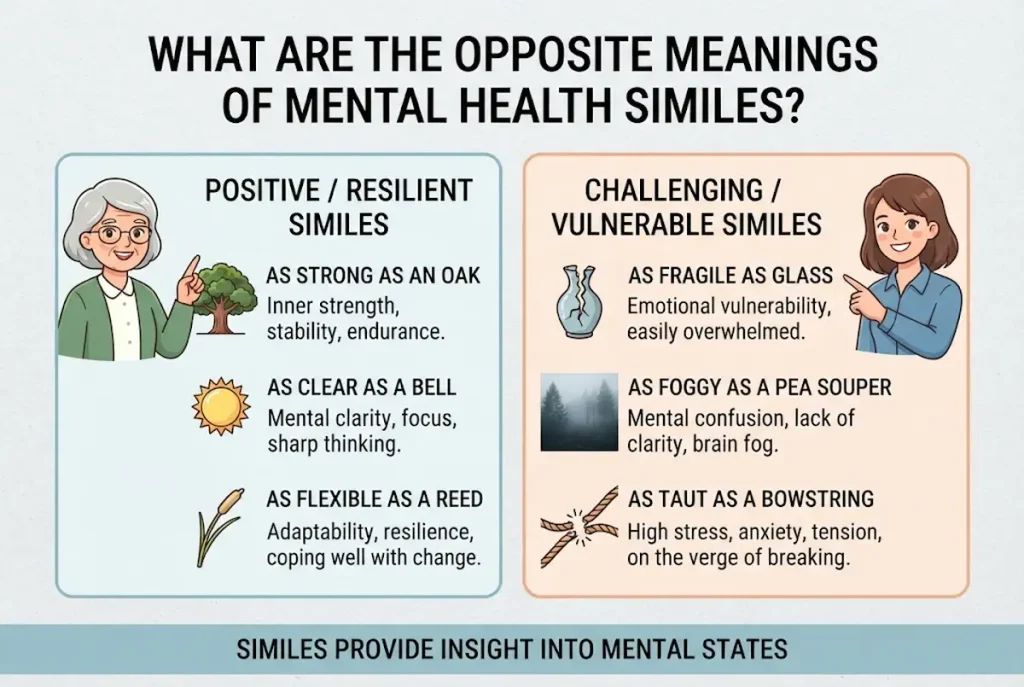
What Are the Opposite Meanings of Mental Health Similes?
Similes don’t have direct antonyms because they are complete expressions rather than single words. However, you can choose comparisons that communicate the opposite emotional experience.
| Difficult Experience | Opposite or Contrasting Comparison |
|---|---|
| Like walking through thick fog | Like seeing a clear road ahead |
| Like carrying a heavy mountain | Like walking with an empty backpack |
| Like a storm inside the mind | Like a peaceful lake |
| Like an alarm that never stops | Like a quiet room at night |
| Like a room without windows | Like an open garden filled with sunlight |
| Like a battery running low | Like a fully charged battery |
| Like being lost in a forest | Like following a familiar path |
| Like a heavy cloud over the heart | Like sunshine after rain |
How Can You Choose the Right Simile for an Emotion?
Choosing an appropriate comparison becomes easier when you understand the feeling and the purpose of your writing.
Use these practical tips.
- Identify the emotion first. Decide if you’re describing anxiety, sadness, loneliness, exhaustion, hope, or recovery.
- Think about the intensity. A slightly stressful day may need a mild comparison, while a deeply challenging experience may require stronger language.
- Choose familiar objects. Weather, roads, gardens, batteries, and everyday activities make useful comparisons.
- Avoid judgmental words. Describe the experience instead of labeling the person.
- Read your sentence aloud. If the comparison sounds unnatural, simplify it.
Conclusion
Good emotional writing helps readers understand experiences that are often difficult to explain. The best Mental Health Similes turn invisible feelings into familiar pictures, making ideas such as anxiety, loneliness, stress, and recovery easier to communicate.
Comparisons involving storms, fog, heavy backpacks, sunlight, and growing gardens can give your sentences more meaning and emotional depth. However, choose each expression carefully. A comparison should describe an experience without judging the person going through it.
For essays, conversations, personal reflections, and creative writing, keep your language clear, respectful, and natural. You don’t need complicated expressions to communicate something meaningful. Sometimes, one simple and thoughtful comparison says more than a whole paragraph of ordinary words.
Frequently Asked Questions
What Is a Simile for Mental Health?
A simile for mental health compares an emotion or psychological experience with something familiar using like or as. For example, anxiety can feel like a storm that refuses to pass.
What Is a Good Simile for Anxiety?
A good simile for anxiety is like an alarm that never stops ringing. It communicates persistent worry and the difficulty of switching off anxious thoughts.
What Is a Simile for Depression?
A useful comparison is like walking through thick fog. It can describe feelings of uncertainty, heaviness, and difficulty seeing a clear path forward.
What Is a Simile for Emotional Exhaustion?
Emotional exhaustion can feel like a phone battery running out of power. This comparison describes having very little energy left after dealing with ongoing responsibilities or stress.
What Is a Positive Simile for Mental Health?
A positive comparison is like sunlight appearing after a long winter. It represents hope, relief, and the possibility of positive change.
What’s Another Way to Say My Mind Feels Overwhelmed?
You can say your mind feels like a crowded train station or a computer running too many programs. Both expressions describe having too many thoughts or responsibilities at once.
What Is the Difference Between a Mental Health Simile and a Metaphor?
A simile compares two things using like or as, while a metaphor describes one thing as another. For example, My mind is like a storm is a simile, while My mind is a storm is a metaphor.

Daniel Grammarfield — The Language Learner
Age: 28Occupation: ESL Learner & Digital Professional
Bio:Daniel is a non-native English speaker who wants to communicate more confidently at work and online. He uses Synotrench to improve grammar, understand confusing words, learn correct sentence structures, and build everyday English skills. He prefers simple explanations with practical examples.
Goals:
Master English grammar rules
Avoid common language mistakes
Improve professional communication
Learn English through real-life examples
Quote:“Learning English is not about memorizing rules — it’s about expressing ideas clearly.”