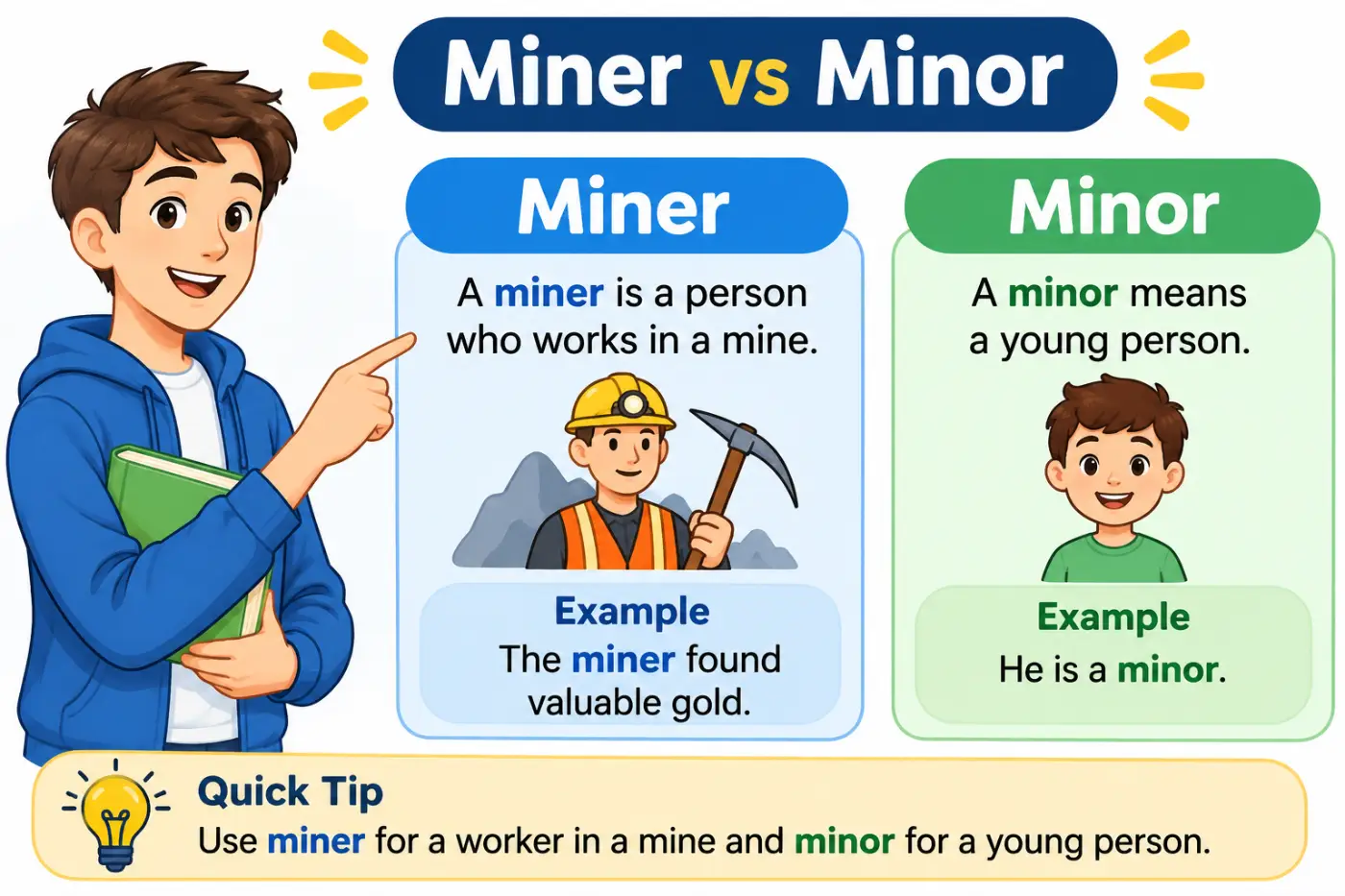
Have you ever written miner vs minor an email, school assignment, or professional document and wondered if you should use miner or minor? These two words look almost identical, but they have completely different meanings. Choosing the wrong one can change the meaning of your sentence.
The difference between miner and minor is simple. One describes a person who works in a mine, while the other can describe something small, less important, or a person who has not reached legal adulthood.
Miner means a person who works in a mine or extracts minerals. Minor means something smaller, less important, or a person who is under the legal age of adulthood.
Although both words contain the same letters except for their middle vowel, they belong to different contexts. You might use one when discussing mining, employment, or natural resources and the other when talking about age, school subjects, music, or small problems.
In this guide, you’ll learn their meanings, origins, synonyms, pronunciation, and grammatical uses. You’ll also find practical examples, common mistakes, and simple tips to help you choose the correct word every time.
What Is the Difference Between Miner vs Minor?
The main difference comes down to what each word describes.
- Miner: A person who works in a mine and removes valuable materials such as coal, gold, silver, or other minerals.
- Minor: Something that is small, less serious, or less important. It can also describe someone who is below the legal age of adulthood.
Here is a quick comparison:
| Feature | Miner | Minor |
|---|---|---|
| Main meaning | A person who works in a mine | Something small or less important |
| Part of speech | Noun | Noun and adjective |
| Main context | Mining and natural resources | Age, importance, education, and music |
| Example | The miner discovered gold. | She made a minor mistake. |
| Plural | Miners | Minors |
| Opposite | No direct everyday opposite | Major |
What Does Miner Mean?
Miner is a noun that refers to someone who works in a mine. This person may dig, extract, collect, or process natural resources found underground.
Miners commonly work with materials such as:
- Coal.
- Gold.
- Silver.
- Copper.
- Iron.
- Diamonds.
- Other valuable minerals.
What Is the Origin of the Word Miner?
The word miner comes from the verb mine, which has historical roots in Old French and earlier Germanic language forms. The English word developed through Middle English and became associated with digging underground to obtain valuable materials.
The suffix -er is commonly added to verbs to describe a person who performs an action.
For example:
| Word | Meaning |
|---|---|
| Mine | To extract minerals from the ground |
| Miner | A person who mines |
| Teach | To give lessons |
| Teacher | A person who teaches |
| Farm | To work on a farm |
| Farmer | A person who farm |
What Are the Different Types of Miners?
The word can describe different workers depending on the type of mining activity.
- Coal miner: A worker who extracts coal from the ground.
- Gold miner: Someone who searches for or extracts gold.
- Diamond miner: A worker involved in extracting diamonds.
- Underground miner: Someone who works beneath the Earth’s surface.
- Surface miner: A worker who extracts materials from open mining sites.
Example sentences:
- The coal miner started his shift early in the morning.
- A gold miner found a valuable piece of gold.
- The underground miner followed strict safety rules.
- Experienced miners know how to operate heavy equipment.
What Does Minor Mean?
Minor has several meanings depending on how it appears in a sentence. It can function as an adjective or a noun.
As an adjective, it describes something small, less important, or less serious than something else.
As a noun, it can refer to a person who has not reached the legal age of adulthood. It can also describe a secondary academic subject or a musical key.
Examples:
- We noticed a minor problem with the computer.
- The hospital treated a minor injury.
- The child is still a minor under the law.
What Is the Origin of the Word Minor?
Minor comes from the Latin word minor, meaning smaller or less. It is the comparative form of the Latin word parvus, meaning small.
The word entered English through French and Latin influences. Over time, it developed several meanings connected to size, importance, age, and rank.
Its original sense of being smaller or lesser still appears in modern English.
For example:
- A minor issue is less serious than a major issue.
- A minor character has a smaller role than the main character.
- A minor subject is secondary to a student’s main field of study.
What Are the Different Uses of Minor?
Minor appears in several areas of everyday English.
1. Minor as an adjective
It describes something that is not very serious or important.
Example: The mechanic found a minor problem with the engine.
2. Minor as a noun for age
It identifies someone who has not reached the legal age of adulthood.
Example: The law provides special protections for minors.
3. Minor in education
It refers to a secondary academic subject that a college student studies alongside a major.
Example: My sister has a major in English and a minor in history.
Are Miner and Minor Pronounced the Same Way?
Yes. Miner and minor are homophones in standard English. This means they have the same pronunciation but different spellings and meanings.
Both words are generally pronounced as /ˈmaɪ.nər/ in American English.
The first syllable carries the main stress. The difference appears in writing, not in their usual spoken sound.
Compare these examples:
- The miner works in a coal mine.
- The doctor treated a minor injury.
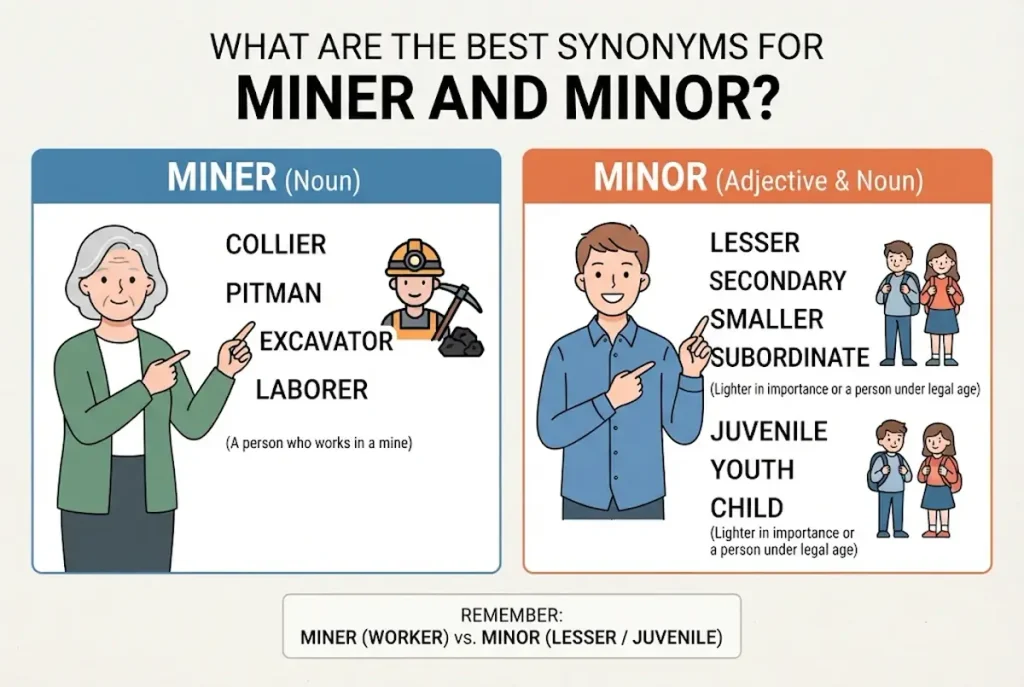
What Are the Best Synonyms for Miner and Minor?
The two words have different meanings, so they also have different synonyms. You should never use a synonym for one word as a replacement for the other.
What Words Can Replace Miner?
There are several words that describe a person who extracts minerals or works in a mining operation. However, some refer to specific jobs rather than every type of miner.
| Word | Meaning | Tone | Example |
|---|---|---|---|
| Mining worker | Person employed in mining | Everyday | The mining worker entered the site. |
| Coal miner | Person who extracts coal | Specific | The coal miner started his shift. |
| Gold miner | Person who extracts gold | Specific | The gold miner searched the riverbank. |
| Excavator | Person or machine that digs | Technical | The excavator removed the soil. |
| Extractor | Person or machine that removes materials | Formal | The extractor collected the mineral. |
| Driller | Worker who operates drilling equipment | Technical | The driller prepared the equipment. |
| Prospector | Person who searches for valuable minerals | Everyday | The prospector searched for gold. |
| Pit worker | Person working in a mine or pit | Informal | The pit worker checked the equipment. |
What Words Can Replace Minor?
The following synonyms describe something small, less important, or less serious. The best choice depends on the situation.
Simple Synonyms
| Word | Meaning | Tone | Example |
|---|---|---|---|
| Small | Not large | Simple | It was a small problem. |
| Little | Small in size or amount | Everyday | We noticed a little difference. |
| Slight | Small in degree | Neutral | There was a slight change. |
| Tiny | Extremely small | Casual | A tiny mistake appeared. |
| Lesser | Lower in amount or importance | Neutral | It was the lesser issue. |
| Low | Not high in degree or level | Everyday | The damage was low. |
Everyday Synonyms
| Word | Meaning | Tone | Example |
|---|---|---|---|
| Small-scale | Limited in size | Everyday | It was a small-scale project. |
| Modest | Not very large | Neutral | The company reported modest growth. |
| Limited | Restricted in amount | Neutral | We experienced limited damage. |
| Slightly | To a small degree | Everyday | The price increased slightly. |
| Secondary | Less important or primary | Neutral | This is a secondary concern. |
| Minor-level | At a low level of importance | Informal | The issue remained at a minor level. |
Formal Synonyms
| Word | Meaning | Tone | Example |
|---|---|---|---|
| Insignificant | Not important | Formal | The difference was insignificant. |
| Negligible | Too small to matter much | Formal | The financial loss was negligible. |
| Trivial | Not serious or important | Formal | The report contained a trivial error. |
| Marginal | Small or limited | Formal | The business recorded marginal improvement. |
| Subordinate | Lower in rank or importance | Formal | The subordinate issue received less attention. |
| Inconsequential | Having little effect | Formal | The delay was inconsequential. |
| Secondary | Less important than something else | Academic | The secondary factor affected the result. |
| Superficial | Only affecting the surface | Formal | The damage was superficial. |
Which Synonyms for Minor Show Different Levels of Importance?
The right synonym can help readers understand how serious a problem really is. Some words describe a very small issue, while others suggest something that has almost no effect.
Here is a useful guide from mild to strong.
| Intensity | Word | Meaning | Example |
|---|---|---|---|
| Very mild | Tiny | Extremely small | A tiny mark appeared on the screen. |
| Mild | Slight | Small in degree | There was a slight delay. |
| Mild | Little | Not large | It was a little concern. |
| Moderate | Modest | Limited but noticeable | The company made modest progress. |
| Moderate | Marginal | Very small in amount | There was marginal improvement. |
| Low importance | Secondary | Less important | The secondary issue can wait. |
| Low importance | Trivial | Not worth much attention | It was a trivial disagreement. |
| Very low importance | Insignificant | Not important | The change was insignificant. |
| Almost no effect | Negligible | Too small to matter | The difference was negligible. |
How Do You Choose the Right Intensity?
Consider what you want to communicate.
- Use slight for a small change or difference.
- Use modest for limited progress or improvement.
- Use secondary for something less important than the main issue.
How Does Minor Work as Different Parts of Speech?
Minor has more than one grammatical function. Understanding these uses helps you build accurate sentences.
When Is Minor Used as an Adjective?
As an adjective, minor describes a person, problem, event, or thing that is smaller or less important.
Examples:
- The company made a minor adjustment to its policy.
- We found a minor error in the document.
- The accident caused minor damage to the vehicle.
When Is Minor Used as a Noun?
As a noun, minor commonly refers to someone who has not reached the legal age of adulthood.
Examples:
- The law protects minors from certain activities.
- A minor must have parental consent for some legal procedures.
- The organization provides support for minors.
Can Miner Be Used as a Verb?
No. Miner is a noun, not the standard verb for extracting minerals.
The correct verb is mine.
| Word | Part of speech | Example |
|---|---|---|
| Mine | Verb | Workers mine coal underground. |
| Miner | Noun | The miner works underground. |
| Mining | Noun or verb form | Mining provides valuable resources. |
| Mined | Past tense or past participle | The company mined the area. |
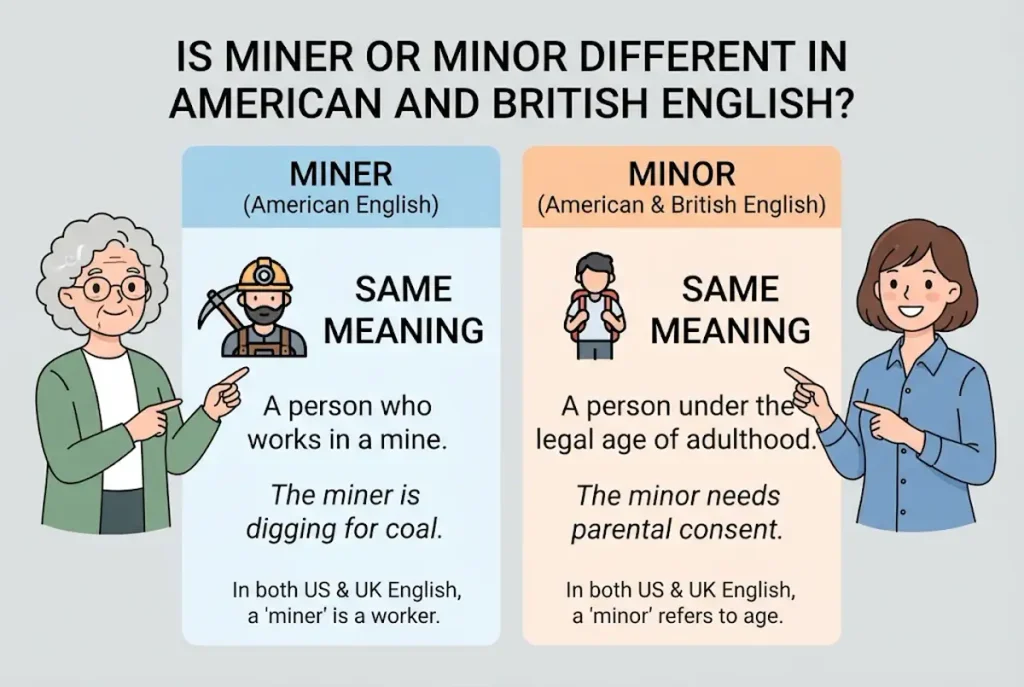
Is Miner or Minor Different in American and British English?
The spelling and basic meanings of miner and minor are the same in American and British English.
Both varieties use miner for someone who works in a mine. They also use minor for something less important or someone below the legal age of adulthood.
However, some uses of minor can differ because laws, education systems, and everyday expressions vary between countries.
| Context | American English | British English |
|---|---|---|
| Mining worker | Miner | Miner |
| Small problem | Minor problem | Minor problem |
| Person under legal age | Minor | Minor |
| University subject | Minor | Course or module terminology may differ |
| Music | Minor key | Minor key |
Does the Legal Meaning of Minor Change by Country?
Yes. The legal age of adulthood is not identical everywhere.
In many parts of the United States, the age of majority is 18, although specific laws can create exceptions. In England and Wales, the general age of majority is also 18.
Other countries may use different ages or rules for particular activities.
Therefore, when writing about legal matters, always check the relevant country’s laws instead of assuming that every minor has the same legal status.
Which Word Should You Use in a Resume?
Use miner when describing mining employment, work experience, or a professional role in the mining industry.
For example:
- Experienced coal miner with five years of underground mining experience.
- Skilled gold miner with knowledge of mining equipment and safety procedures.
- Professional miner with experience in mineral extraction.
Which Word Should You Use in an Essay?
Choose the word based on the subject of your essay.
Use miner when writing about:
- Mining history.
- Natural resources.
- Industrial development.
- Coal production.
- Workers’ safety.
- Gold and mineral extraction.
Example: The miner faced dangerous working conditions during the early industrial period.
Use minor when writing about:
- Small mistakes.
- Less important events.
- Legal adulthood.
- Academic subjects.
- Musical concepts.
Example: The author discusses a minor conflict that influences the main character’s decisions.
Which Word Should You Use in Texting?
In everyday messages, both words are acceptable, but their meanings remain different.
Use miner when talking about a person who works in a mine.
Example: My uncle is a coal miner.
Use minor when describing something small or unimportant.
Example: Don’t worry. It’s only a minor problem.
You can also use casual alternatives such as little issue, tiny problem, or no big deal when discussing something unimportant.
However, avoid replacing miner with a casual synonym if you specifically mean a professional mining worker.
What Are 10+ Example Sentences Using Miner vs Minor?
Reading examples is one of the easiest ways to understand the difference. The following sentences show how each word works in real situations.
Examples Using Miner
- The miner discovered a valuable deposit of gold beneath the mountain.
- My grandfather worked as a coal miner for more than thirty years.
- Every miner must follow safety instructions before entering the underground tunnel.
- The mining company hired an experienced miner to inspect the site.
- A miner found several precious stones while working in the excavation area.
- The local community depends on the work provided by nearby miners.
- The injured miner received immediate medical attention after the accident.
- Each miner received protective clothing and safety equipment.
- The young miner learned how to operate heavy machinery.
- The documentary tells the story of a miner who worked in dangerous conditions.
Examples Using Minor
- The teacher found a minor spelling mistake in my assignment.
- We experienced a minor delay because of heavy traffic.
- The doctor said that the patient had suffered a minor injury.
- She decided to study psychology as a minor at college.
- The manager made a minor change to the company’s schedule.
- A minor disagreement caused confusion during the meeting.
- The car had only minor damage after the accident.
- The student corrected a minor error before submitting the essay.
- The musician performed the entire song in a minor key.
- Parents must provide permission for certain activities involving minors.
What Is the Difference Between Minor and Slight?
Minor and slight are close in meaning when they describe something small or limited. However, they are not always interchangeable.
Minor usually describes something that has less importance, seriousness, or size compared with something else.
Slight focuses on a small amount or degree of something.
| Minor | Slight |
|---|---|
| Describes something less important or serious | Describes a small amount or degree |
| Common with problems, injuries, changes, and roles | Common with differences, movements, changes, and feelings |
| A minor injury | A slight improvement |
| A minor issue | A slight difference |
What Is the Difference Between Minor and Negligible?
Both words can describe something small, but negligible is generally stronger.
Minor means something is relatively small or less important. Negligible means something is so small that it has little or no practical effect.
Compare these sentences:
- The project experienced a minor delay.
- The difference between the two measurements was negligible.
What Are the Most Common Mistakes When Using Miner and Minor?
Even though these words have different meanings, people often confuse them because they sound alike.
Here are some mistakes to avoid.
1. Using Miner to Describe a Small Problem
Incorrect: We found a miner mistake in the report.
Correct: We found a minor mistake in the report.
Why? Miner describes a mining worker. Minor describes something small or less important.
2. Using Minor to Describe a Mining Worker
Incorrect: My father worked as a minor in a coal mine.
Correct: My father worked as a miner in a coal mine.
Why? A person who extracts minerals is a miner.
3. Confusing Minor With Minority
These words are related, but they do not have exactly the same grammatical use.
- Minor: A person below the legal age of adulthood or something less important.
- Minority: The condition of being under the legal age of adulthood or a smaller group within a larger population.
Examples:
The child is a minor.
The child remained under parental care during his minority.
The minority group represented a smaller part of the population.
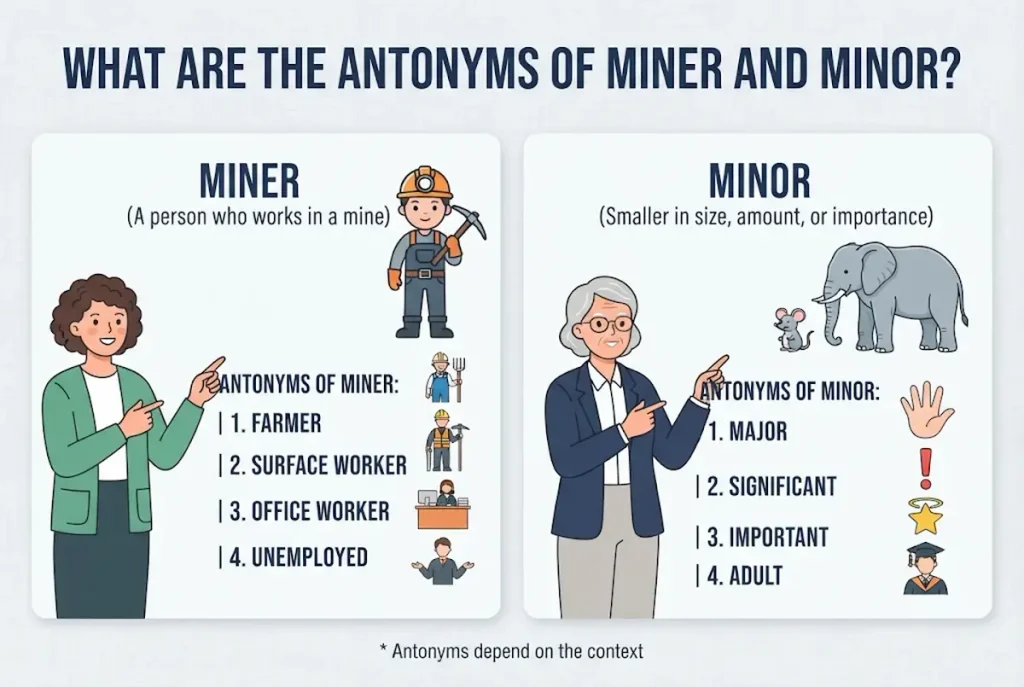
What Are the Antonyms of Miner and Minor?
An antonym is a word with the opposite meaning.
Miner does not have a direct everyday antonym because it identifies a specific occupation. However, you can use words that describe different occupations depending on the context.
Minor has several useful opposites.
| Word | Antonym | Example |
|---|---|---|
| Minor | Major | It was a major problem. |
| Minor | Important | This is an important decision. |
| Minor | Significant | The change was significant. |
| Minor | Serious | The accident caused serious damage. |
| Minor | Adult | The adult signed the document. |
| Minor | Principal | The principal subject received more attention. |
What Are the Quickest Tips for Choosing Miner vs Minor?
If you regularly confuse these words, use the following tips to remember their correct meanings.
1. Connect Miner With Mine
The easiest way to remember miner is to connect it with the word mine.
A miner works in a mine to extract natural resources.
Example: The miner collected coal from the underground mine.
2. Connect Minor With Major
Minor and major are opposites in many contexts.
A minor problem is less serious than a major problem.
Example: The company corrected a minor error before publishing the report.
3. Think About the Person or the Problem
Ask yourself what you are describing.
- Are you talking about a mining worker? Choose miner.
- Are you talking about a small issue? Choose minor.
- Are you talking about someone below the legal age of adulthood? Choose minor.
- Are you talking about a secondary subject in college? Choose minor.
How Can You Remember Miner vs Minor Easily?
The easiest memory trick is to associate each word with a related word.
| Word | Memory connection | Meaning |
|---|---|---|
| Miner | Mine | A person who works in a mine |
| Minor | Major | Something smaller or less important |
Conclusion
Understanding the difference between miner and minor will help you write more accurately in everyday and professional situations. A miner is a person who extracts valuable materials from the ground, while a minor describes something smaller, less important, or a person who has not reached legal adulthood.
Remember that both words sound alike, so pronunciation alone cannot help you choose the correct spelling. Instead, focus on the meaning and context of your sentence.
The easiest trick is to connect miner with mine and minor with major. With regular reading and writing practice, you’ll find it much easier to use these words correctly and avoid confusing them.
Frequently Asked Questions
Is miner or minor the correct spelling?
Both spellings are correct, but they have different meanings. Use miner for someone who works in a mine and minor for something small, less important, or someone below the legal age of adulthood.
Are miner and minor homophones?
Yes, miner and minor are homophones in standard English. They have the same pronunciation but different spellings and meanings.
Can minor describe a person?
Yes, minor can describe someone who has not reached the legal age of adulthood. For example, The organization provides legal support for minors.
What is the opposite of minor?
Major is the most common opposite of minor when discussing importance, size, or seriousness. For age, adult is the appropriate opposite.
Is a miner someone who works underground?
Yes, a miner is someone who works in a mine to extract materials such as coal, gold, silver, or other minerals. Some miners also work at surface mining sites.
Can I use minor in a professional email?
Yes, minor is appropriate in professional emails when describing a small problem, change, delay, or mistake. For example, We noticed a minor issue in the report.
What’s another way to say minor?
You can use words such as small, slight, insignificant, negligible, trivial, or secondary. Choose the alternative that best matches the meaning and seriousness of your sentence.
What is the difference between a minor and a major in college?
A major is a student’s primary field of study, while a minor is a secondary subject. For example, a student might major in English and minor in History.

Daniel Grammarfield — The Language Learner
Age: 28Occupation: ESL Learner & Digital Professional
Bio:Daniel is a non-native English speaker who wants to communicate more confidently at work and online. He uses Synotrench to improve grammar, understand confusing words, learn correct sentence structures, and build everyday English skills. He prefers simple explanations with practical examples.
Goals:
Master English grammar rules
Avoid common language mistakes
Improve professional communication
Learn English through real-life examples
Quote:“Learning English is not about memorizing rules — it’s about expressing ideas clearly.”