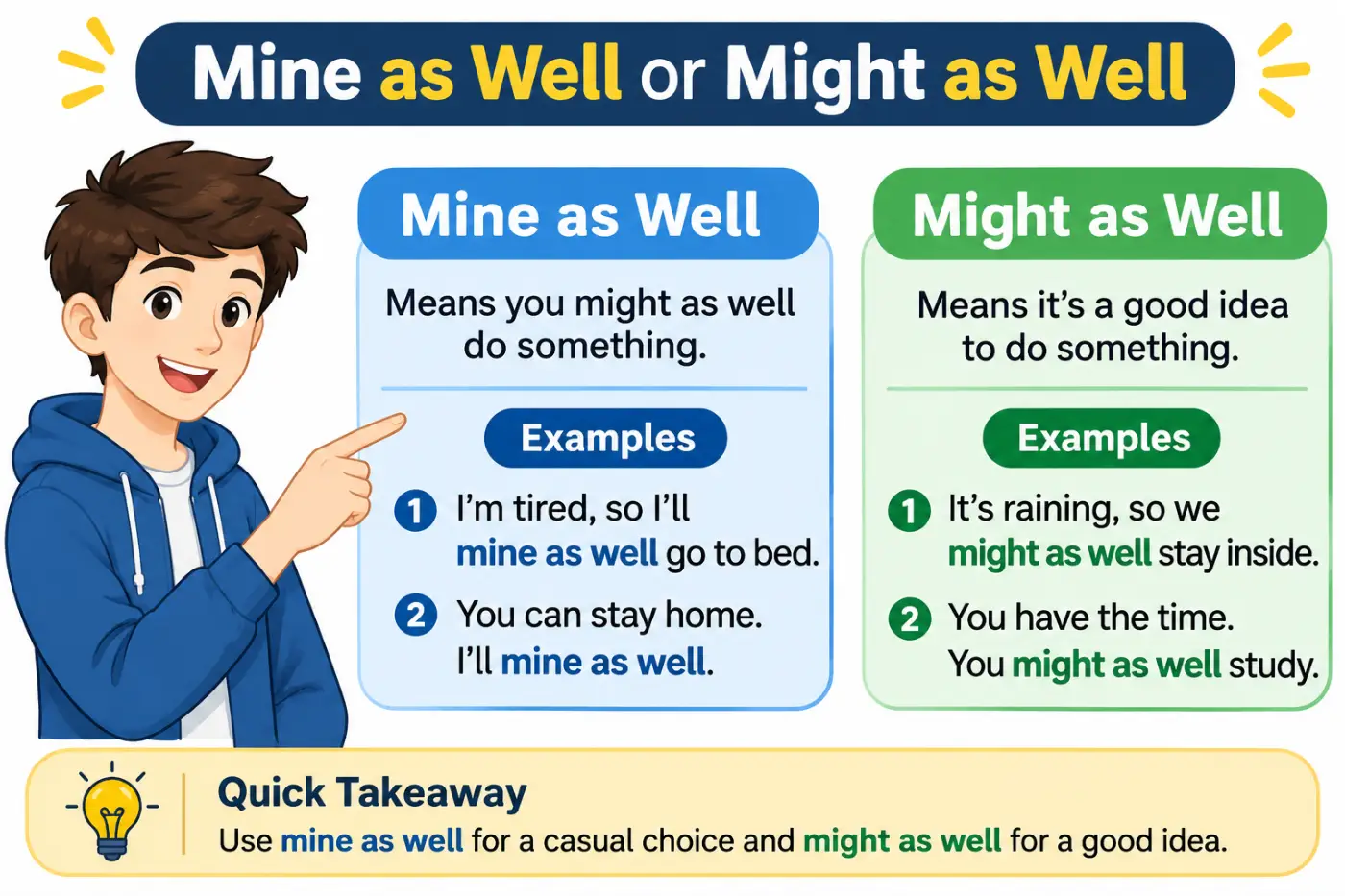
Have you ever typed a sentence like I mine as well go home and wondered if it should be I might as well go home? These expressions look and sound similar, so it’s easy to mix them up. However, only one is the standard expression used to show that something is worth doing or seems like the best available choice.
The correct expression is might as well. People often confuse it with mine as well because of similar pronunciation, but the two forms don’t have the same meaning. Using the wrong one can make your writing look careless, especially in emails, school assignments, and professional documents.
Might as well means that someone should do something because there is little reason not to, or because it seems like the most reasonable option in a situation. For example, I might as well finish my homework now means that finishing the work now seems like a good choice.
In this guide, you’ll learn the difference between these expressions, their meanings and origins, useful synonyms, common mistakes, and examples from everyday situations. You’ll also discover which alternatives work best in formal writing, casual conversations, emails, and professional communication.
What Is the Difference Between Mine as Well and Might as Well?
The main difference is that might as well is a standard English expression, while mine as well is generally an incorrect replacement for it.
Here’s a quick comparison.
| Expression | Correct Usage | Meaning |
|---|---|---|
| Might as well | Correct | Something is worth doing or seems reasonable. |
| Mine as well | Incorrect in this expression | A common spelling mistake caused by confusion with might. |
Why Do People Confuse These Two Expressions?
People often confuse these words because they can sound similar in fast, casual speech.
When someone speaks quickly, the final sounds of might and the following words can become less clear. This can make the expression difficult to recognize, especially for English learners.
There are also spelling differences to remember:
- Might is a modal verb that expresses possibility or a suggested action.
- Mine is a possessive pronoun that shows ownership.
Since both words contain similar sounds, people sometimes choose the wrong spelling when writing from memory.
The easiest solution is to remember that the expression always uses might when you mean that doing something is a reasonable choice.
What Does Might as Well Mean in Simple English?
Might as well means that you should probably do something because there isn’t a strong reason to avoid it.
People use this expression when they want to suggest an action, accept a situation, or make the best of available circumstances.
For example:
We have an extra hour before the meeting, so we might as well grab some coffee.
This sentence means that getting coffee seems like a reasonable way to spend the extra time.
The expression can communicate several slightly different ideas depending on the situation.
1. Making a Practical Suggestion
You can use the expression when suggesting something that seems useful or convenient.
Example:
We might as well take the bus because parking is expensive.
The speaker suggests taking the bus because it offers a practical solution.
2. Accepting an Unavoidable Situation
Sometimes, people use this phrase when they cannot change a situation and decide to make the best of it.
Example:
Since the rain has already started, we might as well stay inside.
The speaker accepts the weather and chooses an alternative activity.
3. Showing That There Is No Better Option
The expression can also suggest that one choice is reasonable because other options aren’t particularly helpful.
Example:
The store closes in ten minutes, so we might as well hurry.
The speaker believes that moving quickly is the best available decision.
What Is the Origin of Might as Well?
Understanding the history of an expression can make its meaning easier to remember.
The word might comes from Old English miht or meaht, which referred to power, strength, or ability. It developed from an older Germanic word connected with the idea of being able to do something.
Over time, might became an important English modal verb. Today, it commonly expresses possibility, uncertainty, or a suggested course of action.
The word well has a different history. It developed from Old English wel, meaning in a good manner or satisfactorily.
When might, as, and well work together, they form an established English expression.
In modern English, might as well doesn’t simply mean that someone has the ability to do something. Instead, it suggests that an action is reasonable, useful, or worth doing in the circumstances.
For example:
We might as well order food now.
This sentence doesn’t necessarily mean that ordering food is the only possible choice. It means that ordering now seems sensible.
The expression has become common in everyday American and British English. Speakers use it in conversations, messages, informal writing, and many other situations.
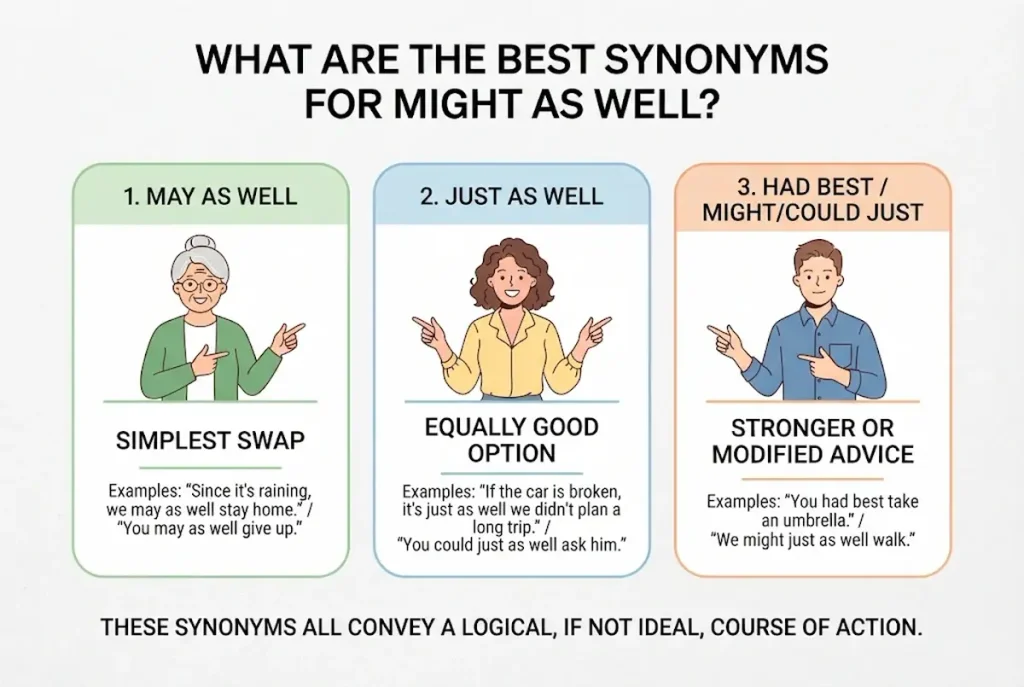
What Are the Best Synonyms for Might as Well?
Several English expressions can replace might as well, depending on the meaning and tone you want.
Some alternatives sound natural in everyday conversations, while others work better in formal writing.
The following table includes 28 useful alternatives grouped by tone.
What Are Simple Synonyms for Might as Well?
These words and phrases are easy to understand and work well in everyday English.
| Word or Phrase | Meaning | Tone | Example |
|---|---|---|---|
| Should | Something is advisable | Simple | We should leave now. |
| Can | Something is possible | Simple | We can start early. |
| Could | Something is an option | Simple | We could walk home. |
| Better | A more suitable choice | Simple | We better call them. |
| Worth doing | Deserves the effort | Simple | It’s worth doing today. |
| No reason not to | Nothing prevents the action | Simple | There’s no reason not to try. |
| Go ahead | Proceed with an action | Simple | Go ahead and ask. |
What Are Everyday Synonyms for Might as Well?
These alternatives sound natural in conversations, emails, and informal writing.
| Word or Phrase | Meaning | Tone | Example |
|---|---|---|---|
| Why not | Suggests an action | Everyday | Why not give it a try? |
| May as well | Another form of the expression | Everyday | We may as well leave. |
| Just as well | Equally suitable or convenient | Everyday | It’s just as well we waited. |
| While we’re at it | Do something during an existing activity | Everyday | Let’s clean the garage while we’re at it. |
| Make the most of it | Use a situation positively | Everyday | Let’s make the most of our free time. |
| Take the opportunity | Use a suitable chance | Everyday | Take the opportunity to learn. |
| Might as easily | Something is equally possible | Everyday | We might as easily take a taxi. |
What Are Formal Synonyms for Might as Well?
When writing reports, professional emails, essays, or academic assignments, you may want a more precise alternative.
| Word or Phrase | Meaning | Tone | Example |
|---|---|---|---|
| It would be advisable | It would be sensible | Formal | It would be advisable to review the document. |
| It would be reasonable | It would make practical sense | Formal | It would be reasonable to reconsider the plan. |
| It is worth considering | Deserves attention | Formal | It is worth considering another option. |
| It may be appropriate | It could be suitable | Formal | It may be appropriate to postpone the meeting. |
| It would make sense | It seems logical | Formal | It would make sense to contact the client. |
| Take the necessary steps | Act to achieve a result | Formal | We should take the necessary steps. |
| Proceed with | Continue with an action | Formal | We can proceed with the application. |
Which Synonyms Are Strongest From Mild to Strong?
Not every alternative communicates the same level of confidence.
Some phrases simply suggest an option. Others express strong advice or encourage someone to take action.
Understanding this difference helps you choose the right words.
| Intensity | Alternative | What It Communicates |
|---|---|---|
| Very mild | Could | Presents a possible choice. |
| Mild | Why not | Suggests trying something. |
| Mild | May as well | Presents a reasonable option. |
| Moderate | Worth considering | Shows that an idea deserves attention. |
| Moderate | Makes sense | Suggests a logical decision. |
| Moderate | Should | Gives advice or expresses expectation. |
| Strong | Better do it | Suggests that action is advisable. |
| Strong | Go for it | Encourages someone to act. |
| Very strong | Do it now | Gives a direct instruction. |
What Part of Speech Is Might as Well?
Might as well is an expression built around the modal verb might. It isn’t a single word with one part-of-speech label.
Understanding its grammatical structure makes it easier to use correctly.
How Does Might Work in a Sentence?
Might is a modal auxiliary verb. It helps the main verb express possibility, suggestion, or a possible course of action.
Example:
She might visit her grandmother tomorrow.
Here, might expresses the possibility of a future visit.
In the expression might as well, the modal verb works with as well to communicate that an action is reasonable under the circumstances.
Why Does the Main Verb Use Its Base Form?
After might, you use the base form of the main verb.
Correct examples:
- We might as well leave.
- They might as well wait.
- I might as well ask.
- She might as well study.
Incorrect examples:
- We might as well leaving.
- They might as well waited.
- I might as well to ask.
Don’t add -ing, -ed, or to before the main verb.
Can You Use Might as Well With Different Subjects?
Yes. You can use it with I, you, he, she, it, we, and they.
Examples:
- I might as well stay.
- You might as well call him.
- He might as well apply.
- She might as well rest.
- We might as well start.
- They might as well join us.
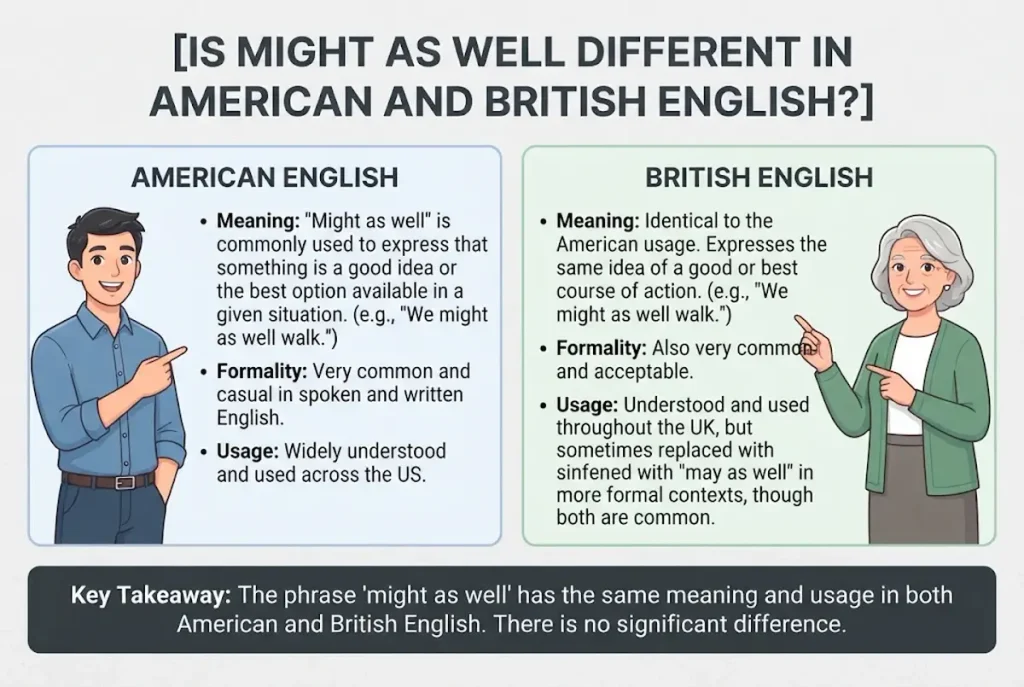
Is Might as Well Different in American and British English?
No major difference exists in the basic meaning of might as well between American and British English.
Speakers in both varieties use the expression to suggest a reasonable action or accept a situation.
However, some related expressions and conversational preferences can differ.
| Expression | American English | British English |
|---|---|---|
| Might as well | Common | Common |
| May as well | Common | Common |
| Why not? | Common | Common |
| We should probably | Common | Common |
| We may as well get going | Natural | Natural |
Which Alternative Should You Use in Different Situations?
The best replacement depends on your audience, purpose, and writing style.
A phrase that sounds natural in a text message may seem too casual in a job application or academic essay.
Here are some practical recommendations.
What Should You Write on a Resume?
A resume should communicate your skills, achievements, and professional value clearly.
Might as well usually sounds too conversational for resume writing. Instead, choose specific action words that explain what you accomplished.
For example:
Informal: I might as well learn new software to improve my skills.
Professional: Developed software skills to improve workplace efficiency.
Other useful resume alternatives include:
- Demonstrated.
- Improved.
- Completed.
- Implemented.
- Acquired.
- Strengthened.
- Contributed to.
These words describe actual achievements rather than suggesting an uncertain action.
What Should You Use in an Academic Essay?
Academic writing usually requires clear reasoning and precise language.
Instead of relying on might as well, choose an expression that explains why an action or conclusion is reasonable.
Example:
Informal: Researchers might as well study the effects of climate change.
Academic: Researchers should consider examining the effects of climate change.
Other suitable alternatives include it is reasonable to, it is worth considering, and it may be appropriate to.
Choose the phrase that accurately represents the strength of your argument.
What Should You Write in a Text Message?
Text messages are usually casual, so might as well works perfectly well.
You can also use shorter expressions such as why not, let’s do it, and go for it.
Examples:
- We might as well watch a movie tonight.
- Why not order pizza?
- We have nothing planned, so let’s go out.
- I might as well finish this game.
What Are 12 Examples of Might as Well in Everyday Situations?
Examples make it easier to understand how an expression works in real communication.
Here are 12 original sentences from different situations.
| Situation | Example Sentence | Meaning |
|---|---|---|
| At home | I’m already awake, so I might as well make breakfast. | Making breakfast seems reasonable. |
| At work | We might as well finish the report before lunch. | Finishing early is a sensible option. |
| At school | I might as well review my notes before the exam. | Reviewing now could be helpful. |
| Traveling | Our flight is delayed, so we might as well get something to eat. | Eating is a useful way to spend the waiting time. |
| Shopping | We’re already at the mall, so we might as well buy the shoes. | Buying them now is convenient. |
| With friends | Nobody has plans tonight, so we might as well watch a movie. | Watching a movie is a reasonable activity. |
| During rain | It’s raining outside, so we might as well stay home. | Staying inside seems sensible. |
| At a restaurant | The waiter is here, so we might as well order. | Ordering now makes sense. |
| On a weekend | I have the whole afternoon free, so I might as well clean my room. | Using the free time productively is reasonable. |
| During a meeting | Everyone has arrived, so we might as well begin. | Starting the meeting is appropriate. |
| On a journey | We’re passing the gas station, so we might as well fill the tank. | Refueling now is convenient. |
| While studying | I already have my books open, so I might as well finish another chapter. | Continuing the work requires little extra effort. |
What Is the Difference Between Might as Well and May as Well?
Might as well and may as well have nearly the same meaning.
Both expressions suggest that an action is reasonable or worth doing in a particular situation.
| Might as Well | May as Well |
|---|---|
| We might as well leave now. | We may as well leave now. |
| I might as well call her. | I may as well call her. |
| They might as well wait outside. | They may as well wait outside. |
Both versions are grammatically correct.
The choice often depends on personal preference, writing style, and regional speech habits.
In many everyday situations, you can use either expression without changing the intended message.
However, don’t confuse may as well with may be.
May as well suggests a reasonable action, while maybe means perhaps.
Example:
- We may as well leave now. This suggests that leaving is a sensible decision.
- Maybe we will leave now. This expresses uncertainty about leaving.
What Is the Difference Between Might as Well and Should?
These expressions can both suggest an action, but they don’t communicate exactly the same idea.
Might as well usually presents an action as reasonable under the circumstances. Should often expresses advice, responsibility, or a stronger recommendation.
| Might as Well | Should |
|---|---|
| We might as well take a taxi. | We should take a taxi. |
| I might as well finish the work. | I should finish the work. |
| You might as well ask for help. | You should ask for help. |
What Are the Common Mistakes When Using Might as Well?
Even though this expression is simple, writers sometimes make grammatical and spelling mistakes.
Understanding these problems can help you avoid them.
Replacing Might With Mine
Incorrect: I mine as well finish the assignment.
Correct: I might as well finish the assignment.
Mine shows ownership. It doesn’t work as a replacement for might.
Adding To Before the Main Verb
Incorrect: We might as well to leave now.
Correct: We might as well leave now.
The modal verb might must be followed by the base form of the main verb without to.
Using the -Ing Form
Incorrect: She might as well going home.
Correct: She might as well go home.
The main verb must stay in its base form.
Using the Past Form of the Main Verb
Incorrect: They might as well went early.
Correct: They might as well go early.
Don’t use went after might. The correct form is go.
Confusing It With Might Be
Incorrect: We might be as well leave.
Correct: We might as well leave.
Might be and might as well have different grammatical structures.
Might be expresses possibility about a state or condition.
Example: She might be tired.
Might as well suggests that an action is reasonable.
Example: She might as well take a break.
When Should You Not Use Might as Well?
Might as well isn’t suitable for every situation.
Although it works in everyday English, some contexts require more precise language.
Here are a few situations where you should consider another expression.
When giving serious instructions.
If someone needs to follow an important instruction, use a direct phrase instead.
Instead of: You might as well take your medication.
Use: You should follow your prescribed medication instructions.
When writing formal academic arguments.
If you’re presenting research findings, use language that accurately explains your evidence.
Instead of: Scientists might as well examine the results.
Use: Scientists should examine the results.
When describing something you definitely plan to do.
If you’ve already made a firm decision, a direct statement may communicate your meaning better.
Instead of: I might as well apply for the position.
Use: I plan to apply for the position.
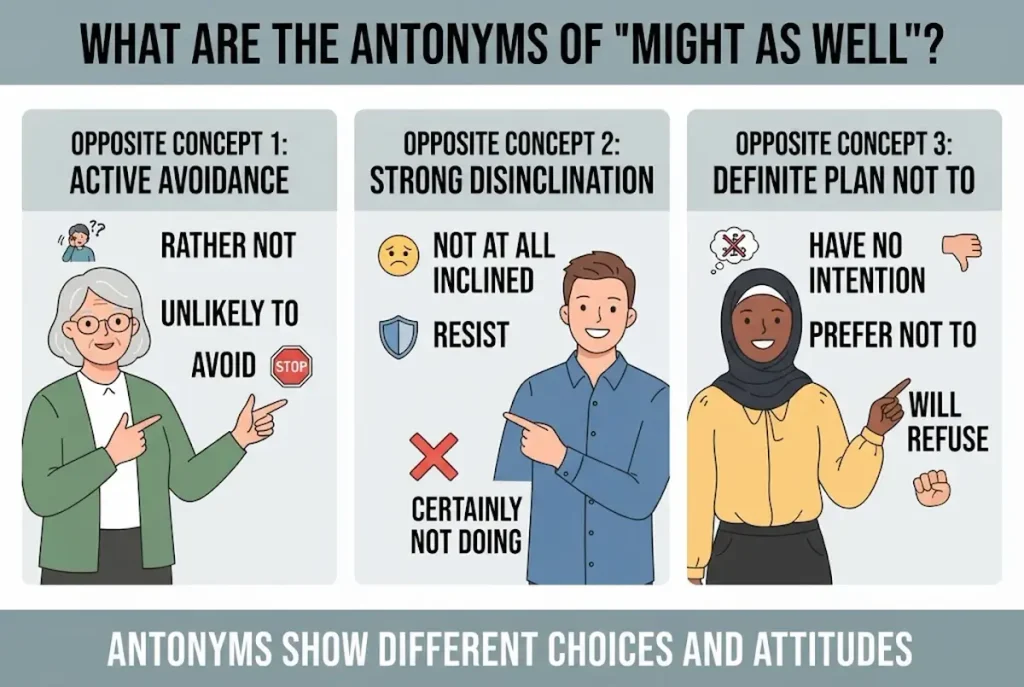
What Are the Antonyms of Might as Well?
An antonym is a word or expression with an opposite meaning.
Might as well doesn’t have one exact opposite because its meaning depends on the situation. However, several expressions can communicate an opposing idea.
| Opposite Expression | Meaning | Example |
|---|---|---|
| Shouldn’t | Advises against an action | We shouldn’t leave yet. |
| No point | Suggests an action is useless | There’s no point in waiting. |
| Not worth it | Suggests the effort isn’t justified | The trip isn’t worth it. |
| Avoid | Stay away from an action | Avoid making that mistake. |
| Better not | Advises against doing something | You’d better not go alone. |
| There’s no need | Shows that an action isn’t necessary | There’s no need to hurry. |
What Are the Best Tips for Choosing the Right Expression?
Choosing the correct expression becomes easier when you understand what you want to communicate.
Use these practical tips when writing or speaking.
1. Remember the correct spelling. Use might as well when suggesting a reasonable action. Don’t replace might with mine.
2. Think about your purpose. Decide if you’re making a suggestion, giving advice, or explaining a practical choice.
3. Consider your audience. Casual conversations allow relaxed expressions, while professional documents often need more precise wording.
4. Check the main verb. Always use the base form after might as well.
5. Avoid unnecessary repetition. Use alternatives such as could, should, why not, and it would make sense when appropriate.
Conclusion
The correct choice between Mine as Well or Might as Well is clear when you understand how the words work. Might as well is the standard expression for suggesting that an action is reasonable, useful, or worth doing in a particular situation. Mine, on the other hand, is a possessive pronoun that shows ownership and cannot replace might in this expression.
You can use might as well in everyday conversations, emails, text messages, and informal writing. For professional or academic work, alternatives such as it would be reasonable, it is worth considering, and should may communicate your ideas more precisely.
Remember to follow might with the base form of the main verb. With a little practice, you’ll find it much easier to choose the correct wording and write with confidence.
Frequently Asked Questions
Is it mine as well or might as well?
Might as well is correct when suggesting that an action is reasonable or worth doing. Mine as well is not a correct replacement for this expression.
What does might as well mean in a sentence?
Might as well means that doing something seems like a sensible choice in a particular situation. For example, We might as well leave early means that leaving early seems reasonable.
Can I use may as well instead of might as well?
Yes, may as well is a grammatically correct alternative with almost the same meaning. Both expressions suggest that an action is reasonable under the circumstances.
What’s another way to say might as well?
You can say why not, should, could, it’s worth doing, or there’s no reason not to. The best alternative depends on the situation and the strength of your suggestion.
Is might as well formal or informal?
Might as well is commonly used in everyday and informal English. In formal writing, alternatives such as it would be reasonable or it may be appropriate can sound more suitable.
Does might as well mean should?
Not exactly. Might as well suggests that an action is reasonable or convenient, while should usually expresses advice, responsibility, or a stronger recommendation.
Can I use might as well at the beginning of a sentence?
Yes, you can use it at the beginning of a sentence when the subject and verb follow the expression. For example, Might as well finish the project today is a natural conversational sentence with an implied subject of we or I.
Is mine as well ever grammatically correct?
Yes, mine as well can be grammatically correct when mine shows ownership and as well means too. For example, That notebook is mine as well means that the notebook belongs to me too.

Daniel Grammarfield — The Language Learner
Age: 28Occupation: ESL Learner & Digital Professional
Bio:Daniel is a non-native English speaker who wants to communicate more confidently at work and online. He uses Synotrench to improve grammar, understand confusing words, learn correct sentence structures, and build everyday English skills. He prefers simple explanations with practical examples.
Goals:
Master English grammar rules
Avoid common language mistakes
Improve professional communication
Learn English through real-life examples
Quote:“Learning English is not about memorizing rules — it’s about expressing ideas clearly.”
1 thought on “Mine as Well or Might as Well: The Best Way to Write It”